


How to Build Time-Zone Aligned Remote Engineering Teams
Building remote engineering teams that work seamlessly across time zones can be challenging, but it's essential for maintaining productivity and collaboration. Here's how you can structure your team for success:
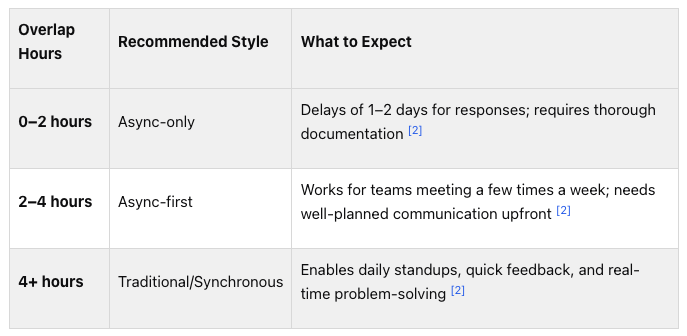
- Time-Zone Overlap Matters: A lack of overlapping hours can delay communication and stretch project timelines by up to 20%. For real-time collaboration, aim for at least 4 hours of overlap.
- Core Working Hours: Map your team’s availability to identify synchronous windows. Use these windows for critical tasks like decision-making and problem-solving.
- Target Regions for Recruitment: Latin America offers excellent overlap with U.S. time zones, while Eastern Europe and Southeast Asia are better suited for hybrid or asynchronous workflows.
- Pre-Vetted Talent: Using pre-screened candidates saves time and ensures smoother integration. Platforms like iDelsoft can help find skilled engineers quickly.
- Aligned Team Structures: Organize engineers into smaller, time-zone-aligned pods to scale engineering teams and maximize collaboration during shared hours.
- Effective Tools and Practices: Use tools like Slack, Jira, and Loom to balance real-time and asynchronous communication. Set clear response expectations for different communication channels.
Why Time-Zone Overlap Matters for Engineering Collaboration
When teams lack time-zone overlap, even minor issues can lead to major delays. Imagine this: a developer in New York asks a question at 4 p.m., but their teammate in Manila doesn't see it until the next morning [4]. Similarly, a production bug discovered late in the day could sit unresolved for up to 8 hours while the engineering team is offline. These delays add up.
In fact, time-zone gaps can stretch project timelines by as much as 20% [5] and reduce the frequency of meetings and messages by over 10% [5]. When overlapping hours shrink, it becomes harder for teams to maintain momentum and resolve issues quickly.
While asynchronous communication works well for tasks like status updates, certain activities demand real-time collaboration. High-bandwidth tasks - such as architecture reviews, sprint planning, pair programming, and incident response - benefit significantly from synchronous communication. Senior engineers might manage with just 2–3 hours of overlap, but junior developers often need 6 or more hours to get the mentoring and support they require [1].
Here’s a quick breakdown of how overlap affects collaboration styles and outcomes:
To tackle these challenges, defining your team's core working hours is a crucial step. This ensures you can maximize overlap and improve collaboration.
Step 1: Assess Your Team's Core Working Hours and Overlap Needs
Before scaling your engineering team, you need to understand when your current team is actually working. While many teams assume a standard 9-to-5 schedule, reality often looks different. You’ll likely find early risers, late finishers, and team members juggling personal commitments like school pickups, all of which impact availability [4].
Start by creating a living availability map. This shared document should include each team member's city, time zone, core working hours (both local and UTC), and their best windows for meetings [4]. Once completed, use this map to identify your synchronous window - the time when at least half your team is online together. Surprisingly, this overlap period can be as short as two hours, far less than managers often expect [6]. This map becomes your go-to resource for scheduling and helps guide future hiring decisions.
"The overlap window is your asset... the team's scarcest resource. Don't fill it with status updates." - Camellia, Principal Product Marketing Strategist [6]
Next, figure out how much overlap your team actually needs for smooth collaboration. The required overlap varies depending on the project and team setup. For example:
- Greenfield projects: Typically need 6–8 hours of daily overlap.
- Mature products and senior roles: Can function well with just 2–3 hours.
- Junior developers: Often require 6 or more hours for mentoring and real-time support [1].
One thing to avoid? Defaulting core hours to your headquarters’ time zone. Doing so can lead to inconvenient schedules for remote team members, potentially harming morale and increasing turnover [6]. Instead, aim for fair scheduling that supports both productivity and team satisfaction. Use the overlap window for high-priority tasks like decision-making, problem-solving, and architecture discussions. For everything else, set clear expectations on response times.
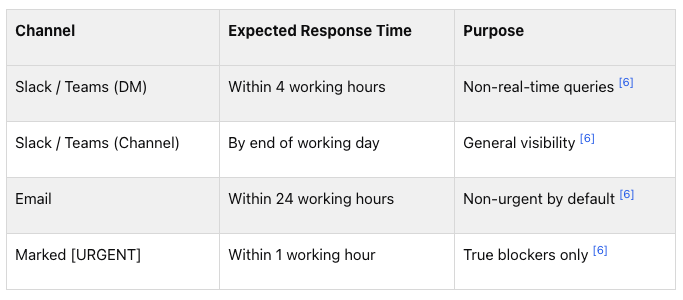
Here’s an example of how to structure communication channels and their response times:
Step 2: Identify the Best Time Zones for Recruitment
Once you’ve established your core working hours, the next step is to figure out which regions align best with your schedule. Time zone differences can’t be ignored - they’re a fixed factor in remote work logistics. By 2026, the average fully remote team operates across 4.2 time zones, a jump from 2.7 in 2022 [8].
How to Use Overlap Calculators
Before posting a job listing, try using a time overlap tool to visualize potential working hour alignments. World Time Buddy is a free option that lets you compare your team’s locations with candidate regions. Simply add the cities, adjust the slider, and see where schedules overlap. For a more automated approach, Clockwise (around $10/seat/month) can identify ideal meeting windows while safeguarding focus time for engineers [8].
Here’s how to use these tools effectively:
- Add team and candidate regions: For example, include cities like New York, Bogotá, and Warsaw.
- Set working hours: Define standard 9 AM–5 PM local hours for each location.
- Spot the overlap: Look for the highlighted window where at least 80% of the team is online together.
- Document the results: Record these overlaps in a shared space like Notion or Confluence, alongside your availability map from Step 1. This step can cut down on "What time is it for you?" messages by about 90% [8].
To avoid confusion caused by daylight saving time changes, use UTC as your universal scheduling reference. This ensures everyone stays aligned, even when seasonal shifts reduce overlap by an hour [8].
Once you’ve nailed down the overlap windows, focus on regions that best complement your US-based team’s working hours.
Key Regions for Time-Zone Alignment
Some regions naturally work better for time-zone alignment, offering varying levels of overlap depending on your team’s needs.
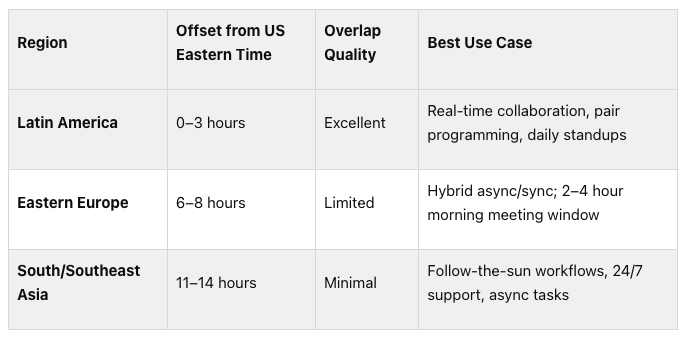
Latin America is often the ideal match for US-based teams. Countries like Colombia and Peru operate on UTC-5, matching US Eastern Time, while Brazil is only 1–2 hours ahead. Mexico's time zones vary, aligning with Pacific, Mountain, or Central schedules. With over 400,000 pre-vetted engineers active across the region and more than 1.5 million engineering graduates annually, the talent pool is substantial [9].
"Timezone overlap is a competitive advantage, not a preference; nearshore engineers in Latin America share working hours with US teams, which directly shortens code review cycles, unblocks decisions faster, and reduces the async lag that quietly slows sprint velocity." - Tamyris Cuppari Kohler, Director of Content, Revelo [9]
Eastern Europe, including countries like Poland, Romania, and the Czech Republic, also offers a strong talent pool with high English proficiency. However, the 6–8 hour time difference limits real-time collaboration to a narrow 2–4 hour morning window. This setup works best for senior engineers who can work independently with minimal supervision.
Meanwhile, South and Southeast Asia provide minimal overlap with US Eastern Time. Teams hiring from these regions often need to adopt a mature async-first workflow, making it ideal for tasks like 24/7 support or follow-the-sun operations.
Step 3: Source Pre-Vetted Talent from Time-Zone-Aligned Regions
Once you've identified your target regions, the next hurdle is finding engineers who meet your technical, time-zone, and team compatibility needs - without the hassle of lengthy screening processes.
Why Pre-Vetted Talent Is a Game-Changer
Recruiting the traditional way can be both time-consuming and expensive. Screening, interviewing, and assessing candidates typically costs 15%–25% of an engineer's annual salary [10]. On top of that, it diverts your team's focus away from critical projects. Pre-vetted talent eliminates much of this inefficiency. These candidates are already assessed for technical expertise, English proficiency, and communication skills, so they’re ready to hit the ground running. Plus, hiring someone who isn’t a good fit can throw off your team’s workflow. Pre-vetted talent ensures smoother collaboration while maintaining essential time-zone alignment.
With the U.S. expected to face a shortage of over 1 million developers by 2026 [11], competition for skilled engineers is heating up. By tapping into pre-vetted talent pools in regions like Latin America and Eastern Europe, you can secure top candidates before they’re snatched up by competitors.
How iDelsoft Makes Talent Sourcing Easier
Using pre-vetted talent doesn’t just save money - it also speeds up team integration. iDelsoft connects you with the top 1% of global tech talent. These engineers, who have at least five years of experience in high-pressure environments, specialize in more than 150 technologies. Talent is sourced from Latin America, Europe, Asia, and MENA, and every candidate is tech-certified and fluent in English, ensuring seamless collaboration with your U.S.-based team.
Here’s how it breaks down: 62% of iDelsoft clients secure talent within seven days, and Global Talent Pods can be deployed in as little as 72 hours. The cost savings are substantial too - while hiring a U.S.-based engineer costs around $251,250 annually, iDelsoft’s talent averages $112,000 per year, saving you nearly $139,250 per hire [10].
Clients have already seen the impact:
"iDelsoft played a crucial role in the development and launch of Koop, delivering a project that was fast, cost-effective, and of high quality." - Sergey Litvinenko, CEO, Koop AI [10]
Beyond sourcing talent, iDelsoft also acts as the Employer of Record. They handle payroll, legal compliance, NDAs, and intellectual property protection, so you won’t have to navigate the complexities of international employment laws yourself.
To make the process even more efficient, create a clear recruitment profile that highlights your team’s specific needs. A skills matrix can help you identify gaps - whether it’s Python expertise or Kubernetes knowledge - so you can target the right candidates. Striking the right balance in your team composition, with about 30% senior, 40% mid-level, and 30% junior engineers, can help optimize both costs and capabilities [10][11].
Step 4: Build Teams Around Time-Zone-Aligned Pods
How you structure your team can make or break its efficiency. Instead of a flat global setup, consider grouping engineers into smaller, time-zone-aligned pods. These pods are self-contained units where members share enough overlapping hours to collaborate in real time. This setup ensures that your pre-vetted talent can work together more effectively.
The key to this strategy is leveraging the team's "golden hours" - a 2–4 hour window when most pod members are online simultaneously. These hours are best used for high-bandwidth activities like sprint planning, architecture discussions, code reviews, and incident response. Meanwhile, tasks like documentation, asynchronous updates, and independent coding can be tackled outside this window.
A hub-and-spoke model works well here. The central hub sets the architectural vision and standards, while the regional pods focus on localized development and support. To avoid bottlenecks, each pod should include at least one decision-maker. This approach eliminates delays caused by waiting for approvals from headquarters. For example, a global SaaS team operating across Toronto, Lagos, and Singapore reduced their feature cycle times from nearly three weeks to under ten days by assigning a Product Owner in EMEA and a QA Lead in APAC [3].
Pod composition should also take experience levels into account. For pods with minimal overlap in working hours, include more senior engineers who can handle reduced synchronous collaboration. This keeps the pods autonomous and productive, regardless of time constraints.
To streamline daily workflows, implement a simple end-of-day update process. Engineers should wrap up by merging their code into a feature branch, updating the user story, and tagging the next contributor. Pair these updates with a RACI matrix to clarify responsibilities and reduce confusion. Teams using clear RACI documentation are 42% less likely to miss deadlines [12].
Step 5: Use the Right Tools and Practices to Maximize Overlap Hours
Even if you've set up dedicated software development teams in aligned pods, poor tool choices or too many meetings can waste those precious overlap hours.
Top Tools for Remote Team Collaboration
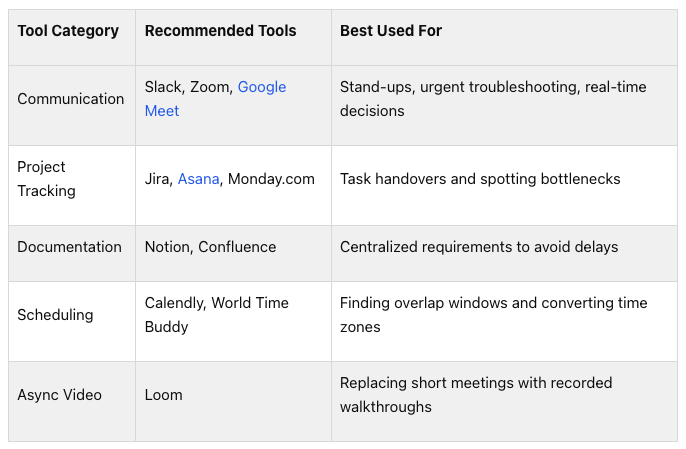
Once you've got time-zone-aligned pods, the next step is making sure you're using the right tools. It's all about balancing real-time and asynchronous communication. For live interactions during overlap hours, tools like Slack and Zoom are great. On the other hand, platforms like Notion or Confluence ensure documentation is always accessible, so team members in different time zones aren't stuck waiting for answers. To keep tasks visible and workflows smooth, tools like Jira and Monday.com let everyone see what’s in progress, what’s blocked, and what’s coming up - no matter when they log in.
One tool that doesn’t get enough credit? Loom. Instead of scheduling a 30-minute meeting, you can send a 5-minute video walkthrough. Tools like World Time Buddy and Calendly also make scheduling easier by automatically converting time zones. These tools align perfectly with the response protocols and scheduling tips mentioned earlier, helping teams work seamlessly.
Best Practices for Working Across Time Zones
Having the right tools is just one part of the equation - clear work practices are just as important for making the most of overlap hours.
Use your overlap hours wisely. Save that time for tasks that absolutely need two people online together, like unblocking dependencies, making architecture decisions, or fixing critical production issues. For things like status updates, code reviews, or documentation, stick to asynchronous methods.
Here are some tips to keep things running smoothly:
- Standardize handoff documents for tasks that cross time zones. These should clearly outline what’s done, what’s next, what’s blocked, and where the work can be found.
- Rotate meeting times every quarter to share the scheduling load across regions.
- Set clear response expectations for different channels - for example, reply to Slack messages within 4 hours and emails within 24 hours - to avoid burnout.
- Use generic time zone abbreviations like "ET" or "PT" instead of "EST" or "EDT" to avoid confusion during daylight saving time changes. A single missed meeting can disrupt an entire sprint [13].
Step 6: Onboard and Scale with Time-Zone-Focused Engagement Models
After setting up the right tools and practices, the next step is ensuring a smooth onboarding process and scaling your team effectively.
Onboarding Best Practices for Remote Engineers
The first few weeks are crucial for setting up new remote engineers for success. From day one, they should have access to key resources like workflow documentation, security policies, project objectives, and communication guidelines. A structured onboarding process that considers time-zone differences can reduce ramp-up time and ensure synchronous collaboration remains intact.
Here’s a practical onboarding timeline to guide the process:
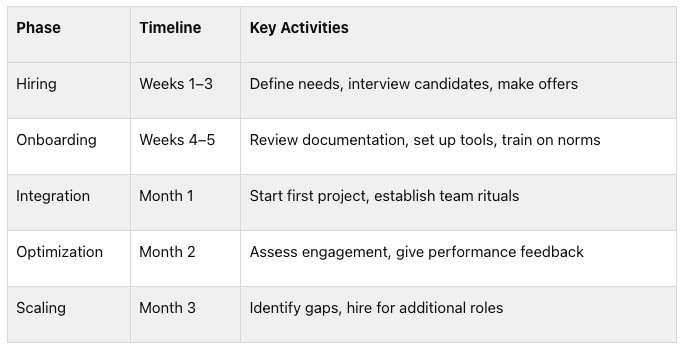
Beyond technical setup, cultural integration is just as important. Include remote engineers in team events and recognition efforts from the beginning. Assigning a regional liaison can help bridge any cultural differences between local teams and headquarters, fostering stronger connections and improving retention.
Once you’ve streamlined onboarding, the next focus should be scaling your team efficiently.
Flexible Engagement Models with iDelsoft
Scaling doesn’t have to mean starting from scratch. iDelsoft offers flexible engagement models tailored to maintain your team’s time-zone overlap. Their Dedicated Teams and Talent Solutions allow you to expand with pre-vetted engineers, adjust working hours, or shift project priorities - all without the delays of traditional hiring. In fact, their global talent pods can be ready in as little as 72 hours, which is invaluable when you need to scale quickly while maintaining your existing team structure.
With approximately 80% of tech leaders increasing their investment in distributed teams [11], scaling efficiently has become a top priority. iDelsoft focuses on time-zone-aligned regions, such as Latin America for U.S.-based companies, where full workday overlap is possible. Plus, costs can be 40–60% lower than equivalent U.S. salaries [11]. This combination of alignment, speed, and cost savings makes flexible engagement models a smart choice for growing your team beyond its initial core members.
Common Pitfalls in Time-Zone Alignment and How to Avoid Them
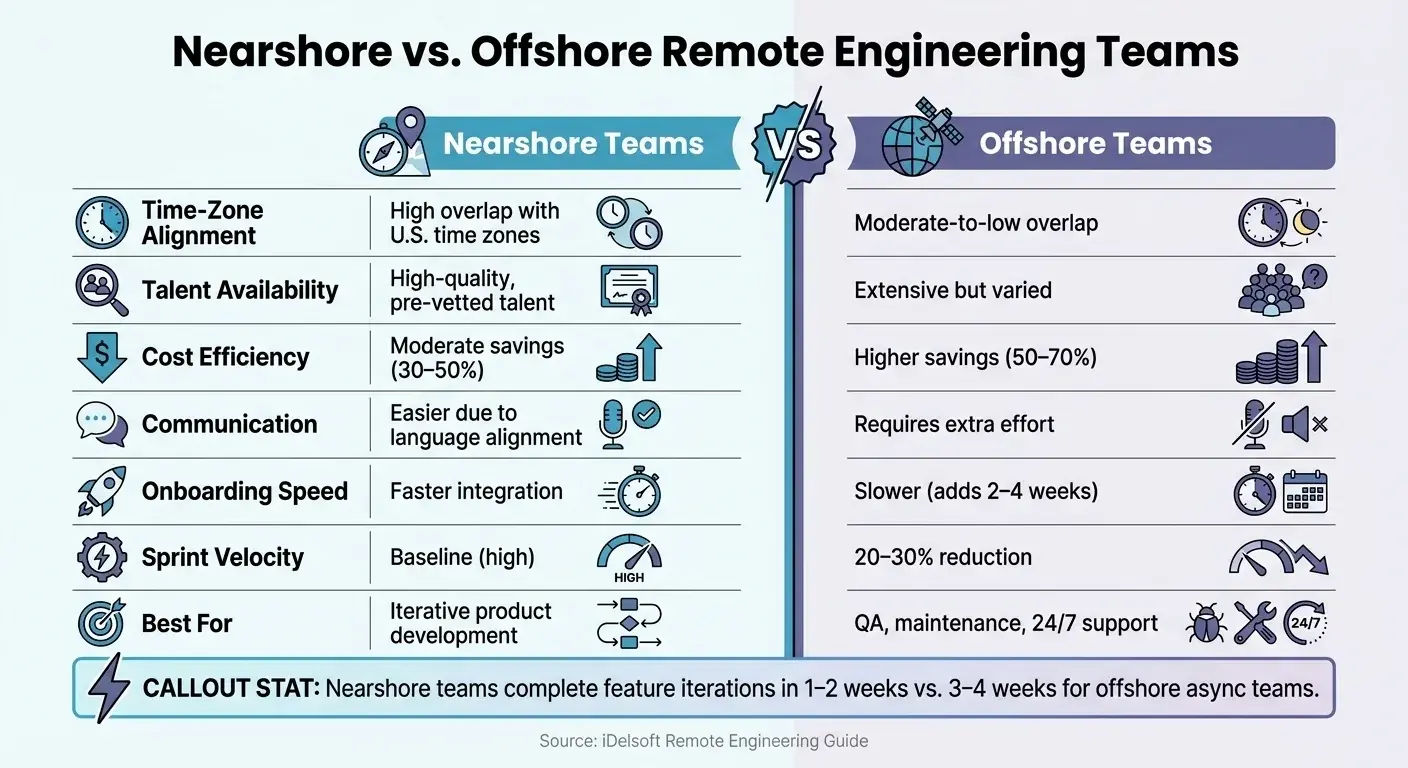
Nearshore vs. Offshore Remote Engineering Teams: Key Metrics Compared
Even the most well-organized remote teams can stumble into common challenges that waste time, money, and energy.
One major issue is async miscommunication. When teams rely heavily on written messages instead of real-time discussions, important details can get lost in translation. This often leads to incorrect implementations that don’t come to light until the next overlap in working hours. The solution? Provide clear, detailed specs with strict acceptance criteria before starting any task. Supplement written instructions with tools like Loom videos to explain complex requirements visually. Poor communication is no small issue - 57% of work projects fail because of it [7].
Another frequent problem is burnout from extended hours, especially in offshore models. Engineers who stretch their schedules to align with different time zones often face exhaustion. Research shows that 68% of offshore IT workers report severe sleep disruptions after just six months of working U.S. hours, which leads to a 14% drop in code quality [5]. To combat this, limit synchronous meetings to shared overlap hours and rotate inconvenient meeting times to distribute the burden fairly. Teams with balanced schedules are 58% less likely to experience burnout [8].
A less obvious but equally impactful challenge is underestimating the productivity cost of time-zone gaps. For every extra hour of time-zone difference, synchronous communication decreases by 11%, which can reduce sprint velocity by 20–30% [14]. Tamyris Cuppari Kohler, from Revelo, captures this perfectly:
One major issue is async miscommunication. When teams rely heavily on written messages instead of real-time discussions, important details can get lost in translation. This often leads to incorrect implementations that don’t come to light until the next overlap in working hours. The solution? Provide clear, detailed specs with strict acceptance criteria before starting any task. Supplement written instructions with tools like Loom videos to explain complex requirements visually. Poor communication is no small issue - 57% of work projects fail because of it [7].
Another frequent problem is burnout from extended hours, especially in offshore models. Engineers who stretch their schedules to align with different time zones often face exhaustion. Research shows that 68% of offshore IT workers report severe sleep disruptions after just six months of working U.S. hours, which leads to a 14% drop in code quality [5]. To combat this, limit synchronous meetings to shared overlap hours and rotate inconvenient meeting times to distribute the burden fairly. Teams with balanced schedules are 58% less likely to experience burnout [8].
A less obvious but equally impactful challenge is underestimating the productivity cost of time-zone gaps. For every extra hour of time-zone difference, synchronous communication decreases by 11%, which can reduce sprint velocity by 20–30% [14]. Tamyris Cuppari Kohler, from Revelo, captures this perfectly:
These challenges highlight the importance of operational decisions, particularly when comparing nearshore and offshore team models.
Building High-Performing Time-Zone-Aligned Teams
Creating a time-zone-aligned remote engineering team requires careful planning and thoughtful decisions. From defining core working hours to designing overlap-focused team structures, every step plays a role in ensuring success. Teams that adopt a "Follow-the-Sun" model with meaningful synchronous collaboration have been shown to accelerate time-to-market by 22% compared to traditional in-house teams [5].
This highlights how time-zone alignment can be more than just a logistical consideration - it can be a strategic advantage. The most effective teams view it as a key element of their operational strategy. Starting with a reliable core team and ensuring a daily overlap of 3–4 hours establishes a strong foundation for long-term success in distributed engineering.
If you're looking to build a high-performing remote engineering team quickly and without recruitment delays, iDelsoft provides pre-vetted, time-zone-aligned talent that can be onboarded in as little as 72 hours. Check out iDelsoft's dedicated team solutions to scale your business with confidence.
Looking to scale more efficiently? Connect with iDelsoft.com! We specialize in developing software and AI products, while helping startups and U.S. businesses hire top remote technical talent—at 70% less than the cost of a full-time U.S. hire. Schedule a call to learn more!
19.05.2026
See also
