


If your engineers do not share a set block of live time each day, scaling engineering teams without slowing down development often requires these shared windows. In most cases, I’d aim for 2–4 shared hours and build the team’s work around that window.
Here’s the short version:
A simple way to think about it: if your team spans regions, you need both shared hours and written handoff rules. Without those, even a strong team can lose hours each week to missed messages, late reviews, and off-hours meeting strain.
Here’s the short version:
- We’d pick one clear model: same-zone, partial overlap, or async-first
- We’d set core hours in one reference time zone, such as 10:00 AM–2:00 PM ET
- We’d keep live time for decisions, blockers, and incidents
- We’d move status updates, reviews, and handoffs into docs, tickets, and pull requests
- We’d set written rules for reply times, PR reviews, and escalation
- We’d review schedules before March and November DST changes
- We’d watch team health through signals like PR cycle time and deployment frequency
A simple way to think about it: if your team spans regions, you need both shared hours and written handoff rules. Without those, even a strong team can lose hours each week to missed messages, late reviews, and off-hours meeting strain.
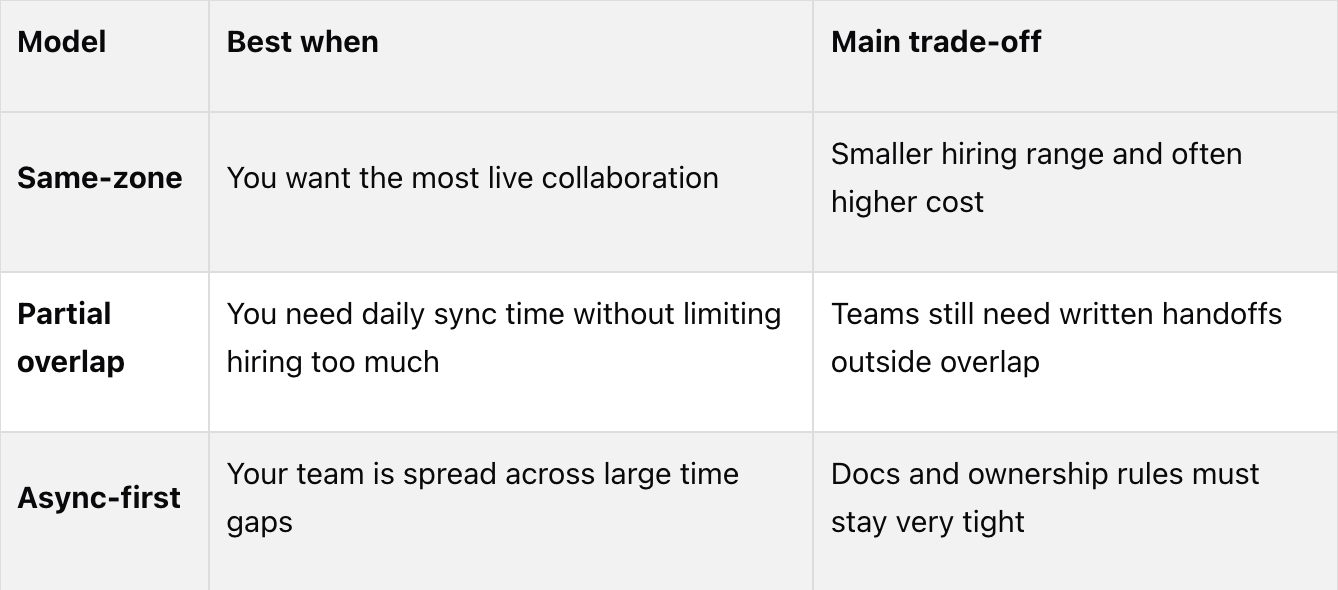
The core idea is simple: set a repeatable overlap window, protect deep work outside it, and make written communication the default for everything that does not need a live call.
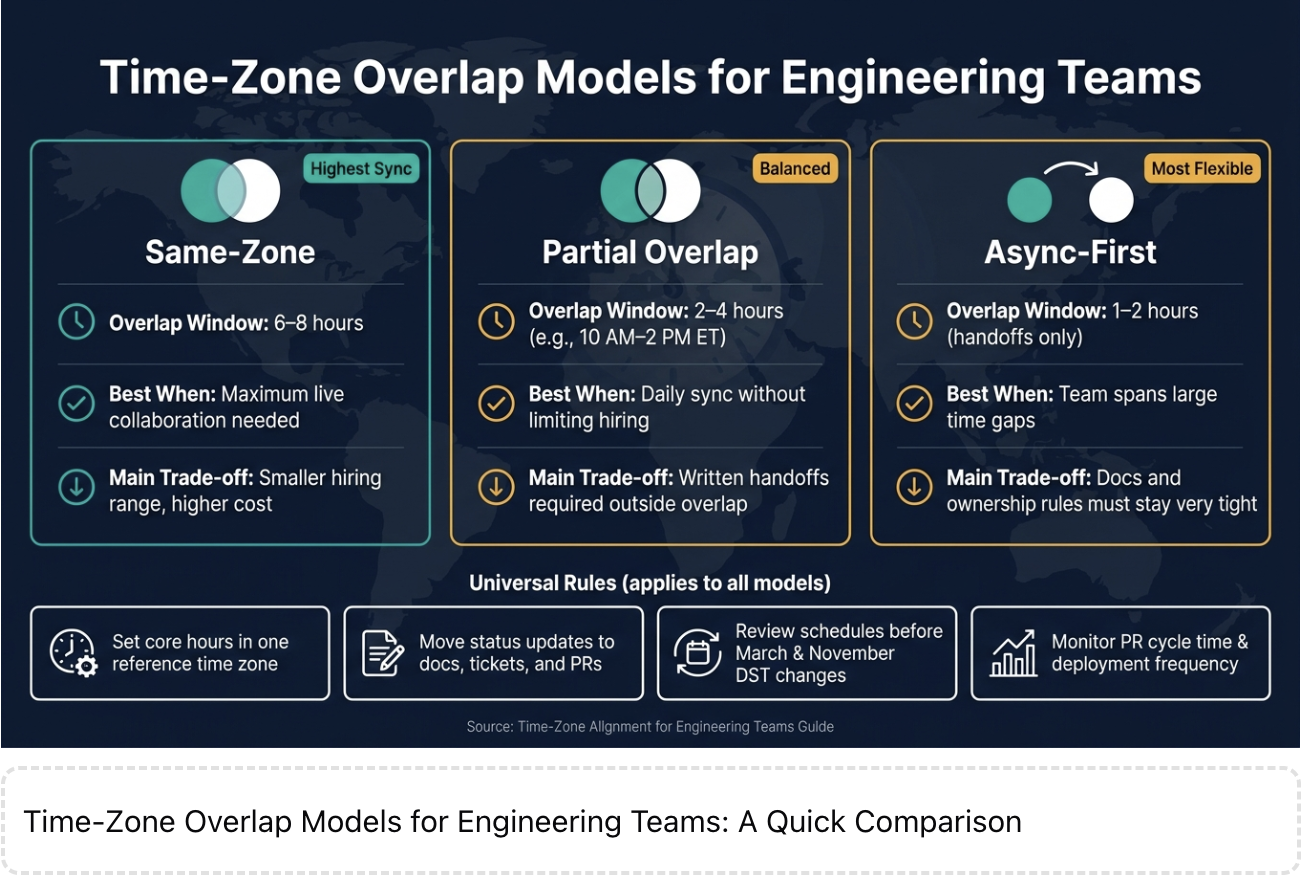
How to Manage Remote Teams Across Time Zones: Effective Strategies for Seamless Communication
Map Working Hours and Set Core Collaboration Windows
Map actual schedules so you can see the overlap your team can protect week after week.
Build a Team Time-Zone Map from Actual Schedules
Ask each engineer for their time zone, working hours, lunch break, and recurring off-days. Then convert everything into one reference time zone - the team's primary time zone - and lay it out in one shared calendar. Once that map is in place, pick one overlap model and build handoffs around it.
Review core hours before each March and November DST shift. Also track U.S., Mexico, Colombia, and Argentina holidays in one shared calendar.
Choose an Overlap Model That Works for Small and Global Teams
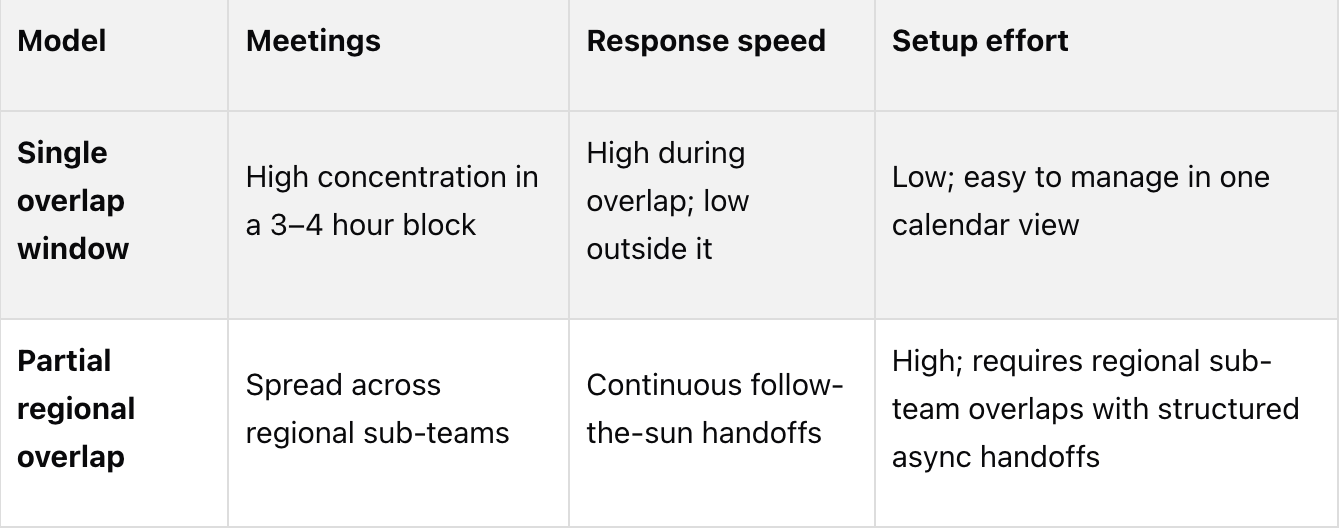
Use the table below to match the width of your overlap to your team size and geography, or hire remote software talent to fill gaps in specific time zones.
Rotate Off-Hours Meetings Instead of Pushing Them to One Region
Rotate early and late meetings across regions so one group doesn't keep taking the hit.
Use the overlap window to decide what needs live discussion and what can move async.
Build Async-First Workflows Around Time Zones
When teammates are offline, lean on written updates, tickets, and recorded walkthroughs so work keeps moving between overlap hours. That way, shared time stays open for decisions, blockers, and coordination instead of routine catch-ups.
Use Documentation, Tickets, and Pull Requests as the Source of Truth
Treat docs, tickets, and pull requests as the system of record for decisions, status, and ownership. If someone needs to know what changed, who owns the next step, or why a call was made, they should be able to find it in the written record without chasing people down.
Set Clear Handoff Rules for Code, QA, and Blockers
Every handoff should make the next move obvious: what's done, what's next, who owns it, and which blockers are still in the way. The handoff should also point back to the same written record so nobody is piecing the story together from Slack messages, meetings, and memory.
Match Communication Mode to the Task
Not every task needs a meeting. Use live communication for incidents and complex brainstorming, written communication for status updates, code reviews, and design docs, and recorded video for logic walkthroughs and bug demos.
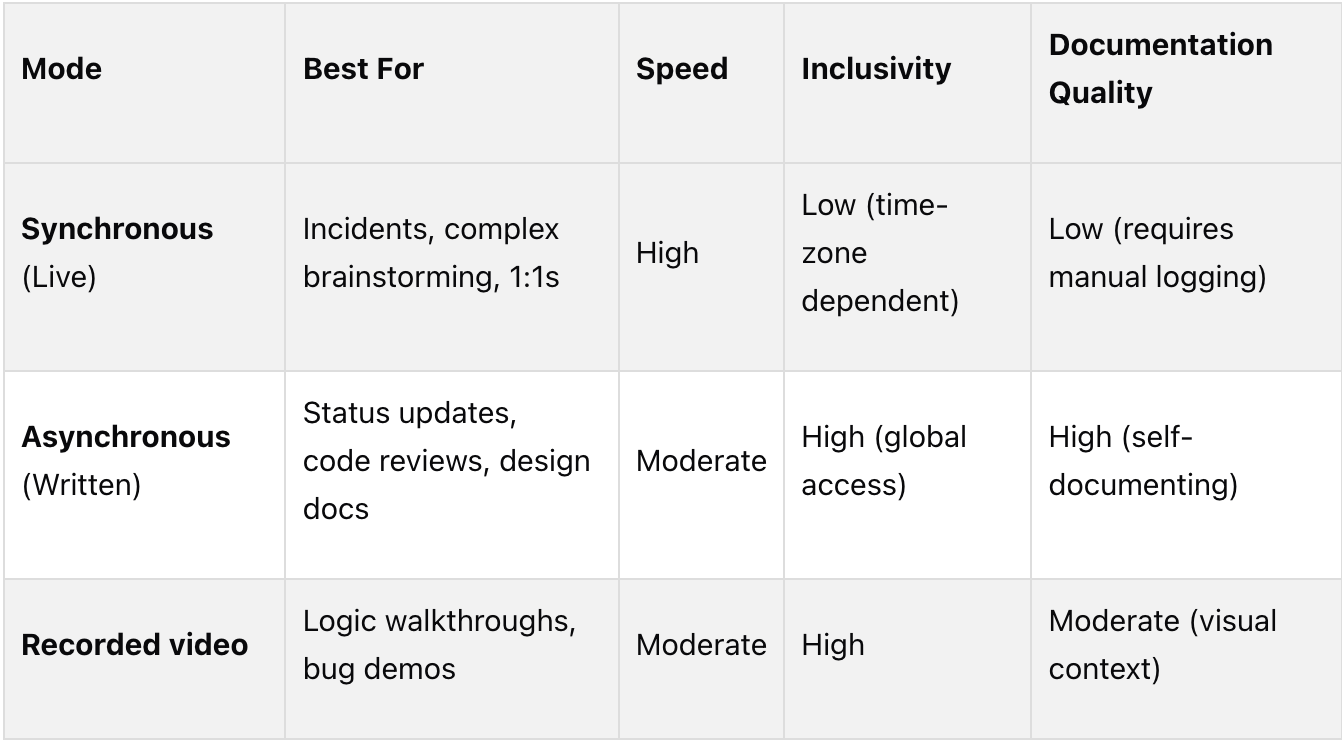
Use live conversation for incidents and complex decisions. Most code reviews and design-doc comments don't need it. Shared live time should go to urgent decisions, not routine updates.
Run Engineering Operations Across Time Zones
Async workflows keep work moving, but the real glue is written operating rules. Those rules decide how overlap hours work, how fast people should reply, and what happens when something needs to be escalated. Without them, teams end up making the same judgment call again and again. With them, response patterns stay steady.
Start with overlap windows. Treat them like prime time. Use them for decisions, not routine status updates.
Protect Overlap Hours for High-Value Collaboration
Overlap hours are limited. Use them for work that needs live back-and-forth. That usually means decision-making, problem-solving, and conversations where timing matters.
Everything else can happen outside that window, including:
- Code reviews
- Async Q&A
- Documentation updates
Deep-work blocks need protection too. Keep them meeting-free, and make that rule plain in the team calendar. If it’s not written down, people will fill the space.
Once you’ve protected overlap time, the next step is setting clear expectations for what happens outside it.
Set Response-Time, Review, and Escalation Standards
Set a reply window for non-urgent messages, a review deadline for pull requests, and a plain escalation path for incidents. If someone is blocked, they should know exactly where to flag it and how long they can expect to wait for a reply.
A dedicated blocker channel helps here. So do clear severity levels for incidents. Remote teams need to know when they should handle an issue on their own and when it’s time to bring in the on-call lead. That kind of clarity cuts down hesitation. It also keeps small issues from turning into long, messy delays.
Then put those rules into the places people use every day: calendars, chat settings, and team policy.
Use Tools and Written Policies to Make Alignment Repeatable
Tools can cut scheduling friction. Multi-time-zone calendar views and local-time display in chat tools make it easier to schedule without doing mental math every time. A shared holiday calendar matters too. If it includes U.S. federal holidays alongside regional holidays in your engineers’ countries, fewer people get caught off guard during key collaboration windows.
Still, tools alone won’t carry this. They need written policy behind them. Your engineering handbook should spell out which collaboration model the team uses. The right model depends on how much coordination your team needs.
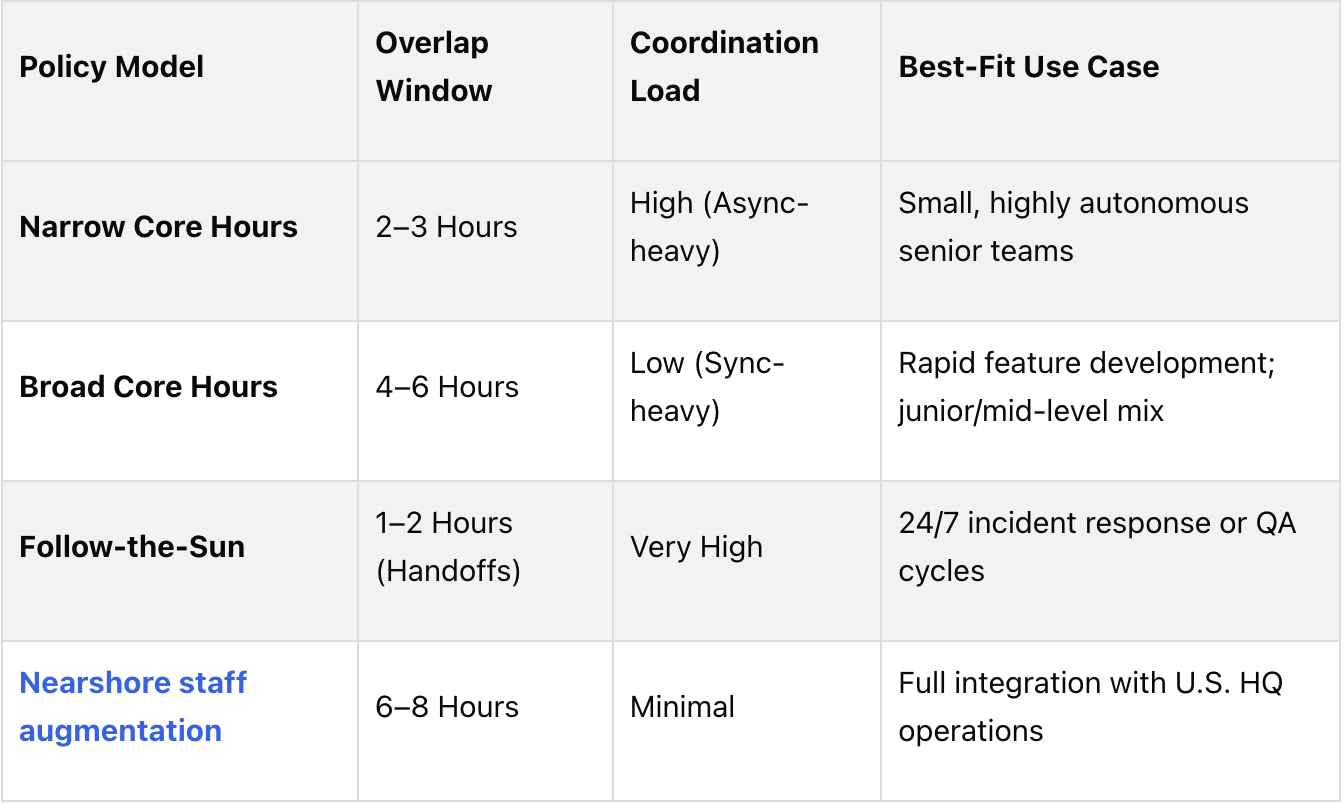
Revisit the model when team size changes or when your time-zone spread shifts. What worked for five people can start to creak when the team doubles or stretches across more regions.
Scale with Time-Zone-Aligned Team Design
Treat time zones as part of the plan from day one. They should shape how you hire, how you split teams, and where each role sits. Once your overlap rules are clear, team structure becomes the next big lever.
When Dedicated Time-Zone-Aligned Pods Make Sense
If the same blockers keep popping up and handoffs stay slow, the issue usually isn't just scheduling. It's team design.
Not every team needs a dedicated aligned pod. But some teams feel the lack of overlap almost at once, especially when the work depends on frequent back-and-forth.
Platform and infrastructure teams are a strong fit here because they support every other team. With the right overlap in place, they can build standardized self-service workflows that cut operational friction and help feature teams move faster [1].
Watch PR cycle time and deployment frequency. Those two signals can tell you a lot. If both are moving in the wrong direction, misalignment may be slowing delivery. In that case, the answer is often pod structure, not more process.
How iDelsoft Supports Time-Zone-Aligned Engineering Teams
If you need this setup fast, a pre-aligned dedicated team can cut out the hiring delay. iDelsoft helps companies build time-zone-aligned dedicated teams with pre-vetted remote engineers across 150+ technologies, along with software development, staff augmentation, custom AI development, and technical recruiting.
Conclusion: Core Rules for Better Time-Zone Alignment
Time-zone alignment is a design choice. It cuts handoff friction and helps delivery keep moving. Distributed teams are complex, but missed handoffs and off-hours escalations don't have to be part of the deal. The right team structure helps prevent them.
FAQs
How many shared hours does an engineering team need?
Engineering teams should aim for 3 to 4 hours of overlap each day to keep collaboration smooth and communication clear.
That shared window gives people enough time for standups, sprint planning, retrospectives, and live code reviews. It also makes it easier to clear blockers fast and keep everyone aligned, even when team members work across different local schedules.
Which time-zone model fits my team best?
It comes down to one thing: how much live collaboration your team needs, and how much work can happen async.
If your team depends on smooth, back-and-forth communication during the workday, it makes sense to hire in regions that line up with U.S. time zones, like Latin America. That gives you more shared hours, fewer delays, and an easier rhythm for meetings, reviews, and day-to-day teamwork.
If your team can work across larger time gaps, an overlap-based model often works well. Set a few core hours for meetings and decisions, then handle the rest through async docs, updates, and clear handoffs.
iDelsoft can help build time-zone-aligned engineering teams for either setup.
What should happen during overlap hours vs. async time?
During overlap hours, teams should work together in real time. That means confirming priorities, clearing blockers, and using that window for must-have meetings so decisions happen fast instead of dragging out.
During async time, work should still move forward. The best way to do that is with clear docs, up-to-date project tracking, and direct communication about who owns what, when to reply, and what kind of response is expected.
Looking to scale more efficiently? Connect with iDelsoft.com! We specialize in developing software and AI products, while helping startups and U.S. businesses hire top remote technical talent — at 70% less than the cost of a full-time U.S. hire. Schedule a call to learn more!
