


How to Build a Dedicated Development Team in 2026
Building a dedicated development team in 2026 is a fast, cost-effective way to address the growing shortage of skilled developers. Here's what you need to know:
This approach ensures faster results, reduced costs, and access to specialized skills like AI, cloud, and blockchain development.
- Why It Matters: Hiring locally takes 5–7 months, while demand for developers is growing by 25% through 2032. Dedicated teams offer a faster alternative with savings of 40–60%.
- Key Benefits: Access top global talent in 72 hours, reduce costs, and shorten delivery timelines by 30–40%.
- How to Start:
- Define your project goals, required skills, and budget.
- Use platforms like iDelsoft to hire pre-vetted experts.
- Focus on onboarding with clear workflows and team integration.
- Manage performance with outcome-based metrics and flexible scaling.
This approach ensures faster results, reduced costs, and access to specialized skills like AI, cloud, and blockchain development.
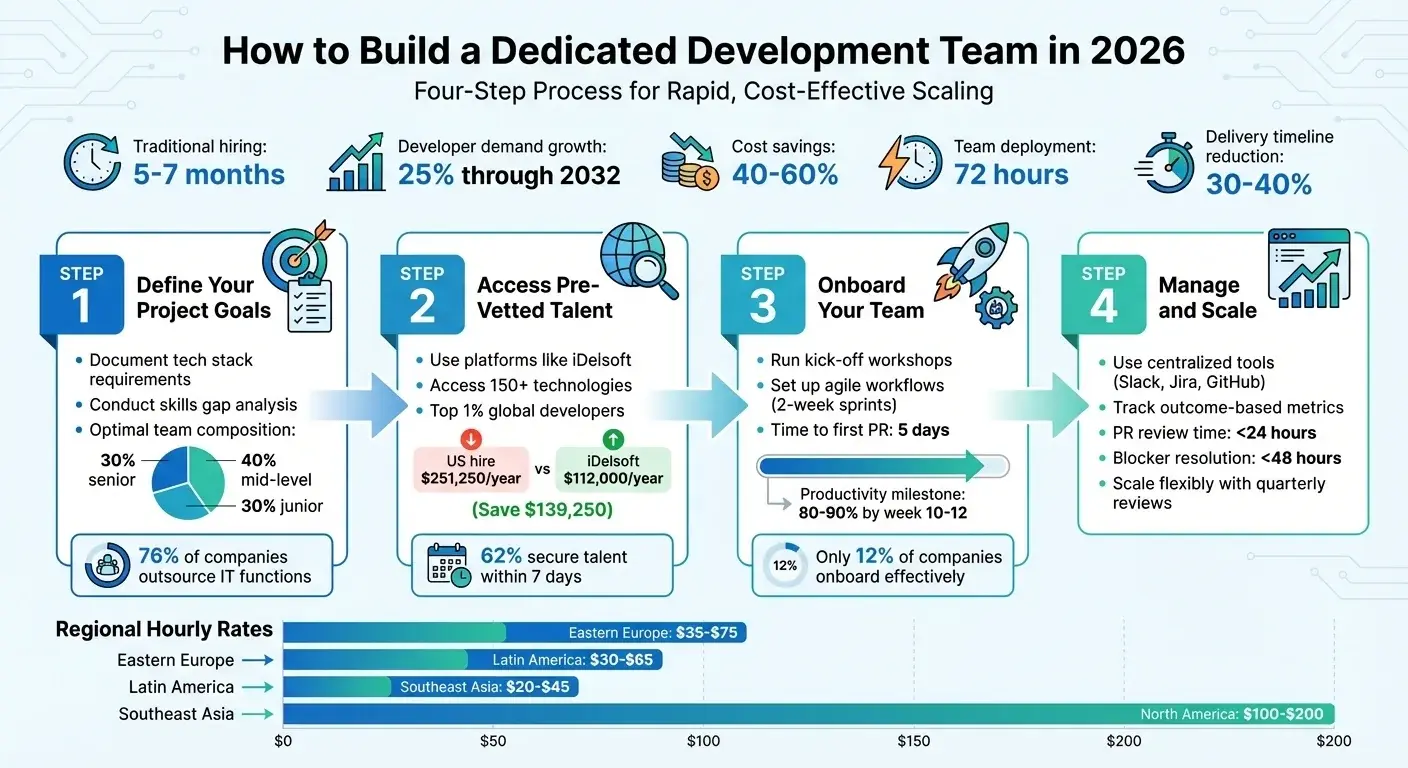
6 Simple Steps to Hire Dedicated Development Team
Step 1: Define Your Project Goals and Team Requirements
Before diving into hiring, it’s crucial to clearly outline your project goals and team needs. Did you know that 76% of companies already outsource IT functions? Successful ones start with detailed documentation. This means outlining your tech stack - think front-end frameworks, back-end languages, databases, and your architectural approach (microservices versus monolithic structures) [1][5]. Without this clarity, you risk receiving proposals that don’t align with your requirements.
A skills gap analysis can help pinpoint missing expertise. For example, you might need Python for AI features, Kubernetes for scalable infrastructure, or specialized knowledge like HIPAA compliance for healthtech or fintech regulations [5]. Use a skills matrix to document these gaps - it will serve as your roadmap for hiring [9].
Identify Required Roles and Skills
The roles you need depend on the project’s scope and timeline. A balanced team typically includes core roles like project managers, back-end and front-end developers, QA engineers, and UI/UX designers. To optimize both capability and cost, aim for a team split of 30% senior, 40% mid-level, and 30% junior professionals [2][6]. Senior engineers focus on architecture and mentoring, mid-level developers handle most of the features, and junior developers manage smaller, well-defined tasks while gaining experience.
Looking ahead, some projects may require additional roles, such as AI/ML engineers for intelligent features, DevOps or cloud architects to handle platforms like AWS, Azure, or GCP, data scientists for analytics, and security specialists for compliance needs [2]. Team composition will vary depending on the size and complexity of your project.
Set Your Budget and Timeline
Where your team is based will have a big impact on costs. Hourly rates differ significantly by region:
- Eastern Europe: $35–$75
- Latin America: $30–$65
- Southeast Asia: $20–$45
- North America: $100–$200 [1]
For a five-person dedicated team, monthly costs range from $25,000 to $70,000, depending on location and the seniority mix [1]. Most providers require an upfront payment of 10–20%, with minimum contracts lasting 3–6 months [1].
Plan for the first two weeks to focus on context transfer - reviewing documentation, architecture, and aligning goals - before any coding begins [1]. Teams typically hit 80–90% productivity by week 10 or 12 [1]. To ensure smooth collaboration, aim for at least 3–4 hours of daily overlap in working hours. It’s also a good idea to run a one- to two-week paid discovery sprint to test communication and code quality before committing to a longer contract [1].
Once you’ve defined your goals, identified roles, and set a budget, platforms like iDelsoft can connect you with top talent quickly and efficiently.
Step 2: Use iDelsoft to Access Pre-Vetted Global Talent

Once your project requirements are set, skip the hassle of drawn-out hiring cycles by tapping into iDelsoft's on-demand global talent network. Traditional recruitment can take a significant bite out of your budget, costing 15–25% of an annual salary just in hiring expenses [2]. iDelsoft eliminates these delays by offering a network of experts across 150+ technologies, including AI and cloud infrastructure, cutting recruitment time and costs [8][10].
The talent you’ll find through iDelsoft is nothing short of elite. Developers rank in the top 1% globally, with at least five years of experience in high-pressure startup or enterprise environments [8][10]. These professionals hail from thriving tech regions like Latin America, Europe, Asia, and MENA. They’re not only tech-certified and fluent in English but also aligned with U.S. time zones, enabling seamless, real-time collaboration [8][10]. Moreover, iDelsoft serves as the Employer of Record, managing payroll, legal compliance, NDAs, and intellectual property protection. This ensures you’re working with experts who are ready to hit the ground running.
iDelsoft's Dedicated Teams Plan
The Dedicated Teams plan offers flexible engagement terms with no upfront fees, making it simple to scale your team up or down as needed [11]. The financial benefits are undeniable. For example, hiring a senior software engineer in the U.S. costs approximately $251,250 annually, whereas sourcing the same role through iDelsoft costs $112,000 annually - a savings of $139,250 per hire [8][12].
"iDelsoft delivered the project on time, meeting all expectations. Their thoroughness and availability were hallmarks of their work."
- Alex Brodsky, CEO, Iteright [10]
While cost savings are impressive, speed is often the real game-changer.
Deploy Global Talent Pods in 72 Hours
For projects requiring immediate attention, iDelsoft can deploy Global Talent Pods in as little as 72 hours [8][10]. This rapid turnaround is possible because the talent pool is pre-vetted and ready to integrate seamlessly into your workflows [8]. In fact, 62% of iDelsoft clients secure the talent they need within 7 days [8]. John Cummings, CEO of BodySite, shared his experience:
"iDelsoft delivered the project and resources on a reasonable timeline and communicated promptly. Moreover, their rapid mobilization and skilled talent impressed clients!" [8][10]
This approach can reduce delivery timelines by 30–40% compared to temporary staffing solutions [2].
Step 3: Onboard Your Team
Once you’ve defined your project needs and brought together the right talent, the next step is ensuring a smooth onboarding process. A well-structured onboarding plan is crucial for getting your team up to speed quickly. Surprisingly, only 12% of employees feel their company handles onboarding effectively, while 81% of new hires report feeling overwhelmed during the process [13]. The solution? A balanced approach that combines technical setup with meaningful team integration.
Run Kick-Off Workshops
Begin with a quick validation call the day before your team officially starts. This 15-minute video session ensures that tools, VPNs, and accounts are ready to go, avoiding Day 1 delays caused by IT issues [13]. On the first day, hold an architecture review session where the team can ask questions that go beyond what’s covered in documentation [1]. Use this time to walk through your tech stack, system architecture diagrams, and the reasoning behind your product roadmap [1][4].
Establish clear communication guidelines early on. For example:
Assign a simple Day 1 task, like updating documentation, that walks the team through the entire workflow - branching, committing, pushing, reviewing, and merging [13]. This ensures everyone gets hands-on experience with your processes right away.
Once the technical setup is out of the way, shift your focus to creating agile workflows and building a strong team culture.
Set Up Agile Workflows and Build Team Culture
After the kick-off workshops, establish a two-week sprint cycle and define clear criteria for what "Done" means [1][4]. Start small by scoping the first sprint to focus on minor bugs or well-defined features.
By the 12th week, a properly onboarded team should be operating at 80–90% of the efficiency of an internal team [1].
For remote teams, it’s important to compensate for the lack of passive context-sharing that happens in an office. Use tools like Loom to record walkthroughs of your architecture and codebase, so these resources can be reused for future hires [13][1]. Pair new developers with a buddy who can answer casual questions about systems and team culture [14][15]. Additionally, schedule weekly one-on-one meetings for at least the first month. These 15–30 minute check-ins are one of the strongest indicators of onboarding success [13].
To track your onboarding effectiveness, monitor metrics like:
- "Time to First Meaningful PR": Aim for within 5 days.
- "Sprint Commitment Accuracy": Target above 70% [1].
These benchmarks will help you fine-tune your onboarding process and set your team up for long-term success.
Step 4: Manage and Scale Your Team
Once your team is up and running, shift your focus to results - such as features delivered, bugs fixed, and metrics improved - rather than tracking hours worked [17]. This approach encourages autonomy while keeping the team aligned with measurable goals.
Use Centralized Tools
For remote teams, having the right tools is essential [16]. Standardize your platforms to ensure everyone stays on the same page. Use tools like Slack or Microsoft Teams for communication, Jira or Linear for project management, GitHub or GitLab for code and CI/CD, and Notion or Confluence for documentation. Shared dashboards in your project management tool can help track key metrics like sprint velocity, blocker resolution time, and bug escape rates [7].
To avoid bottlenecks, aim for:
- PR review turnaround time: Less than 24 hours
- Blocker resolution time: Under 48 hours [17]
These benchmarks keep workflows smooth and maintain momentum. By standardizing tools and monitoring progress effectively, you create a solid foundation for both productivity and performance tracking.
Track Performance and Scale Flexibly
With your tools in place, focus on outcome-based metrics rather than just activity tracking. For example, monitor the bug escape rate (bugs found in production versus QA) and aim to see it decrease over time [17]. Avoid invasive monitoring methods like keystroke or screenshot tracking, as these erode trust and don’t accurately measure productivity [16]. Instead, conduct bi-weekly retrospectives to identify process bottlenecks and improve team velocity [7].
When you’re ready to grow your team, consider iDelsoft's flexible model, which allows you to quickly add specialized roles - like Rust developers, AI/ML engineers, or DevOps experts - without the long delays of traditional hiring [2][6]. Start by adding senior-level roles to maintain quality and mentorship, then balance your team with a 30-40-30 distribution: 30% senior, 40% mid-level, and 30% junior roles. This mix ensures strong technical capability while being cost-efficient [2].
Finally, review your team structure every quarter and adjust roles as needed to align with your product roadmap [3]. This ongoing evaluation keeps your team adaptable and ready to tackle new challenges.
Conclusion
To launch a dedicated development team, start by clearly defining your goals, selecting vetted talent, streamlining onboarding, and managing with tools that focus on outcomes. This approach allows you to deploy skilled engineers in as little as 72 hours [3]. It’s a method designed to speed up project timelines while supporting long-term scalability and growth.
One of the key advantages of dedicated teams is the cost savings they offer. Companies leveraging this model can cut hiring costs by 40–70% compared to traditional in-house recruitment, all while ensuring quality through experienced, pre-vetted professionals [3]. In some cases, businesses have reported cost reductions of up to 90%, highlighting the financial benefits of this strategy [1].
Beyond the financial impact, these teams bring continuity and technical expertise to the table. They quickly develop a deep understanding of your product, take ownership of their work, and deliver results faster. Whether you need AI engineers, DevOps specialists, or other niche roles, this model allows you to scale your team flexibly according to your roadmap.
To get the most out of your dedicated team, treat them as an integral part of your organization. Involve them in key activities like product reviews, goal-setting, and retrospectives. By focusing on measurable outcomes - such as sprint velocity, PR cycle time, or bug escape rates - you can drive meaningful results.
With the right approach and a reliable partner, you can build a high-performing team that meets your evolving needs while delivering quality work from the very start.
What’s the difference between a dedicated development team and staff augmentation?
A dedicated development team is a long-term collaboration where an external partner provides and manages a complete team - developers, project managers, designers, and QA engineers. This team operates as an extension of your company, taking responsibility for the product's direction while working closely with your internal team.
On the other hand, staff augmentation is more about temporarily bringing in specialists to address specific skill gaps in your team. In this setup, you retain control over project management, making it a good fit for short-term needs or highly specialized tasks.
How do I protect IP and keep my code secure with a remote dedicated team?
To safeguard your intellectual property (IP) and secure code when working with a remote team, it's essential to combine technical tools with clear legal agreements. Start with secure VPNs and IP protection tools to shield your data during remote access. Implement access controls to ensure only authorized team members can reach sensitive information.
Make sure contracts explicitly outline IP ownership to avoid any misunderstandings. Use secure cloud storage solutions and enforce device posture checks to verify that only compliant devices can access your systems. Restrict access further by granting permissions based on roles or tasks.
By pairing these technical safeguards with well-defined legal agreements, you can protect your proprietary assets while collaborating remotely.
What are the best KPIs to manage a dedicated team without tracking hours?
To effectively manage a dedicated development team without tracking hours, the focus should shift to productivity, efficiency, and quality. Some of the most useful metrics include:
- Cycle Time: Measures the time it takes to complete a task from start to finish.
- Lead Time: Tracks the duration from when a request is made to when it’s completed.
- Throughput: Evaluates the number of tasks or features completed over a specific period.
- Deployment Frequency: Indicates how often new updates or features are delivered.
- Flow Efficiency: Assesses how much of the total time is spent actively working on tasks versus waiting.
Additionally, metrics such as developer productivity, effort allocation, and change failure rate provide deeper insights into team performance. These indicators encourage a results-focused mindset, which aligns well with the needs of modern remote team management.
Looking to scale more efficiently? Connect with iDelsoft.com! We specialize in developing software and AI products, while helping startups and U.S. businesses hire top remote technical talent—at 70% less than the cost of a full-time U.S. hire. Schedule a call to learn more!
28.03.2026
See also
