


Estimated Reading Time: 9–11 minutes
The role of a developer has evolved dramatically. Modern engineering teams no longer need people who simply write code — they need contributors who understand why features matter, how users think, and what business outcomes their work supports. This mindset shift, known as product thinking, has become one of the defining skills separating high-impact developers from average ones.
Teams that embrace product thinking deliver features faster, reduce rework, and collaborate more effectively across product, design, and engineering. In this article, we break down why product thinking is now essential, how it transforms development teams, and what skills developers need to thrive in 2025 and beyond.
Table of Contents
- What “Product Thinking” Really Means for Developers
- Why Product Thinking Has Become Essential in 2025
- How Product-Focused Developers Improve Engineering Outcomes
- Key Skills Behind Strong Product Thinking
- How Product Thinking Reduces Technical Debt
- How Leaders Can Encourage Product Mindsets
- Final Thoughts
1. What “Product Thinking” Really Means for Developers
Product thinking is the ability to zoom out from the code and deeply understand the user problem, business goals, and long-term product strategy. It’s the shift from:
❌ “What code should I write?” to
✅ “What outcome are we trying to achieve — and is this the best solution?”
Developers with this mindset don’t just receive requirements; they question assumptions, anticipate UX friction points, identify risks, and propose better alternatives when needed.
This ability to connect engineering decisions with customer value is quickly becoming non-negotiable.
2. Why Product Thinking Has Become Essential in 2025
Four major trends have driven product thinking to the forefront:
1. Engineering teams are more distributed
In global teams, developers must make more autonomous decisions without relying on constant clarification. Product thinking fills those gaps.
2. Release cycles are faster
Continuous deployment demands engineers who can make product-driven decisions on the fly.
3. AI accelerates the coding process
With AI tools automating repetitive tasks, human value shifts toward judgment, creativity, and strategic reasoning. According to McKinsey & Company, top-performing companies that score high on their Developer Velocity Index (DVI) — which measures a range of factors including processes, tooling, and team enablement — significantly outperform peers in revenue growth and innovation.
4. Businesses expect engineers to think in outcomes, not tasks
A strong developer today is an owner — not just an implementer. That means thinking about user value, long-term impact, and strategic alignment.
This aligns with the mindset described in our article How to Identify and Vet 10x Product Engineers, where product intuition is listed as one of the top differentiators for high-impact talent.
3. How Product-Focused Developers Improve Engineering Outcomes
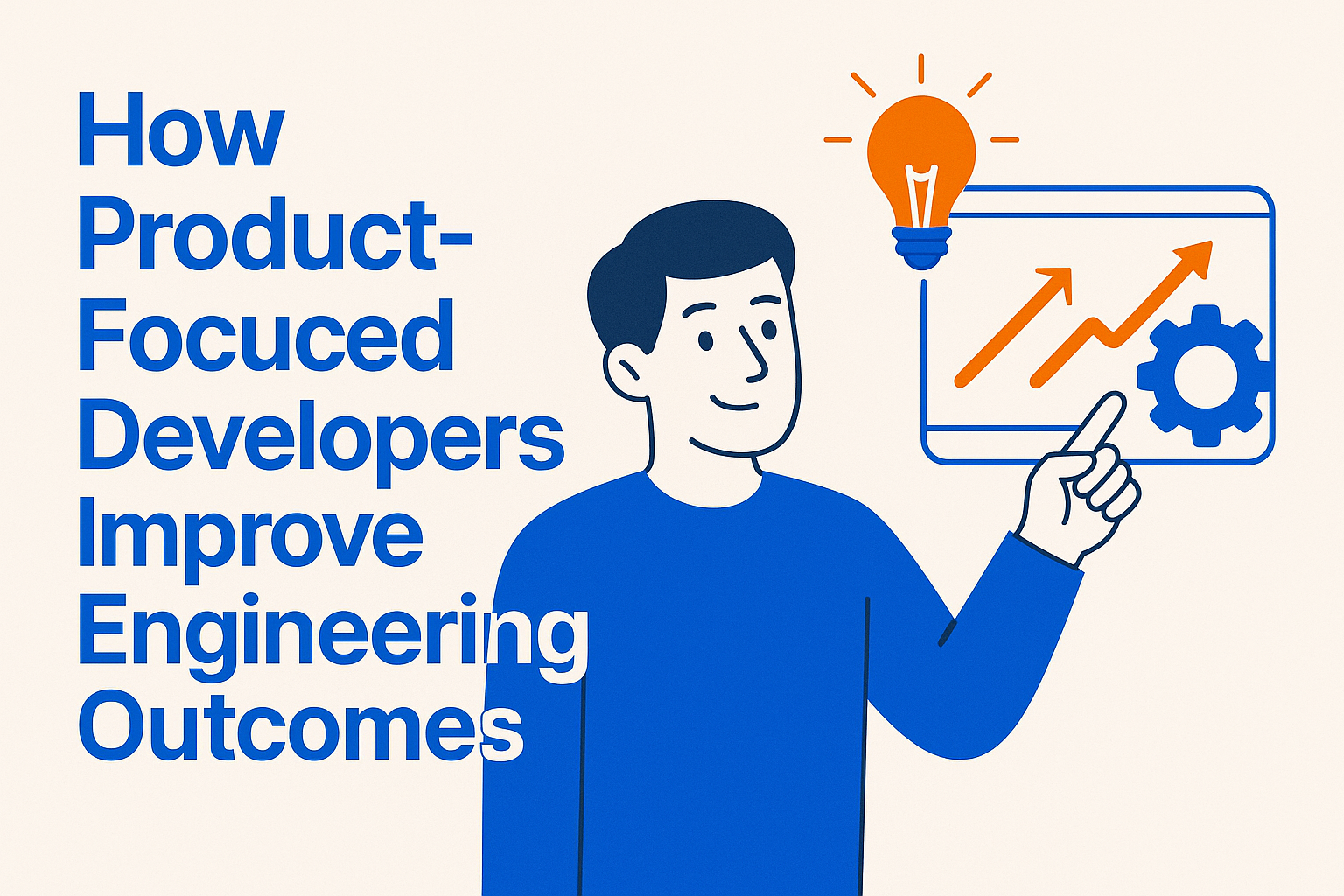
Better prioritization & trade-off decisions
Product thinkers understand which features matter most, enabling better effort allocation and avoiding wasted cycles.
Less rework
By confirming that the solution truly addresses the root problem — not just ticking off requirements — product-aware teams avoid building “the wrong thing” and putting in extra work later.
Better user experiences
Engineers who care about user context catch UX friction, accessibility gaps, or performance concerns early — often before design handoff or QA.
Stronger cross-functional collaboration
Clear communication and understanding of product value helps developers work more effectively with product managers, designers, and stakeholders — reducing misunderstandings and accelerating delivery.
This kind of alignment is a core principle in your article How to Conduct Effective Code Reviews with Distributed Teams, where shared context and clarity drive better collaboration across distributed developers.
4. Key Skills Behind Strong Product Thinking
User empathy
Understanding the user’s motivations, frustrations, and workflows — not just technical requirements.
Systems thinking
Seeing how changes impact the entire product ecosystem: performance, scalability, maintainability.
Data literacy
Product decisions should be backed by data. The HEART Framework — originally developed by Google — offers a practical way to measure user experience through metrics like Happiness, Engagement, Adoption, Retention and Task Success. This helps connect engineering decisions to user value and business impact.
Business awareness
Understanding how technical decisions affect cost, revenue, market fit, competitive differentiation.
Communication & initiative
Explaining trade-offs, system impacts, and proposing better alternatives — instead of blindly implementing specs.
5. How Product Thinking Reduces Technical Debt
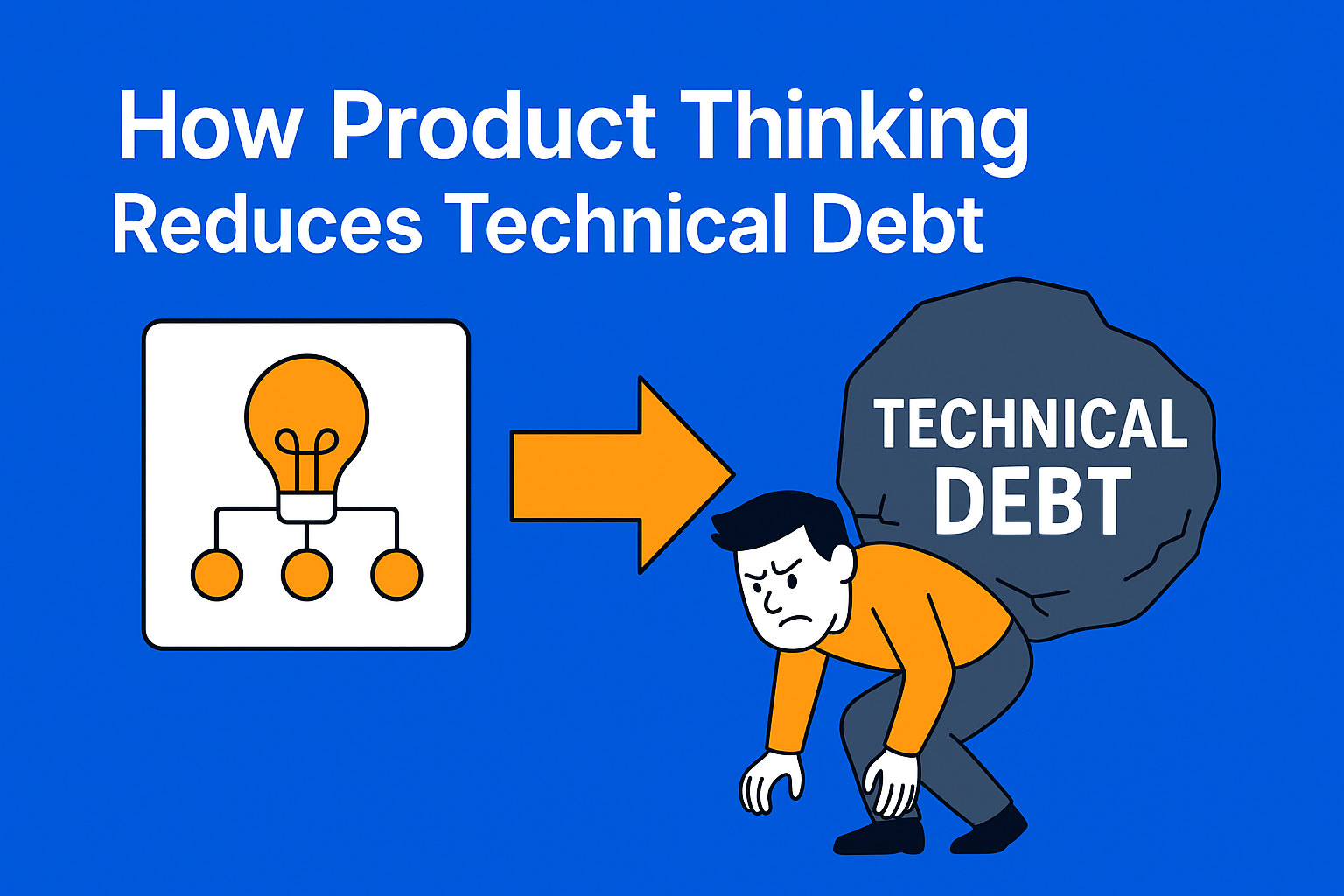
Developers who understand product strategy make smarter long-term decisions:
- Avoid premature over-engineering when a simple MVP suffices
- Identify risky assumptions early and question their validity
- Push back on unnecessary features or complexity
- Align architecture with future roadmap direction and scalability needs
- Prevent “build-first, refactor-later” patterns which lead to clogged codebases
Teams lacking product thinking often suffer from duplicated features, rework, bugs, and bloated backlogs — while product-aware engineers steer clear of these traps, making sustainable, value-driven decisions from the start.
6. How Leaders Can Encourage Product Mindsets
Include developers in discovery phases
Invite them to user interviews, requirement discussions, and roadmap planning so they see the context behind features.
Share user feedback and metrics with the team
Real user stories and data drive empathy and product awareness — not just tickets.
Promote a culture of questioning and ownership
Encourage engineers to challenge unclear requirements, propose better solutions, and treat features as experiments delivering value — not just chores.
Cross-train with product & design teams
Allow developers to shadow PMs/designers and vice versa — building shared understanding and product empathy.
Reflect product outcomes in performance reviews
Reward not only clean code, but also impact: user adoption, quality, performance, down-time reduction, etc.
7. Final Thoughts
Product thinking is no longer optional — it’s one of the most important skills a modern developer can have. It transforms engineers into strategic contributors, aligns tech output with business value, and reduces wasted effort. Especially in distributed, AI-assisted, fast-moving environments, product–aware developers become a competitive advantage.
As companies continue to evolve, those who cultivate product thinking within their engineering ranks — and hire developers who already embrace it — will build stronger products, ship faster, and stay ahead of the competition.
Looking to scale more efficiently? Connect with iDelsoft.com! We specialize in developing software and AI products, while helping startups and U.S. businesses hire top remote technical talent—at 70% less than the cost of a full-time U.S. hire. Schedule a call to learn more!
