


In the future the biggest AI software companies may look like service firms on the outside, but run like software businesses on the inside. Instead of selling a tool, they sell a finished result - like a processed claim, coded medical record, or closed set of books. That matters because the services budget is much bigger than the software budget.
This is a prediction done by many, including Sequoia Capital.
A few facts make the case stronger. The U.S. lost about 340,000 accountants from 2019 to 2022, and about 75% of U.S. CPAs are near retirement age. When skilled labor gets harder to find, companies that turn expert work into software-led delivery have a big opening.
If I boil the article down to one point, it’s this: the next giant company may look like a service vendor, but its margin engine will come from software, automation, and data.
What software-disguised services companies look like in practice
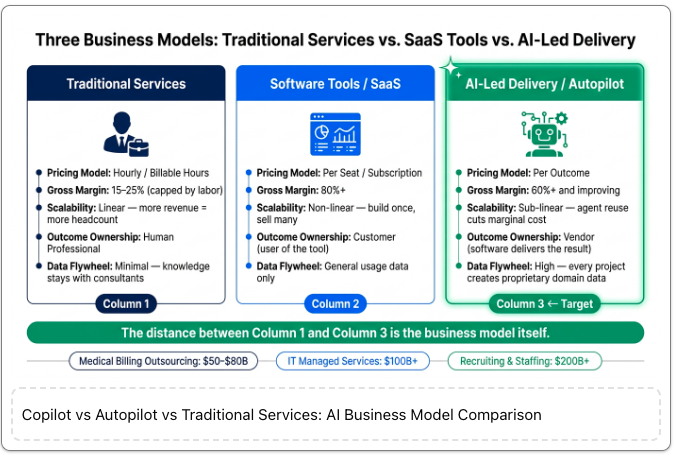
Copilot vs Autopilot vs Traditional Services: AI Business Model Comparison
A software company wrapped in service delivery doesn’t look like a software company at first glance. On the outside, it looks like a service firm. But under the hood, software does most of the heavy lifting.
Here’s the basic setup: the company charges for the result, not for access to a tool. A customer sends in a request, like a claim or an invoice. The software takes it from there. It handles intake, routes the task, runs the step-by-step process, and flags anything odd. A person steps in only when the case needs judgment, like an edge case or a disputed outcome.
That’s the autopilot model. The company owns the full workflow from start to finish, not just the software used somewhere in the middle.
The delivery loop: workflow ownership, automation, and learning
What makes this model stronger over time is the data it creates.
Each completed job feeds the system. That helps the next job move faster and cost less. The loop is simple: standardize intake → automate execution → flag exceptions → learn → improve.
Over time, that turns operating know-how into structured data the system can use. And that’s where things start to click. The company isn’t just doing the work again and again. It’s turning each job into input for the next one.
Real examples that show this model in action
Amazon Web Services began as internal infrastructure built to deliver cloud services at scale. It later turned that operating capability into a platform that now runs a large share of the internet. In other words, it owned the outcome layer instead of just selling tools to developers. [6]
Palantir pushed this pattern further by placing engineers directly inside government and enterprise customers. These forward-deployed engineers worked close to messy data systems and built custom workflows that could later turn into repeatable product primitives. That gave Palantir deep operating context that off-the-shelf software struggles to match. [6]
Reserv, an insurance third-party administrator, mapped the full decision map of the claims adjuster role. That included every decision point, routing rule, and data relationship. It then used that map to automate parts of the claims workflow. The company linked that work to faster processing, better customer satisfaction, and stronger cash flow after winning a major contract. [5]
Anterior (formerly Co-Helm) built an autopilot for healthcare revenue cycles. Instead of selling a tool to medical coders, it took over the translation process itself. It converts clinical notes into 70,000 standardized ICD-10 codes with higher accuracy and lower cost than outsourced providers. [9]
The pattern is the same across all four examples: workflow ownership plus a data loop that gets better with every job. This works best when the work is repeatable, tied to a clear outcome, and easy to measure.
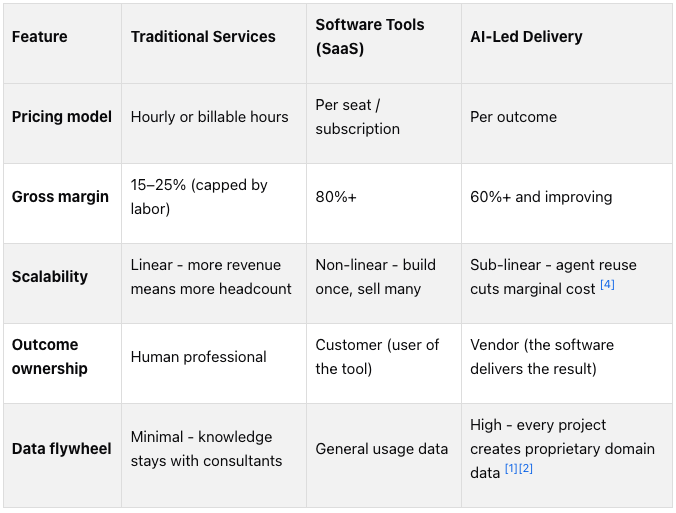
Comparison table: traditional services vs. software tools vs. AI-led delivery
Where this model works first and why it wins there
The software-disguised services model doesn’t win across the board on day one. It tends to land first in a specific kind of category, and the pattern is pretty clear: outsourced, repetitive, judgment-heavy work where the buyer already pays for an outcome. That’s where software-like margins can sit inside service contracts. So the first wins usually come from replacing an existing vendor, not from asking buyers to learn a whole new way to purchase.
Start with outsourced, outcome-based work
That’s why vendor replacement is the easiest way in. If a company already outsources medical billing, IT managed services, or lead qualification, it’s used to paying for a result instead of running the work in-house. Swapping one vendor contract for another is a replacement decision, not a company-wide reorg. Friction is much lower.
The best near-term categories tend to show the same signals:
- High labor spend
- Slow turnaround times
- Recurring exceptions that follow patterns
Medical billing ($50–$80 billion in outsourced U.S. spend), IT managed services ($100 billion+), and recruiting and staffing ($200 billion+) all match that profile. [2] These markets are large because buyers already pay for repeatable, measurable work. That matters. The buyer already looks at output, speed, and error rate, so the value story is easy to prove.
The bigger opening sits inside the much larger work budget, not the software budget.
Expand from narrow workflows into adjacent intelligence tasks
The playbook starts small. Choose one narrow workflow - invoice processing, resume screening, or lead qualification - where the outcome is easy to define and easy to check. Then own the full loop: intake, execution, exceptions, and delivery. Once that first workflow is steady, the same model can move into nearby tasks.
Every completed case improves routing, exception handling, and resolution logic. Over time, that creates delivery data that gets better with every job. The more of the delivery loop the company automates, the lower the marginal cost gets - and the tougher the system is to copy from the outside. [3][4]
The team and operating model needed to productize services
Once the workflow is proven, the bottleneck moves from picking the right market to building the right operating model. At that point, delivery has to be treated like a product roadmap. You map the workflow, automate the repeatable parts, and cut down the amount of human review needed for each job. That’s where software-like margins start to show up inside a services business: when delivery works like a system instead of a pool of labor.
Comparison table: manual delivery vs. software-assisted delivery vs. AI-led delivery
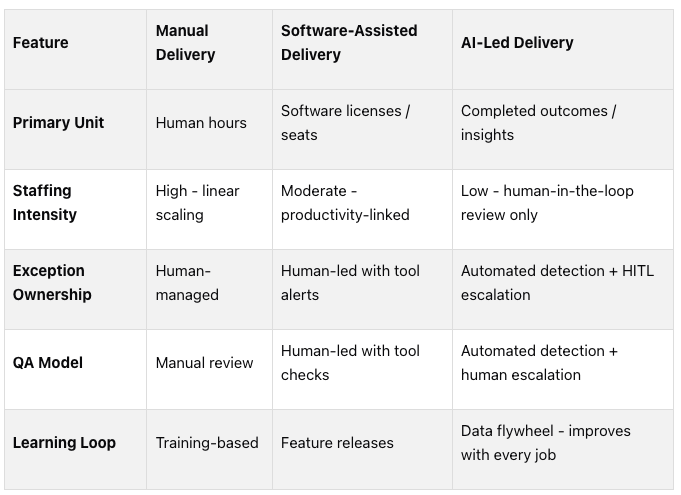
The distance between column one and column three is the business model itself. Old-school services firms stay stuck in column one. The companies aiming for trillion-dollar scale are pushing toward column three.
Key hires: product engineering, applied AI, data, workflow automation, and solutions talent
That operating model shapes the team. AI-native service companies often aim for about 60% product and engineering, 30% domain and delivery, and 10% sales and customer success. [8] That’s a very different setup from a standard services firm.
The most important early hire is often a product leader who can sit between engineering and delivery. Without that person, the company can drift into a body shop that handles one-off requests instead of turning manual work into a roadmap.
Each role ties to a clear part of the delivery loop:
- Product engineering owns the roadmap.
- Applied AI and data engineers own the flywheel and model performance.
- Workflow automation specialists own routing and escalation.
- Product and solutions leaders handle edge cases and customer adoption.
Forward Deployed Engineers work side by side with customers, map workflows, and build reusable primitives. [5] Then a quality layer - rubrics, evals, and human-in-the-loop review - helps keep outputs steady enough to sell at scale. [7]
How iDelsoft helps build remote teams for AI-led service delivery
Remote engineering pods make this setup easier to staff and scale. iDelsoft builds dedicated remote teams across full-stack development, cloud, AI, and enterprise systems. These teams are put together for FDE, applied AI, data, and automation roles.
The model can lower delivery cost compared with U.S.-only hiring, and it supports flexible engagement structures for both short-term and long-term work.
Go-to-market signals, defensibility, and key takeaways
What customers notice first: outcomes, speed, and reliability
When a company owns the workflow, buyers judge it on a different set of signals. Once that workflow is turned into a product, attention moves away from software features and toward completed work.
That’s the big shift. Buyers notice this model when it owns the finished output, not just the tool behind it. It feels less like buying software and more like replacing an outsourced process. In some cases, it can even feel like skipping the need to add headcount.
The demo changes too. Instead of walking through a feature list, the company shows something much simpler: real inputs go in, completed work comes out. That’s what lands. And when pricing is tied to outcomes, it sends a clear message: the company is taking responsibility for the result.
Why this model becomes hard to copy
Once buyers see the result, the next thing they want to know is simple: does the system get better the more it runs?
The moat sits in the workflow, the data, and the integration layer around the model. Every delivery cycle can improve accuracy, cut cost, and increase switching costs. That matters because the edge usually doesn’t come from the model alone. It comes from how the whole system is set up and refined over time.
Forward-deployed engineers play a big role here. They put domain knowledge straight into configurable parameters, which helps the system fit live business processes. And once that system is wired into day-to-day workflows, a new competitor can’t just show up and copy the surface. They have to go through the same delivery cycles to catch up.
Key takeaways for founders and hiring leaders
That shift changes both go-to-market and hiring.
The core thesis is simple: the next $1T company will sell completed work, not access to tools. Start with a workflow that’s already outsourced. That way, the budget is already there, and the buyer is already used to paying for outcomes.
A few points matter most:
- Measure outcomes before scaling sales
- Own the system of record so the data flywheel stays with you
- Build product, AI, and delivery as one system
- Hire specialized remote teams in applied AI, workflow automation, and forward-deployed engineering
Looking to scale more efficiently? Connect with iDelsoft.com! We specialize in developing software and AI products, while helping startups and U.S. businesses hire top remote technical talent—at 70% less than the cost of a full-time U.S. hire. Schedule a call to learn more!
