


Countries With the Lowest Tax Rates for Freelancers: A Complete Guide
Want to keep more of your freelance income? Certain countries offer tax systems that allow freelancers to significantly reduce their tax burden. From 0% tax in the UAE and the Bahamas to Georgia’s 1% tax rate under its Small Business Status program, these destinations can save you thousands annually. But it’s not just about tax rates - factors like residency rules, living costs, and infrastructure matter too.
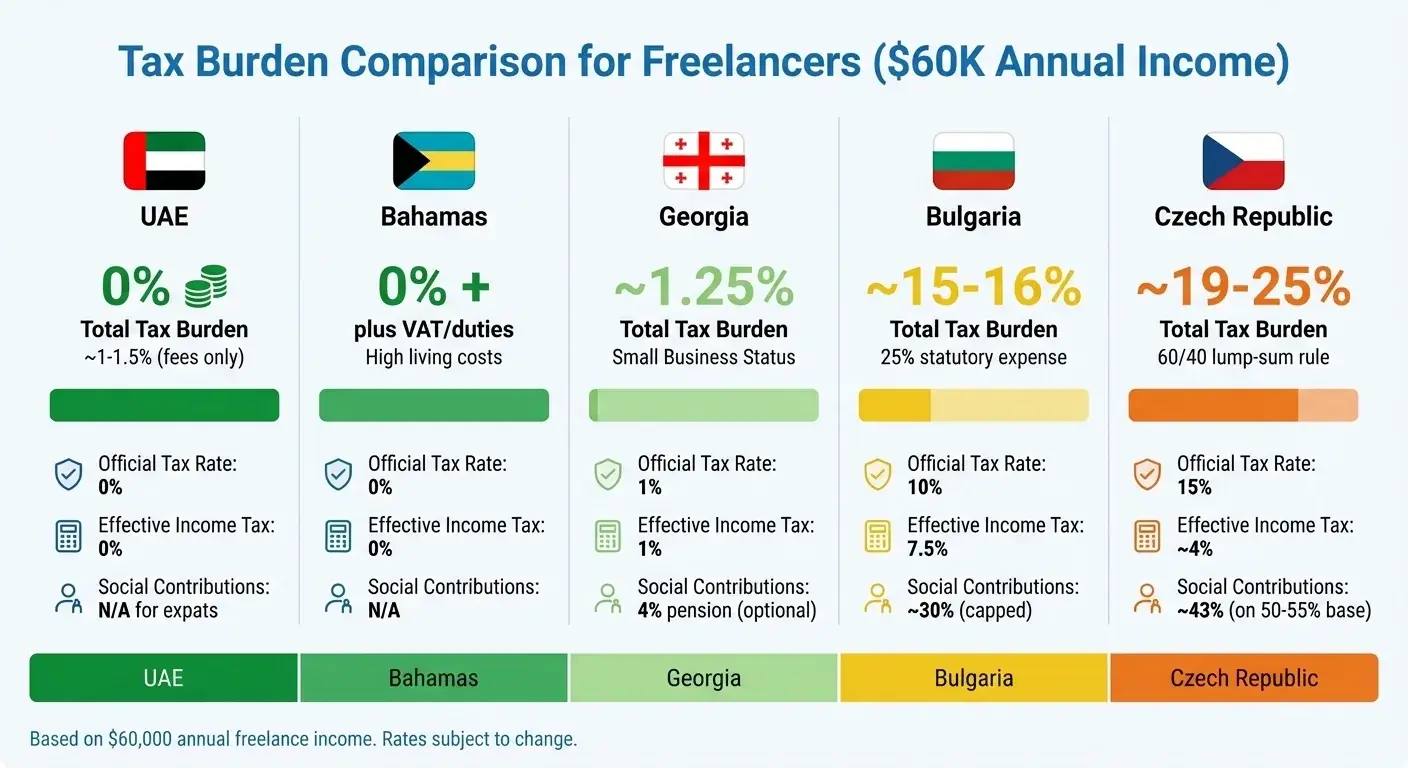
Here’s a quick look at some top options:
Key takeaway: Choosing the right country depends on your income, lifestyle, and compliance needs. Keep in mind U.S. citizens are taxed on global income but can benefit from exclusions like the Foreign Earned Income Exclusion (FEIE). Plan carefully to maximize savings and ensure compliance.
Here’s a quick look at some top options:
- UAE: 0% personal income tax; requires 180 days of residency for tax status.
- Bahamas: 0% income and capital gains tax, but high living costs.
- Georgia: 1% tax for small businesses earning up to $185,000; low living costs.
- Czech Republic: Effective 4% tax rate using the 60/40 rule, plus mandatory social contributions.
- Bulgaria: 10% flat tax with capped social contributions.
Key takeaway: Choosing the right country depends on your income, lifestyle, and compliance needs. Keep in mind U.S. citizens are taxed on global income but can benefit from exclusions like the Foreign Earned Income Exclusion (FEIE). Plan carefully to maximize savings and ensure compliance.
Top 5 Low-Tax European Countries for Digital Nomads in 2025
Some countries offer tax systems that are especially appealing to freelancers, allowing for reduced taxable income and simplified compliance. If you're a freelancer looking to maximize your earnings while minimizing tax obligations, here are five destinations worth considering, along with their unique tax benefits.
United Arab Emirates (UAE): 0% Personal Income Tax
Freelancers in the UAE enjoy a 0% personal income tax rate, making it a standout option for those seeking tax-free earnings [8]. However, if your annual revenue exceeds AED 1 million (approximately $272,000), you'll need to register for corporate tax. Even then, the first AED 375,000 (about $102,000) of profits is tax-exempt, with a 9% tax rate applied to amounts above that [4][8].
The UAE also provides freelance-friendly visas and investor residency options, making it easier to establish a base there [11]. To obtain a Tax Residency Certificate, which can help avoid withholding taxes from international clients, you must spend at least 180 days in the country [2]. While living costs in cities like Dubai and Abu Dhabi are high, the low 5% VAT and absence of personal income tax can offset these expenses.
"The UAE has become a magnet for entrepreneurs, investors, and remote professionals seeking financial efficiency." - Andrew Coleman, CPA, Taxes for Expats [8]
Czech Republic: 4% Effective Tax With 60/40 Rule
The Czech Republic's "60/40 rule" offers freelancers a straightforward and low-tax option [4][13]. Under this system, 60% of your gross income is treated as a lump-sum expense (up to CZK 2 million, roughly $88,000), leaving only 40% subject to a 15% tax rate. For freelancers earning around €60,000 ($65,000) annually, this brings the effective tax rate down to approximately 4% [4][13].
For those earning less, a fixed monthly tax option is also available [13]. It's important to note that mandatory contributions for social insurance (29.20% on 55% of taxable income) and health insurance (13.5% on 50% of taxable income) must also be factored in. Overall, operating as a sole proprietor is typically more tax-efficient than forming a corporation [4].
Bulgaria: 10% Flat Tax on Freelance Income
Bulgaria offers a flat 10% tax rate on both personal and corporate income, the lowest in the European Union [8]. Freelancers can deduct 25% of their income as lump-sum expenses before calculating taxes. For example, if you earn $80,000, your taxable income would be reduced to $60,000 after the deduction.
Social security contributions are required but capped at a maximum monthly base of roughly $2,495, which helps reduce the overall financial burden as your income increases [10]. To qualify as a tax resident, you must spend at least 183 days per year in Bulgaria [4]. Depending on your income and business needs, you can choose between registering as a sole proprietor or forming a company.
"In Bulgaria, you can opt to register yourself as a sole-proprietor or to open a company. Both can be beneficial and the best option will depend on your situation." - Digital Nomad Tax [4]
Georgia: 1% Tax Under Small Business Status
Georgia's "Small Business Status" program is a game-changer for freelancers, offering a 1% tax rate on annual turnover up to 500,000 GEL (approximately $185,000) [4][11]. This rate is significantly lower than the standard 20% personal income tax, but you must actively apply and register for the program [10].
Freelancers operating in Georgia must also obtain a work permit and residency to comply with local regulations [10]. Additionally, foreign-source income can be exempt under certain conditions, which is advantageous for those working with international clients. With a relatively low cost of living - especially in Tbilisi - and growing digital infrastructure, Georgia is becoming a popular choice for remote professionals.
"Georgia is a rising star for U.S. expats, especially self-employed individuals and small business owners." - Katelynn Minott, CPA, Bright!Tax [11]
Bahamas: No Income or Capital Gains Tax
The Bahamas offers a 0% tax rate on personal income, corporate profits, and capital gains [8]. While this tax-free environment is appealing, it comes with high living costs and indirect taxes, such as a VAT of around 10–12% on most goods and services [8].
Residency requirements include obtaining a permit or making a minimum real estate investment of $750,000 [2]. These factors make the Bahamas more suitable for high-net-worth freelancers who can meet the residency requirements and afford the cost of living. For those who qualify, the lack of income tax and reporting obligations provides a streamlined financial setup.
If you're a freelancer exploring these options, each country offers its own set of advantages depending on your income level, lifestyle preferences, and long-term goals.
Tax Residency and Freelancer Visas Explained
Tax residency determines which country has the right to tax your income, and it operates independently of your citizenship. For freelancers, properly establishing tax residency is crucial - not just to avoid double taxation by your home country but also to maintain access to banking services under CRS/FATCA regulations.
Most countries follow the 183-day rule: if you spend more than half the year in a country, you’re generally considered a tax resident there [3][14]. However, some countries offer more lenient options. For instance, Cyprus has a 60-day rule - you only need to spend 60 days in the country, provided no other country claims you as a tax resident under the 183-day rule and you maintain a permanent home in Cyprus [4][1]. Additionally, some jurisdictions assess your "center of vital interests", which includes factors like where your family resides, where you own property, or where your business operates [4][1].
"Most clients, banks, and tax authorities will want to see a certificate of tax residence. Without it, they can withhold tax, refuse payments, or even report you back to your home country." - Sebastian Sauerborn, Expatriate Consultant [1]
For freelancers, Digital Nomad Visas can provide a pathway to residency. For example, the UAE's Remote Work Visa requires proof of a minimum monthly income of $5,000, while Estonia's Digital Nomad Visa sets the requirement at €4,500 per month [15][16]. However, it’s essential to note that these visas only regulate your immigration status - not your tax residency. To gain tax residency, you’ll need to meet the physical presence requirements and secure a Tax Residency Certificate (TRC) [15]. These steps align with broader strategies to reduce your freelance tax burden, as discussed earlier.
Once your tax residency is established, you’ll need to take steps to finalize your relocation. This includes formally canceling your tax registration in your home country to avoid lingering tax obligations. For example, Germany enforces "extended limited tax liability" for up to 10 years after you leave unless you establish clear residency elsewhere [1][14]. To ensure compliance, track your travel days meticulously, secure a legitimate residential address (not just a mailbox), and obtain a TRC to confirm your new tax home.
How to Relocate and Lower Your Taxes as a Freelancer
Relocating to a low-tax country as a freelancer requires careful planning to meet both the host country's rules and IRS regulations. For U.S. citizens and green card holders, worldwide taxation applies, meaning you owe U.S. taxes on all income, no matter where you live [8]. However, the Foreign Earned Income Exclusion (FEIE) can help reduce your tax burden by allowing you to exclude up to $132,900 of foreign earnings for the 2026 tax year, provided you meet its criteria [12].
To qualify for the FEIE, you need to establish a tax home in your new country and pass either the Physical Presence Test (spending 330 full days abroad within any 12-month period) or the Bona Fide Residence Test (residency for an entire calendar year) [12][17]. Keeping a detailed travel log is essential for IRS verification [17]. Timing your move strategically can help you maximize the exclusion period, but remember that even excluded income must still be reported on your U.S. tax return [12]. Before relocating, update any legal or financial ties to reflect your move.
Dissociate from High-Tax U.S. States
If you're moving abroad, it's smart to cut ties with high-tax U.S. states like California or Virginia. Establish domicile in a no-tax state such as Texas, Florida, or Nevada [18]. This means updating your driver's license, voter registration, and bank accounts to reflect your new address. These steps can help avoid state tax complications while you're abroad.
Securing Tax Residency in Your Host Country
Once abroad, renting or buying a home in your new country and running your business locally can help you secure a Tax Residency Certificate (TRC). This document is crucial for proving tax residency to banks, clients, and even the IRS. Without a TRC, you risk being considered "stateless" for tax purposes, which could leave you liable for taxes in your home country for up to 10 years [1][14].
For example, an Austrian developer earning $120,000 relocated to Cyprus as a Non-Dom resident. By setting up a Cyprus Ltd alongside a New Mexico LLC, they were able to benefit from a 12.5% corporate tax rate and tax-free dividends, aside from a small health levy of 2.65% [1]. Structuring your business this way can minimize double taxation while maintaining credibility.
Additional Costs and Tax Systems to Consider
Be prepared for extra expenses like import duties and VAT, especially in zero-tax jurisdictions like the Bahamas, where these costs can drive up living expenses [6]. On the other hand, countries with territorial tax systems - such as Panama, Paraguay, and Thailand - only tax income earned within their borders, which can be advantageous if your clients are U.S.-based [5].
If your host country has a Totalization Agreement with the U.S., you can avoid paying social security contributions in both countries. Without such an agreement, freelancers must pay the full 15.3% U.S. self-employment tax on net earnings of $400 or more [18]. Planning for these additional costs is essential to making your relocation financially viable.
Other Low-Tax Countries for Freelancers
Looking beyond the primary options, several other countries provide appealing tax benefits tailored specifically for freelancers.
Take Romania, for example. It offers a flat 10% income tax on freelance earnings. On top of that, small businesses operating under its microenterprise regime pay just 1% on total revenue - perfect for freelancers with higher revenues and minimal expenses[3][19].
Then there’s Estonia, which has consistently topped the International Tax Competitiveness Index for 12 years straight as of 2025[20]. Freelancers using a Private Limited Company (OÜ) enjoy a unique tax model: a 0% corporate tax on profits that are reinvested or retained. Taxes only kick in when dividends are distributed, with a rate set to be 24% starting in 2026[13][22][23]. This system is ideal for those who prioritize reinvesting profits into their business[20].
Panama, on the other hand, operates on a territorial tax basis. This means freelancers don’t pay taxes on income earned from clients outside of Panama[9]. As one source explains, "In Panama, only income generated within Panama is taxed - foreign-sourced income is not"[9]. To benefit, freelancers need to secure migratory residency (via programs like the Friendly Nations Visa) and then apply for tax residency[21].
Each of these countries offers distinct advantages depending on your business setup and income structure. Romania’s microenterprise regime is a solid option for EU-based freelancers with straightforward operations[3]. Estonia’s tax-deferral model works well for those reinvesting back into their business[9]. Meanwhile, Panama’s territorial system is a smart choice for freelancers earning exclusively international income, provided residency requirements are met[21]. These destinations open up even more opportunities to streamline your freelance tax planning.
Conclusion: Choosing the Right Country for Your Freelance Business
Picking the best low-tax country for your freelance business involves more than just looking at tax rates. You'll need to dig into details like tax residency rules, visa requirements, and local factors such as infrastructure and living costs. After all, a 0% tax rate won't mean much if high living expenses or poor infrastructure offset the savings [10]. For U.S. citizens, keep in mind that worldwide taxation applies no matter where you live, though smart planning can help reduce your overall tax burden. On the other hand, countries with territorial tax systems - like Panama, which only taxes income earned locally - can be a great option for freelancers who work exclusively with international clients [21].
"Choosing the right jurisdiction can mean keeping more profits to reinvest, hire talent, or scale faster." – Expatriate Global [5]
Before making a commitment, consider spending at least three months in your chosen country during the off-season. This gives you a chance to see if the infrastructure, community, and overall environment align with your personal and professional goals [10]. Be sure to keep detailed travel records to back up your tax residency claims. And if you're leaving your home country, sever any remaining ties to avoid being classified under "deemed residency" rules [18][24].
Ultimately, the ideal choice strikes a balance between tax savings, financial stability, professional credibility, and quality of life. Lower taxes can free up funds for reinvestment, business growth, and building wealth - as long as the legal framework and lifestyle are a good match for your needs [5][7].
Looking to scale more efficiently? Connect with iDelsoft.com! We specialize in developing software and AI products, while helping startups and U.S. businesses hire top remote technical talent—at 70% less than the cost of a full-time U.S. hire. Schedule a call to learn more!
06.03.2026
See also
