



Eastern Europe is a top choice for U.S. companies hiring remote developers. Why? The region offers a mix of highly skilled talent, cost savings, and manageable time-zone overlaps. Here's a quick breakdown:
Quick Comparison:
- Top Countries: Ukraine, Poland, Romania, Bulgaria, and Hungary.
- Key Benefits:
- Skilled Developers: Over 1 million IT professionals with expertise in AI, cybersecurity, backend development, and more.
- Cost Savings: Senior developer salaries range from $25,000 to $97,200 annually - up to 70% less than U.S. rates.
- Time-Zone Compatibility: 3–6 hours overlap with U.S. East Coast for real-time collaboration.
- Strong English Proficiency: Ranked globally in top tiers for English skills.
Quick Comparison:
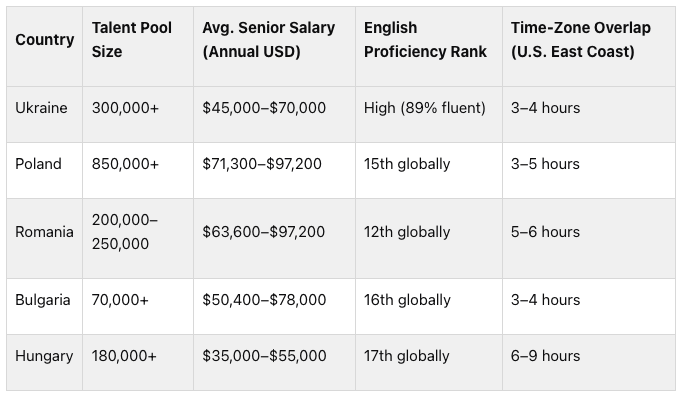
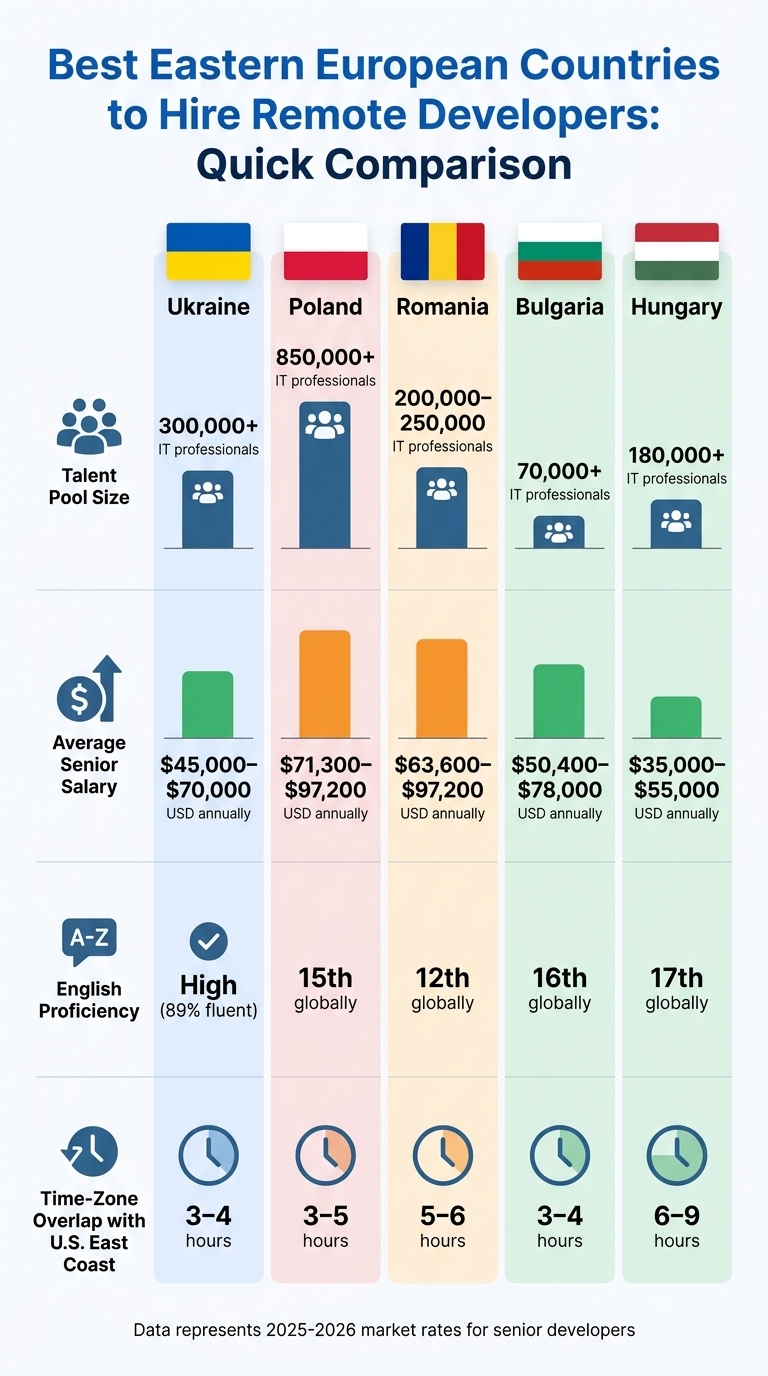
Each country offers unique strengths. For large talent pools and enterprise needs, Poland is a standout. Ukraine and Romania balance cost and expertise. Bulgaria and Hungary are great for budget-conscious hiring or niche skills.
Hiring from Eastern Europe gives you access to top-tier developers without breaking the bank. Whether you're scaling your team or looking for specific expertise, this region has options to match your goals.
Hiring from Eastern Europe gives you access to top-tier developers without breaking the bank. Whether you're scaling your team or looking for specific expertise, this region has options to match your goals.
1. Ukraine
Ukraine has become a standout choice for hiring remote developers, thanks to its strong technical foundation and cost advantages. Eastern Europe is known for its tech expertise, and Ukraine is a key player in the region. With a tech workforce of over 300,000 IT professionals, it holds the title of the second-largest tech talent pool in Eastern Europe [3]. Each year, the country produces between 23,000 and 31,500 IT graduates, with 97% earning bachelor's or master's degrees in STEM fields [3]. Ukrainian developers excel in critical areas like systems programming, cybersecurity, backend development, and AI/ML, where technical depth is essential.
Talent Availability
Ukraine's tech talent is concentrated in major hubs such as Kyiv (71,000+ developers) and Lviv (20,000+ developers) [3]. The demand for specialized skills is growing rapidly, as reflected in the 115% increase in AI and machine learning job vacancies in 2025 [3]. Despite facing geopolitical challenges, the IT industry has shown resilience, maintaining 96% of its client contracts through 2025 [3]. Infrastructure investments have also been a priority, with over 47,000 active Starlink terminals ensuring uninterrupted connectivity by the end of 2023 [3].
Cost-Effectiveness
Ukrainian developers offer a compelling cost advantage. Annual salaries for senior developers range between $45,000 and $70,000, mid-level developers earn $25,000 to $45,000, and junior developers make $15,000 to $25,000. In comparison, senior developers in the U.S. command $140,000 to $195,000 annually [3]. AI engineers in Ukraine average $69,000 per year, which is 15–16% lower than rates in Poland and Romania [4]. Additionally, most developers work as B2B contractors under a simplified 5% tax system, keeping costs competitive.
English Proficiency
Communication is another strength of Ukrainian developers, with 89% speaking English at a professional level [3]. More than half have Upper-Intermediate or Advanced proficiency [5]. Their communication style is often direct and results-focused, paired with a strong commitment to project success [6].
Time-Zone Alignment
Located in the UTC+2/3 time zone, Ukraine offers a 3–4 hour overlap with the U.S. East Coast [3]. This overlap ensures smooth collaboration, allowing for daily standups and quick responses during U.S. business hours. Such alignment makes real-time teamwork with U.S.-based teams seamless.
2. Poland
Poland boasts over 850,000 IT professionals, making it the largest tech talent pool in Central and Eastern Europe [7]. Each year, the country produces between 45,000 and 70,000 IT graduates from prestigious institutions like Warsaw University of Technology and AGH University of Science and Technology [7]. Polish developers consistently rank among the best globally - placing in the top 3 on HackerRank and within the top 6 worldwide [7]. This reputation has attracted major tech investments. For instance, Intel has committed to a $4.6 billion semiconductor facility near Wrocław for 2025–2026, and both Microsoft and Google operate billion-dollar cloud regions in Poland as of 2026 [7]. Poland’s thriving tech scene is supported by robust regional hubs and a dynamic ecosystem.
Talent Availability
Poland’s leading tech cities - Warsaw, Kraków, and Wrocław - are home to R&D centers for global tech leaders and a flourishing startup culture. In the first half of 2025, IT job postings surged by 68%, driven largely by investments in AI [8]. Polish developers are making strides in cutting-edge fields like generative AI, cybersecurity, and cloud-native architectures [7]. A notable example of Poland’s innovation is ElevenLabs, a startup that became a global leader in AI voice synthesis by 2026 [7]. Additionally, many senior engineers in Poland prefer fully remote B2B contracts due to their tax benefits and simplified legal framework [8].
Cost-Effectiveness
Hiring developers in Poland can result in considerable cost savings while maintaining high-quality output. Senior software engineers in Poland earn annual salaries ranging from $71,300 to $97,200, which is about 40–55% less than their U.S. counterparts [8]. A five-person Polish development team can save a company approximately $487,800 annually compared to a U.S.-based team [8]. Mid-level developers earn between $48,600 and $71,300 annually, while junior developers make around $26,000 to $39,000. For more advanced roles, tech leads and staff engineers earn $87,500 to $123,100 per year, while principal-level developers command salaries between $103,700 and $162,000 or higher [8].
English Proficiency
Poland ranks 15th globally in English proficiency, with IT professionals demonstrating near-native fluency [11].
This high level of communication aligns seamlessly with U.S. business practices, supported by a strong work ethic and a results-driven mindset [11].
Time-Zone Alignment
Poland operates on CET/CEST, providing a 3–5 hour daily overlap with the U.S. East Coast [8]. This overlap is ideal for coordinating activities like daily stand-ups, sprint planning, and code reviews during U.S. morning hours, ensuring smooth real-time collaboration without disrupting normal business hours.
3. Romania
Romania stands out as a hub for tech talent, with a developer pool estimated between 202,000 and 250,000 professionals [12][13]. It ranks first in Europe and sixth globally for the number of certified tech specialists per 1,000 inhabitants [13]. Major tech cities such as Bucharest, Cluj-Napoca, and Iași host over 7,290 software companies and 1,662 startups [13]. Romanian developers are highly skilled in languages like Java, JavaScript, Python, C++, and C#. They are also gaining traction in areas like AI, machine learning, cybersecurity, and fintech [12][13]. Notably, the software industry is expected to generate a turnover of €9 billion by 2025 [14].
Talent Availability
Romania continues to deliver a strong pipeline of skilled professionals. Each year, the country produces around 10,000 engineering and IT graduates [12][13]. Globally, Romania ranks third in the Best Developers World Ranking and 15th in the Index of Excellence in STEM fields [16].
A case in point: BigCommerce partnered with Alcor to expand in Eastern Europe, successfully hiring 30 developers in Romania within six months - a move that supported the company’s public offering [13]. Similarly, Tonic Health, a Silicon Valley-based company, ran an employer branding campaign in Romania and consistently onboarded 5–6 senior developers per month [13].
Cost-Effectiveness
Hiring developers in Romania can result in 50% to 70% cost savings compared to U.S. rates [15]. Senior developers in Romania earn between $63,600 and $97,200 annually - about 40% less than their U.S. counterparts [12][13][16]. For example, a senior DevOps engineer typically earns $60,000 to $81,600 per year, compared to $138,000 in the United States [12][13]. Mid-level developers earn between $35,000 and $40,000 annually, while junior developers make $20,000 to $26,000 [12][15]. Additionally, hiring from smaller tech hubs like Iași and Timișoara can be 5% to 10% cheaper than hiring in Bucharest [15].
English Proficiency
Romania leads Central and Eastern Europe and ranks 12th globally in English proficiency [13][18][19]. Approximately 70% of Romania’s IT workforce is fluent in English, with younger developers demonstrating particularly high levels of fluency [17].
Many developers also speak additional languages, such as German, French, Italian, or Spanish [18][19]. This multilingual capability, combined with strong English skills, supports seamless communication in international projects.
Time-Zone Alignment
Romania’s time zone (UTC+2/+3) offers a practical advantage for remote collaboration. It provides a 5–6 hour overlap with the U.S. East Coast, enabling real-time communication during U.S. morning hours for activities like stand-ups, code reviews, and sprint planning [15][1][19]. Additionally, Romania’s time zone aligns perfectly with Western European business hours, making it a strategic choice for companies operating across both regions [15][1].
4. Bulgaria
Bulgaria is becoming a standout option for remote hiring, boasting a tech workforce of around 70,000 software developers and over 2,400 software firms. These companies generate $900 million annually in outsourcing revenue [21][22]. The country ranks 18th globally in the Coursera 2023 Global Skills Report and is among the top 20 in Europe for IT expertise [20][21]. Global giants like IBM, SAP, and Microsoft have either development centers or strong ties to Bulgarian talent [21][22]. The ICT sector has seen explosive growth of 300%, reaching a value of €2.5 billion (about $2.7 billion) and contributing 5.5% to Bulgaria’s GDP [21]. Let’s explore the country’s talent pool, cost advantages, language skills, and time-zone compatibility.
Talent Availability
Bulgaria’s tech ecosystem is supported by an annual output of 3,000 ICT graduates from more than 50 universities specializing in STEM fields [21]. This steady stream of skilled graduates has solidified Bulgaria’s status as a growing tech hub in Eastern Europe. Developers here excel in JavaScript, Python, Java, cloud computing, AI, and fintech [21]. Impressively, 100% of Bulgarian software companies have embraced AI technologies as of 2024 [20]. While Sofia remains the central tech hub, cities like Plovdiv, Varna, Burgas, and Stara Zagora are gaining traction in the tech scene. Nadiia Kovalchuk, a Leading IT Recruiter at Huntly, highlights Bulgaria’s strengths:
"Bulgaria ranks 37th in the Global Startup Ecosystem Index 2024... mainly results from a robust Bulgarian digital infrastructure, diverse support programs, and highly skilled tech talent at competitive rates." [20]
Cost-Effectiveness
When it comes to salaries, Bulgaria offers a strong cost advantage. Senior developers earn between $50,400 and $78,000 annually, while mid-level developers make $27,600 to $60,000. Junior developers typically earn $12,000 to $36,000. Specialized roles, like senior DevOps engineers (AWS/Azure/GCP), command salaries of $62,400 to $72,000, and senior full-stack developers (.NET/Angular) earn $63,600 to $78,000 [20]. Software development costs in Bulgaria are 80% lower than California's and about 49% lower than Poland's [20].
English Proficiency
Bulgaria stands out for its language skills, ranking 16th globally in the EF English Proficiency Index 2024. This places it ahead of countries like France, Spain, and Italy [24]. In Sofia’s tech sector, over 80% of IT professionals are fluent in English [26], ensuring smooth communication with both U.S. and European teams.
Time-Zone Alignment
Operating on Eastern European Time (UTC+2/UTC+3 DST), Bulgaria offers a 3–4 hour morning overlap with the U.S. East Coast [1]. This overlap is ideal for real-time collaboration on tasks like standups, code reviews, and sprint planning.
5. Hungary
Hungary stands out as an excellent choice for remote hiring, thanks to its thriving tech industry and skilled workforce. With more than 180,000 IT professionals - representing about 3.9% of the national workforce - Hungary is home to over 700 tech vendors and 1,500 startups. These companies contribute $2.85 billion annually in ICT service exports. Ranked 5th on the IT Competitiveness Index (as per the Future of IT Report) and 17th globally in the EF English Proficiency Index, Hungary has attracted major corporations like Microsoft, Siemens, Ericsson, Nokia, and TATA, all of which have established R&D centers in the country. The digital economy plays a key role in Hungary's GDP, contributing between 6.7% and 10%, while the IT sector is expected to grow at an annual rate of 11.41%, reaching a projected market value of $60.4 billion by 2030 [27].
Talent Availability
Hungary's education system is a strong contributor to its tech talent pool, producing around 4,000 ICT graduates each year - a 135% increase since 2015. Prestigious institutions like the Budapest University of Technology and Economics and Eötvös Loránd University are at the forefront of this effort. Major tech hubs include Budapest, Debrecen, Szeged, and Gyor. Hungarian developers excel in JavaScript, HTML/CSS, and SQL, while expertise in TypeScript, Java, and Python is steadily growing. Additionally, tools like Redis, Microsoft SQL Server, and Apache Cassandra are gaining traction among developers [27].
These factors make Hungary a competitive destination for tech talent.
Cost-Effectiveness
Hungary offers a cost-efficient hiring environment. Senior developers earn between $35,000 and $55,000 annually, with a median base salary of approximately $49,001 [1][28]. Mid-level developers typically earn between $20,000 and $35,000 [29], and hourly rates range from $30–$40 for junior developers, $42–$62 for mid-level, and $56–$85 for senior developers [23][25]. Overall, development costs are 40–60% lower than in Western Europe and North America [29].
Hungary's tax structure further enhances its appeal. A 9% corporate tax rate and a flat 10% employer charge on salaries simplify payroll management [27][30]. The total annual employment cost for a median developer is approximately $59,536, making Hungary more affordable than countries like the Czech Republic and Croatia [28].
English Proficiency
Strong language skills are another advantage Hungary offers. Ranked 17th globally in the EF English Proficiency Index, Hungarian developers are well-equipped for collaboration with U.S. companies [27].
Many developers also speak German or French, which is particularly beneficial for partnerships in the DACH region [27][29].
Time-Zone Alignment
Hungary operates on Central European Time (UTC+1/UTC+2 DST), creating a 6–9 hour time difference with U.S. time zones [27][1]. This overlap allows for effective real-time collaboration during afternoons and supports seamless "follow-the-sun" development workflows. Additionally, Hungary ranks 2nd in emerging Europe for broadband speed, ensuring reliable infrastructure for remote work [27].
Pros and Cons
Eastern European countries offer a mix of benefits and challenges when it comes to building remote engineering teams. Deciding on the right location means weighing factors like talent availability, costs, and operational requirements. Below, we break down key aspects of each country, making it easier to compare their unique strengths and limitations.
Poland boasts the largest tech workforce in the region, with over 430,000 professionals. It ranks #3 globally for developer skills on HackerRank, making it a top choice for high-quality talent. However, this comes at a cost, as senior developer salaries range from $40,000 to $65,000 annually [1][34].
Ukraine stands out for affordability, with senior developers earning between $25,000 and $50,000 annually. Its talent pool includes about 285,000 specialists, known for their resilience and adaptability. That said, geopolitical risks and fewer Employer of Record options can pose challenges [1][2].
Romania offers a balanced option, excelling in areas like cybersecurity and backend development. It aligns with EU standards, including GDPR compliance, and senior salaries fall between $35,000 and $55,000 annually. On the downside, strict labor laws can complicate employee termination [1][36][10].
Bulgaria is an attractive choice for companies prioritizing cost efficiency. Its flat income tax system makes it appealing, although the talent pool is smaller, with around 70,000 developers [34][32].
Hungary specializes in fields like e-commerce and cybersecurity, supported by a talent pool of roughly 80,000 IT professionals. Senior salaries here are comparable to Romania, ranging from $35,000 to $55,000 annually [1][34].
All five countries offer moderate overlap with EST, making daily collaboration feasible. The table below provides a quick summary of the key metrics for each location:
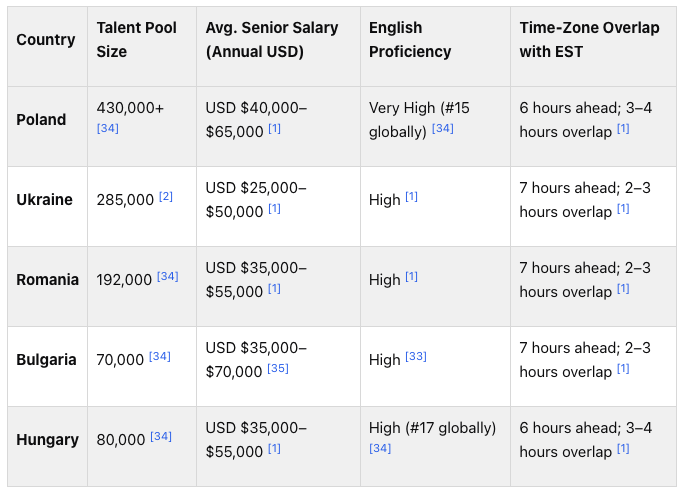
Your decision will depend on your specific goals. For enterprise-level resources, Poland is a strong contender. If cost savings are a priority, Ukraine delivers value despite potential risks. Romania offers a well-rounded option with EU compliance, while Bulgaria is ideal for budget-conscious hiring. Hungary, meanwhile, provides specialized expertise in niche sectors.
Conclusion
Eastern Europe stands out as a prime destination for U.S. companies looking to build remote engineering teams. The region combines technical expertise, cost efficiency, and time-zone compatibility, offering a compelling package for businesses. Poland leads with its expansive talent pool and enterprise-grade stability, albeit at slightly higher costs. Ukraine delivers exceptional skills in AI and cybersecurity at competitive rates, even while navigating regional challenges. Romania offers a balanced mix of EU compliance and strong English proficiency, while Bulgaria and Hungary cater to niche needs for companies with tighter budgets.
The cost savings compared to U.S. rates are substantial, all while maintaining comparable skill levels. As Lenar Mukhamadiev, CEO of iDelsoft, puts it:
"Eastern Europe in 2026 is defined by engineering depth, delivery governance, and strategic capability".
iDelsoft makes accessing this talent pool seamless by offering pre-vetted developers across more than 150 technologies. Their approach removes the hurdles of international hiring, such as legal complexities, compliance issues, and time-consuming vetting processes. By leveraging iDelsoft, companies can quickly align with dedicated engineering teams that match their time zone and business goals.
Ultimately, your choice will depend on your specific needs - whether it’s Poland’s stability, Ukraine’s cost-effectiveness, Romania’s EU compliance, or Bulgaria and Hungary’s specialized skills. iDelsoft ensures that tapping into these markets is straightforward, allowing you to access the right talent without the usual operational headaches. With this combination of expertise, affordability, and collaboration, Eastern Europe remains a top contender for building remote engineering teams.
FAQs
Which country is best for my tech stack?
The ideal country for your tech stack hinges on what matters most to your business - whether that's technical skills, budget, or the size of the talent pool.
- Poland: Known for its well-established and sizable developer community, Poland is a great choice for handling complex and large-scale projects.
- Estonia: If cutting-edge digital infrastructure is a top priority, Estonia's forward-thinking tech ecosystem makes it a strong contender.
- Ukraine and Romania: For those focused on cost-effectiveness, both countries offer highly skilled STEM professionals at competitive rates.
Weigh these factors carefully to find the right match for your project's unique requirements.
How do I handle contracts, payroll, and compliance?
Hiring remote developers in Eastern Europe comes with its own set of challenges, especially when it comes to managing contracts, payroll, and staying compliant with local labor laws. This is where an Employer of Record (EOR) can make a big difference. An EOR serves as the legal employer on your behalf, taking care of employment contracts, processing payroll, and ensuring compliance with local regulations. By outsourcing these administrative and legal responsibilities, your company can streamline international hiring and focus on its core operations without worrying about navigating complex regional requirements.
What hiring model works best (contractor vs employee)?
The ideal hiring model depends on what your company needs most. If you're looking for stability and compliance - especially in areas like Eastern Europe - hiring developers as employees through an Employer of Record (EOR) is often the better choice. This approach ensures legal adherence and provides a more secure arrangement for long-term goals.
On the other hand, contract models can be a good fit when flexibility and cost savings are priorities. However, they often come with potential legal and compliance challenges. For ongoing stability and legal peace of mind, the employee model is usually the safer bet. Meanwhile, contract arrangements work best for short-term assignments or highly specialized projects.
Looking to scale more efficiently? Connect with iDelsoft.com! We specialize in developing software and AI products, while helping startups and U.S. businesses hire top remote technical talent—at 70% less than the cost of a full-time U.S. hire. Schedule a call to learn more!
