


The Hidden Cost of Hiring Engineers Too Slowly
If your engineering hiring process drags, you pay for it in product delays, team strain, and lost candidates. We at iDelsoft would sum it up like this: when a role stays open too long, shipping slows, burnout risk goes up, and top engineers often accept another offer before your team makes a decision.
Slow hiring is not just a recruiting issue. It becomes a product and revenue issue fast. The article shows where the time gets lost, what that delay costs, and which process changes help teams cut wasted days while keeping hiring standards in place.
Slow hiring is not just a recruiting issue. It becomes a product and revenue issue fast. The article shows where the time gets lost, what that delay costs, and which process changes help teams cut wasted days while keeping hiring standards in place.
The Real Cost of Slow Hiring Processes
The Hidden Costs of Slow Engineering Hiring
Most hiring teams keep a close eye on recruiter fees and job board spend. But there’s another cost that often slips by: what an open engineering seat is costing the business every day it stays unfilled.
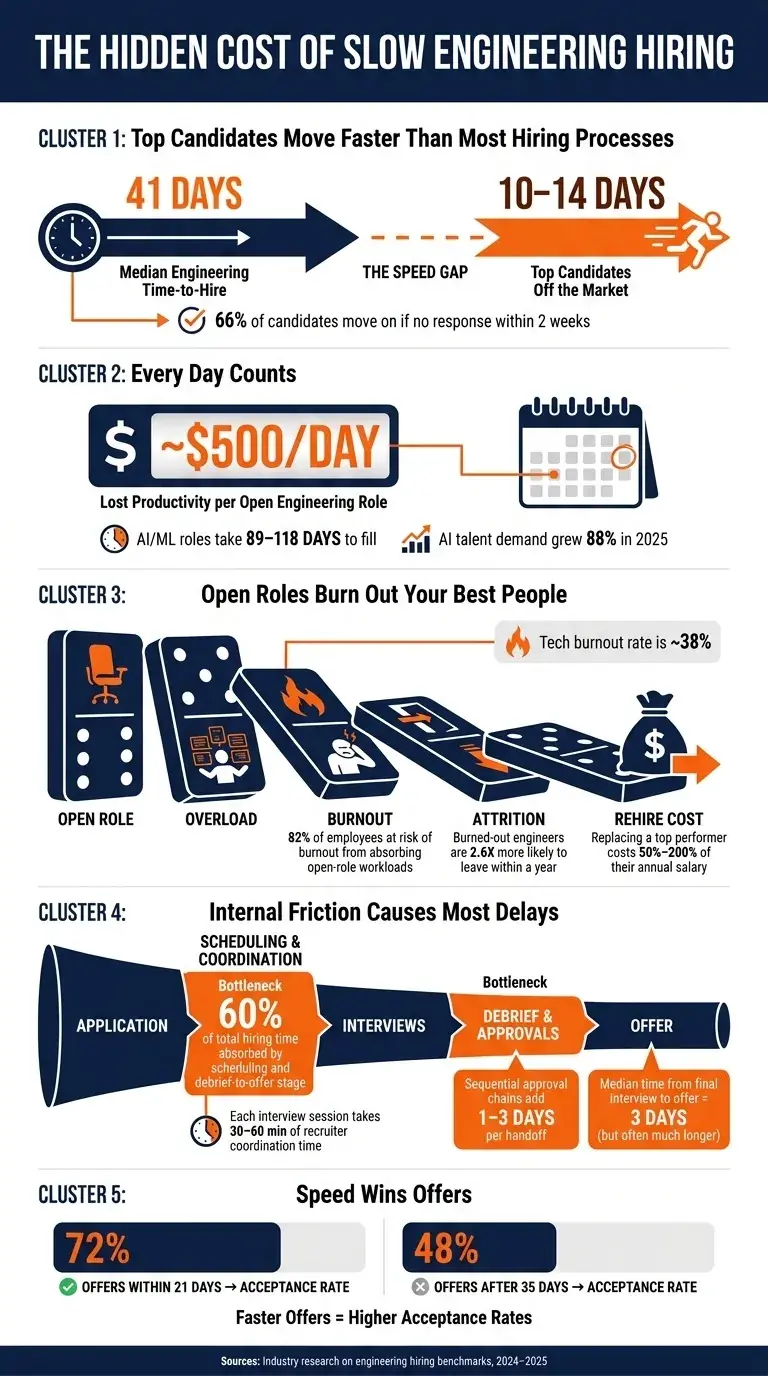
A vacant engineering role can cost about $500 per day in lost productivity, and senior roles can cost much more once delayed delivery and missed revenue are part of the picture [2][3].
Those costs tend to hit in three areas:
- Delivery delays - open roles push releases back and let market chances pass by before the team can move
- Team strain - overloaded engineers burn out and leave, which kicks off another expensive hiring cycle
- Technical debt - quick fixes used to cover staffing gaps slow future development and pile up over time
Open roles slow down releases and build up technical debt
When an engineering role stays open, teams don’t just move a little slower. They start shifting into survival mode. Engineers spend time patching holes instead of shipping planned work, and senior leads get dragged into day-to-day coverage instead of focusing on architecture and code quality.
That tradeoff adds up fast. Managing technical debt becomes harder as it grows 15% to 20% annually in understaffed teams [7]. Week by week, that drag makes delivery slower and future work harder.
Your current team absorbs the gap and starts to break down
The work doesn’t disappear when a seat is empty. The rest of the team takes it on: more on-call shifts, more rushed code reviews, and more context switching.
That kind of load has a cost. 82% of employees are currently at risk of burnout from absorbing workloads tied to open roles, and in tech, burnout rates are around 38% [3]. Once people hit that point, retention gets shaky. Burned-out engineers are 2.6 times more likely to leave within a year [3].
And then the bill gets even bigger. Replacing a top performer can cost 50% to 200% of their annual salary when you factor in knowledge loss, team disruption, and re-hiring [6].
Slow decisions cost revenue and drive away strong candidates
Hiring delays don’t stay stuck in HR dashboards. They show up in the business. Companies dealing with hiring difficulties can see a 3% drop in profits and a 5% reduction in sales [2][3].
The candidate side moves just as fast. 66% of candidates will move on if they don't hear back within two weeks [2]. By the time a slow process wraps up, the best people are often already gone.
And that damage doesn’t stop with one role. A sluggish process can hurt referrals and shrink the pool for the next hire too.
The result is plain: slower shipping, weaker teams, and lost candidates.
Where Engineering Hiring Gets Stuck
Most hiring delays don’t come from a weak candidate pool. They come from internal friction. And the pattern is pretty predictable.
The slowdown usually starts in three spots: defining the role, running assessments, and making the final call. When those stages drag, the cost shows up fast - slower releases, more pressure on the team, and more candidates slipping away.
Vague role definitions and missing scorecards
When a job description tries to please everyone, it often pushes strong candidates away before they even apply [5]. The requirements list grows into a wishlist, and by the time interviews begin, the team still hasn’t lined up on what “good” means.
Missing scorecards make that problem worse. If there’s no set criteria, interviewers lean on gut feel. That’s shaky ground, especially when interviewers forget about half the behavioral detail within 24 hours [8]. Once feedback gets fuzzy, teams often react by adding more interview rounds. It feels like caution, but it doesn’t add much signal. It just stretches the process.
A vague role at the start tends to weaken every step that comes after it.
Once the role is nailed down, the next choke point is usually assessment length and interview scheduling.
Long assessments and slow scheduling between interviews
Take-home tests are a major drop-off point in engineering hiring. If an assessment runs longer than 4 hours - or just feels disconnected from the actual job - senior candidates often walk away [5][1]. That shrinks the final pool, and not in a good way.
Then there’s scheduling. This is where a lot of teams lose time without noticing it. Roughly 60% of total hiring time gets absorbed by interview scheduling and the debrief-to-offer stage [8]. On top of that, each interview session can take 30 to 60 minutes of recruiter time just to coordinate [8].
So even when the interview itself is fine, the process around it can drag like wet cement.
Even after a candidate performs well, one more bottleneck can stall the whole thing: the final decision.
Slow final decisions after the final interview
This is often where momentum fades. The median time from final interview to extended offer is 3 days [4]. But at slower companies, sequential approval chains can tack on 1 to 3 days per handoff [1].
That delay has a direct cost. Candidates who get offers within 21 days accept at a 72% rate. If the process stretches past 35 days, the acceptance rate drops to 48% [8].
That means a few extra business days of internal debate can decide whether you land a strong hire - or end up reopening the search.
How to Cut Time-to-Hire Without Cutting Standards
Those delays are fixable. The goal isn't to lower the bar. It's to tighten each step so the process moves faster while hiring quality stays high.
Use structured scorecards and set SLAs for each hiring stage
A scorecard sets the definition of "good" before the first resume even shows up. For engineering roles, that means laying out the exact criteria you want to assess and leaving space for written proof, not just a score.
That written feedback matters. It pushes interviewers to say what they saw instead of tossing out a vague rating. And when notes are clear, debriefs move faster and are less likely to slide into opinion-based back-and-forth.
Then add interview SLAs. A 48-hour window for recruiter screens and a same-day debrief after the final round can make a big difference. The same-day debrief is the one many teams miss. Within 24 hours of an interview, interviewers lose roughly 50% of the behavioral detail needed for an accurate evaluation[8]. Waiting three days doesn't add signal. It just slows the decision.
Once the rubric is locked in, the next move is to trim the evaluation itself.
Replace long take-home tests with focused technical assessments
The answer isn't skipping technical evaluation. It's making it tighter and closer to the work.
A live interview loop that stays under three hours total can do the job well:
- A 30-minute technical screen
- A 60-minute pair-programming session
- A 45-minute system design discussion[1]
That's enough signal to make a confident call without draining the candidate or your team.
Pair programming is especially useful because it shows how someone thinks, communicates, and works with another person in real time. A take-home test can't show that nearly as well. A shorter and more relevant process also helps keep strong candidates engaged and cuts the load on your team for every open role.
Then it becomes a scheduling problem. If strong candidates sit between rounds, interest fades.
Speed up sourcing and vetting with repeatable workflows and pre-vetted talent pods
A lot of hiring delay comes down to calendar friction. Pre-blocking interviewer calendars with 2–3 recurring slots per week before a role even opens helps cut that friction and reduce the 11-day median lag between interview stages[4]. Auto-scheduling links for next steps, booked before the current call ends, can trim another 3–5 days of back-and-forth[1].
For teams that need to move faster than a standard hiring loop allows, iDelsoft's pre-vetted talent pods can compress sourcing from weeks to as little as 72 hours[4]. And if compensation bands are approved before the role opens, candidates are less likely to stall out in final negotiation. That keeps the close moving at the same pace as the rest of the process[9].
Build a Hiring Process That Stays Fast Over Time
One fast hire is easy. Building a fast hiring process that stays fast is the hard part.
The fixes above only stick when they become part of how your team works every time a role opens, not just when someone notices things have slowed down. Once the weak spots are clear, the team can assign owners and fix them step by step.
The metrics and ownership model that keep hiring on track
Start by measuring where time gets lost. Track median time-to-hire and time-in-stage to spot where candidates are waiting. Median cuts down outlier noise, and time-in-stage shows the pauses between steps.
A few other metrics are worth watching too:
- Offer acceptance rate by days-to-offer: See how acceptance changes based on how fast the offer goes out.
- Stage drop-off rate: If you see a sharp drop at the technical assessment, that usually means the assessment is too long or the criteria aren't clear.
- On-time completion rate: Track whether screeners and interviewers are meeting their 48-hour screening and feedback deadlines. [1][10]
Metrics alone won't fix anything. Each stage needs one clear owner. That means one named person is responsible for hitting that stage's SLA. If a deadline slips, that person should deal with it the same day.
That’s how a process stays fast over time: the rules are built into every new search, not treated like a one-off push.
Key takeaways for founders and engineering leaders
Slow hiring is a workflow problem, and it has a real P&L cost. Most delays come from gaps you can fix: vague role definitions, blocked calendars, late feedback, and offer approvals sitting in a queue.
Speed and quality don't have to fight each other. Structured scorecards protect the technical bar. Focused assessments give you the signal you need without dragging things out. Pre-cleared compensation bands remove delays at the offer stage. And when sourcing support like iDelsoft's pre-vetted talent pods is already in place, you can get qualified engineers ready in as little as 72 hours.
Use scorecards, SLAs, shorter assessments, and pre-cleared compensation to keep roles from dragging. Add fast sourcing to the mix, and hiring speed is much less likely to fade over time.
FAQs
What is a good time-to-hire for engineers?
The median time-to-hire for software engineers is 41 days. But that’s not the mark to aim for if you want strong candidates.
Top-tier candidates are often off the market within 10 to 14 days. That’s why high-performing teams usually close hires in 14 to 21 days.
The goal isn’t to rush interviews or squeeze people through too fast. It’s to cut dead time between steps, especially around scheduling and final decisions. That’s where deals often stall.
A structured 3-stage process helps remove bottlenecks and keeps things moving without turning the hiring experience into a scramble.
How can we speed up hiring without lowering the bar?
Speed up hiring by taking friction out of the process, not by lowering the bar.
Start by setting evaluation criteria upfront. Use scorecards and structured interview guides so everyone is judging candidates against the same standards. That cuts down on back-and-forth, second-guessing, and repeated interviews that don’t add much.
You can also use asynchronous screening to trim scheduling delays. Instead of trying to line up calendars for every early-stage conversation, let candidates respond on their own time and move the right people forward faster.
Then put your energy into the steps that tell you the most. Relevant work samples and structured interviews tend to give clearer signals than extra rounds that repeat the same ground.
One more place teams get stuck: offer approvals. Let hiring managers make offer decisions within pre-defined compensation bands, so they don’t have to wait for several layers of sign-off before moving.
Which hiring stage causes the biggest delays?
The biggest slowdowns usually show up in interview scheduling and in the gap between the final debrief and the offer. Put those two stages together, and they make up about 60% of total hiring time.
That’s the part many teams miss. The actual evaluation often takes just 6 to 8 hours. Most of the waiting comes from calendar conflicts, internal approvals, and decision bottlenecks between stages.
Looking to scale more efficiently? Connect with iDelsoft.com! We specialize in developing software and AI products, while helping startups and U.S. businesses hire top remote technical talent — at 70% less than the cost of a full-time U.S. hire. Schedule a call to learn more!
14.10.2026
See also
