


Latin America Engineering Salary Data 2026
Latin America Engineering Salary Data 2026
If we at iDelsoft need the short answer, here it is: Latin America still gives U.S. companies a much lower engineering cost base in 2026, but senior pay is getting tighter. Senior engineer demand in the region was up 34% year over year in Q2 2026, and the highest salary pressure sits in senior, DevOps, and AI roles.
If we were planning a team today, we’d use this page for three things:
- Set budget bands fast
- Compare six main hiring markets
- Match pay by role and seniority before making offers
The salary picture is simple:
- Junior engineers: about $18,000 to $45,000
- Mid-level engineers: about $35,000 to $85,000
- Senior engineers: about $60,000 to $130,000
- Average savings vs. U.S. hiring: about $139,250 per engineer per year
The main country split is also clear. Argentina and Colombia usually come in lower. Mexico, Brazil, Chile, and Uruguay tend to sit higher, especially for senior hires in large cities. And the main role split is just as clear: QA is often the lowest-priced track, while AI and DevOps sit near the top.
Quick comparison
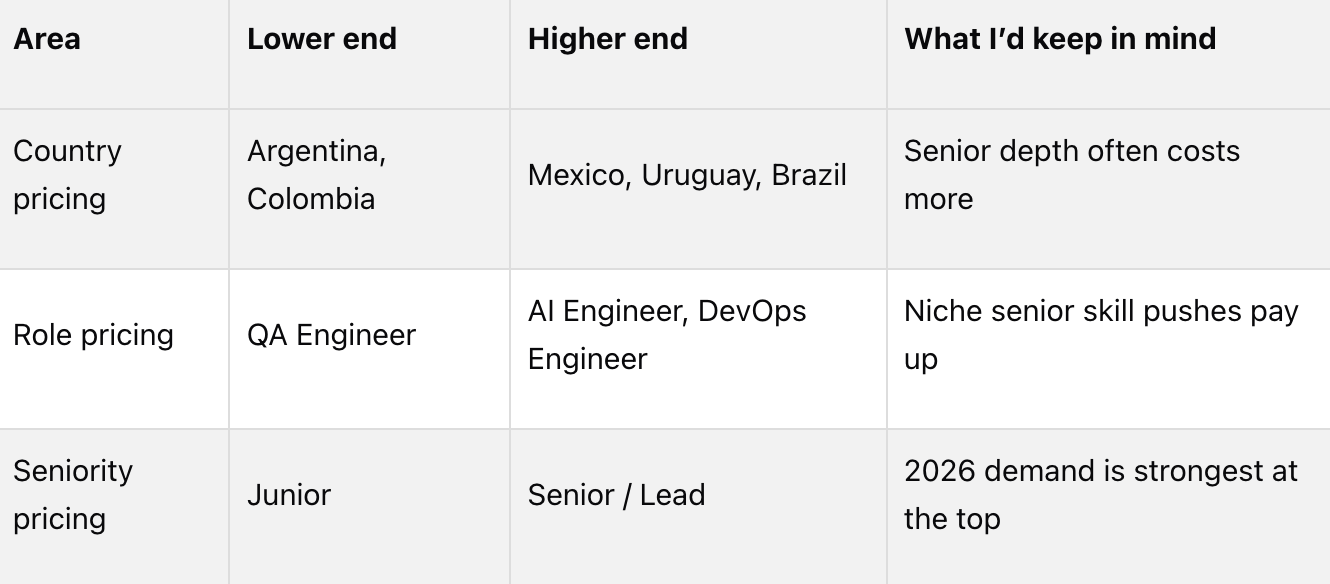
Our takeaway: if you want to hire in Latin America in 2026, the best move is to treat salary data as a team-planning tool, not just a pay chart. Start with country budget limits, then narrow by role, then price harder for senior talent.
That’s the core of this report.
Regional Salary Benchmarks for Engineering Roles
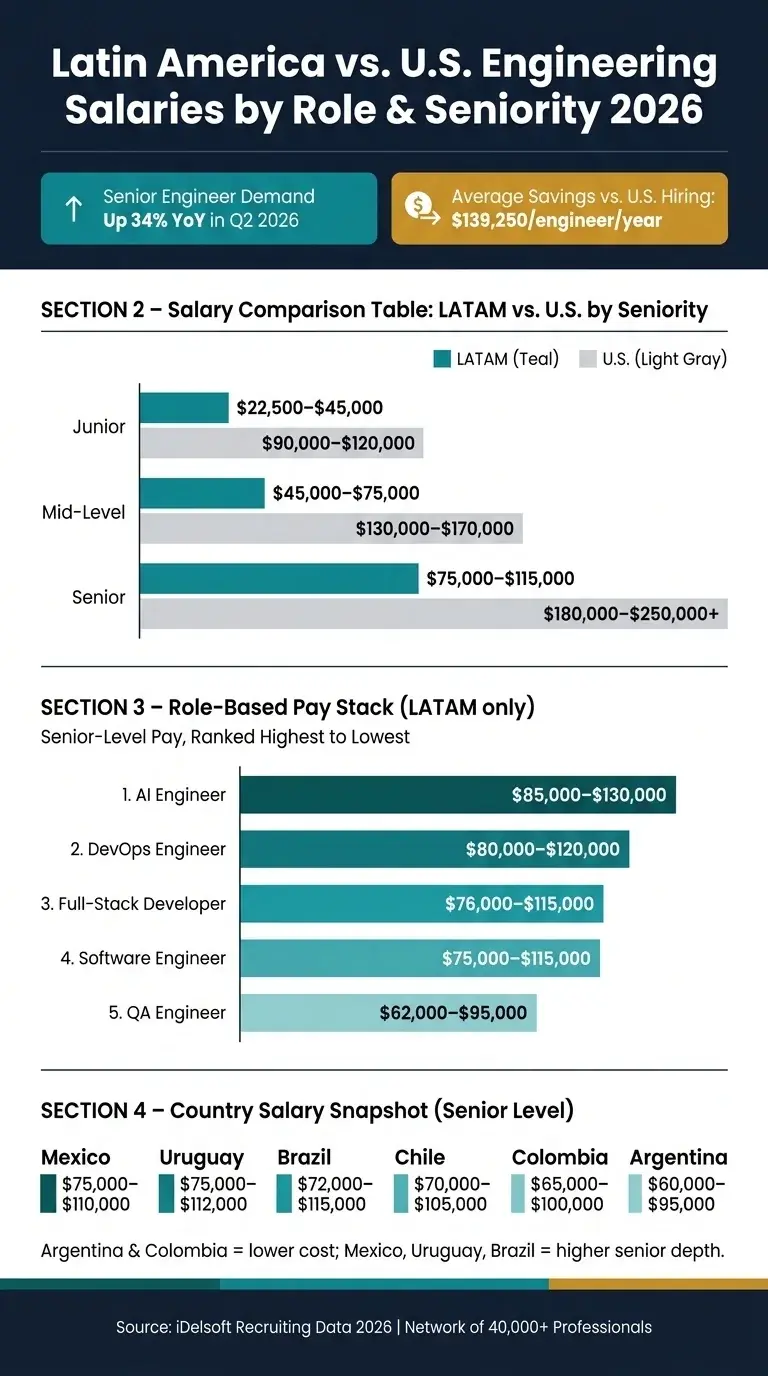
Latin America vs. U.S. Engineering Salaries by Role & Seniority 2026
Software Engineer Salary Baseline by Seniority
The table below shows the regional baseline for software engineers across Latin America in 2026. Treat these ranges as the starting point for the role comparisons that follow.
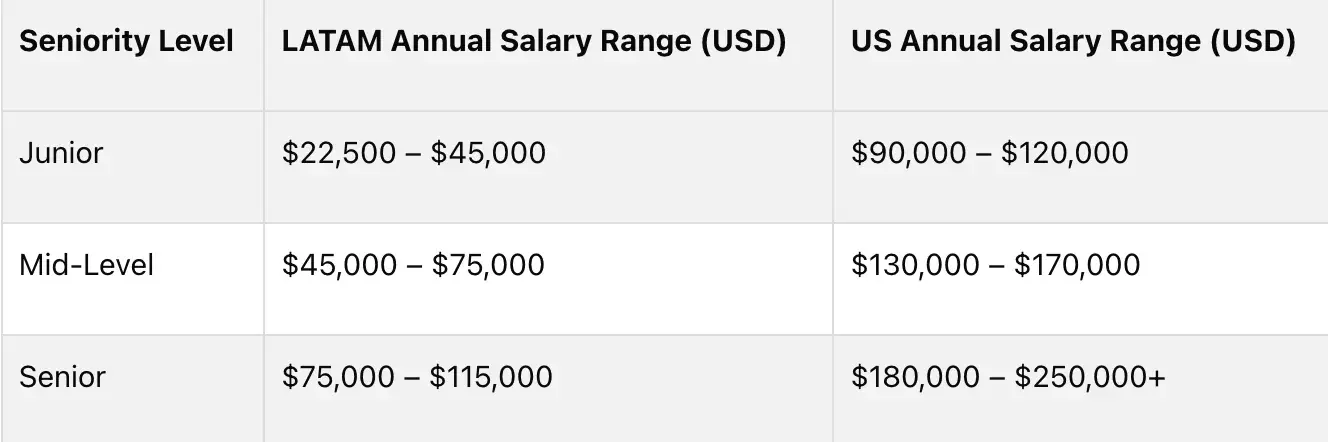
One pattern stands out fast: pricing pressure is strongest at the senior end of the market [1]. Companies are putting more weight on senior and mid-level engineers, while entry-level hiring has dropped hard [1].
"The market now favors engineers who can ship end to end with little oversight [1]."
That quote gets to the heart of it. Teams don't just want extra hands. They want people who can step in, own the work, and move it across the finish line.
Use this baseline when reading the next section's role-by-role pay differences.
How DevOps, QA, Full-Stack, and AI Pay Compare
Use software engineer pay as the baseline for the role comparisons below. Demand is highest for senior talent, especially AI-fluent engineers and AI-native QA profiles [1]. That's a big reason AI-fluent and senior-specialist roles sit at the top end of the pay stack.
Next, compare how each role prices against this baseline. The next section breaks these benchmarks down by country.
Engineering Salaries by Country: Mexico, Brazil, Argentina, Chile, Colombia, and Uruguay
Pay across these countries tends to vary less by job title and more by market depth and the supply of senior talent.
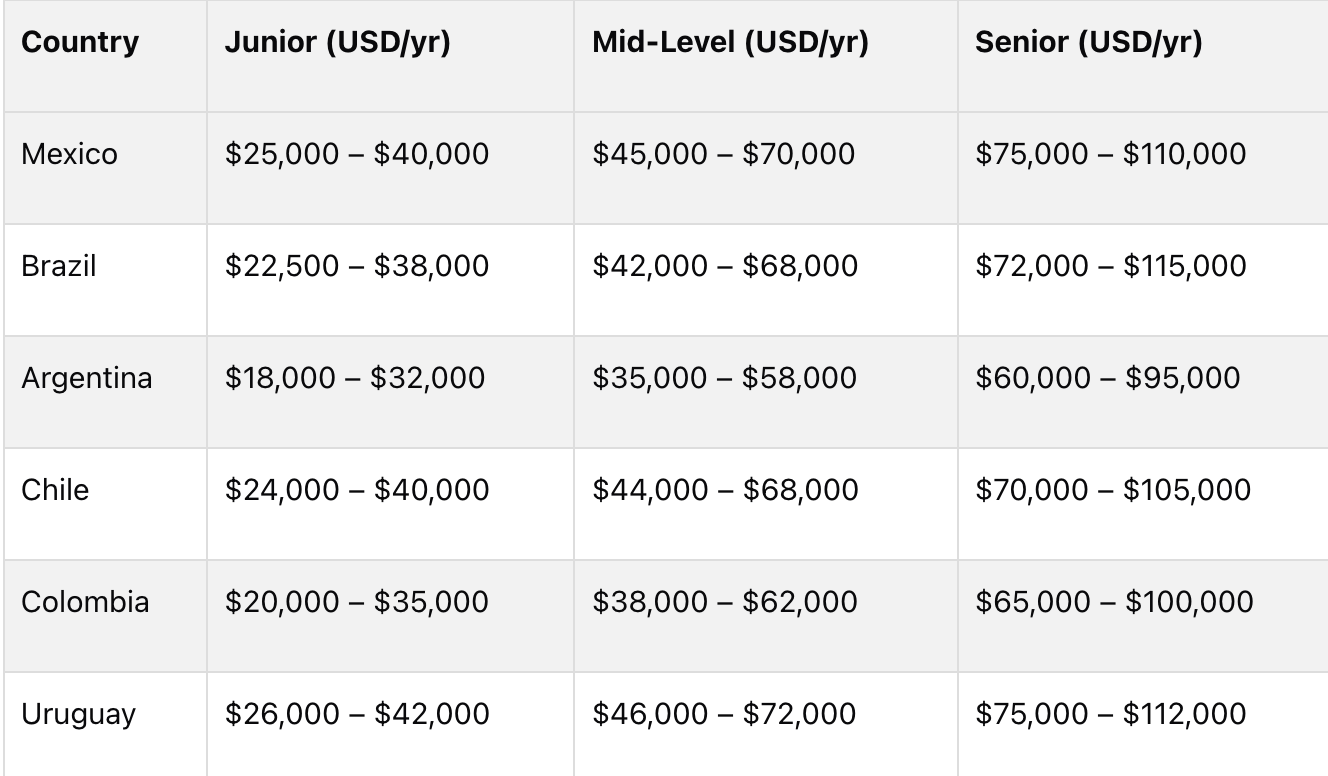
Country-by-Country Salary Comparison Table
Mexico, Brazil, Argentina, Chile, Colombia, and Uruguay each land at different price points based on senior talent depth, hiring demand, and currency conditions.
What Drives Salary Differences Between Countries
In 2026, pay shifts mostly based on local demand, senior-talent supply, currency swings, and English fluency. Higher-cost markets like Mexico City, São Paulo, and Montevideo tend to have deeper pools of senior talent and stronger English skills. That usually puts more upward pressure on pay.
Argentina and Colombia often come with lower senior-salary pressure. But there’s a catch: currency volatility in Argentina can make planning harder, especially if you’re setting annual budgets or making long-term offers.
Which Markets Fit Different Hiring Budgets
Once you know the country ranges, the next step is simple: match them to your budget. Higher budgets usually line up better with senior-heavy hubs. Tighter budgets often work better in markets where senior pay is lower.
The main tradeoff is pretty clear: senior depth versus cost. If your team needs to move fast, a smaller group of senior engineers and a shorter hiring cycle can make more sense than trying to build a large team all at once.
Use these country differences to balance seniority, speed, and cost before you make offers. Start with these ranges as your budget ceiling, then narrow from there by role and seniority.
Salary by Role and Seniority for Hiring Decisions
Once you’ve set country budgets, the next step is simple: narrow your offers by role and seniority.
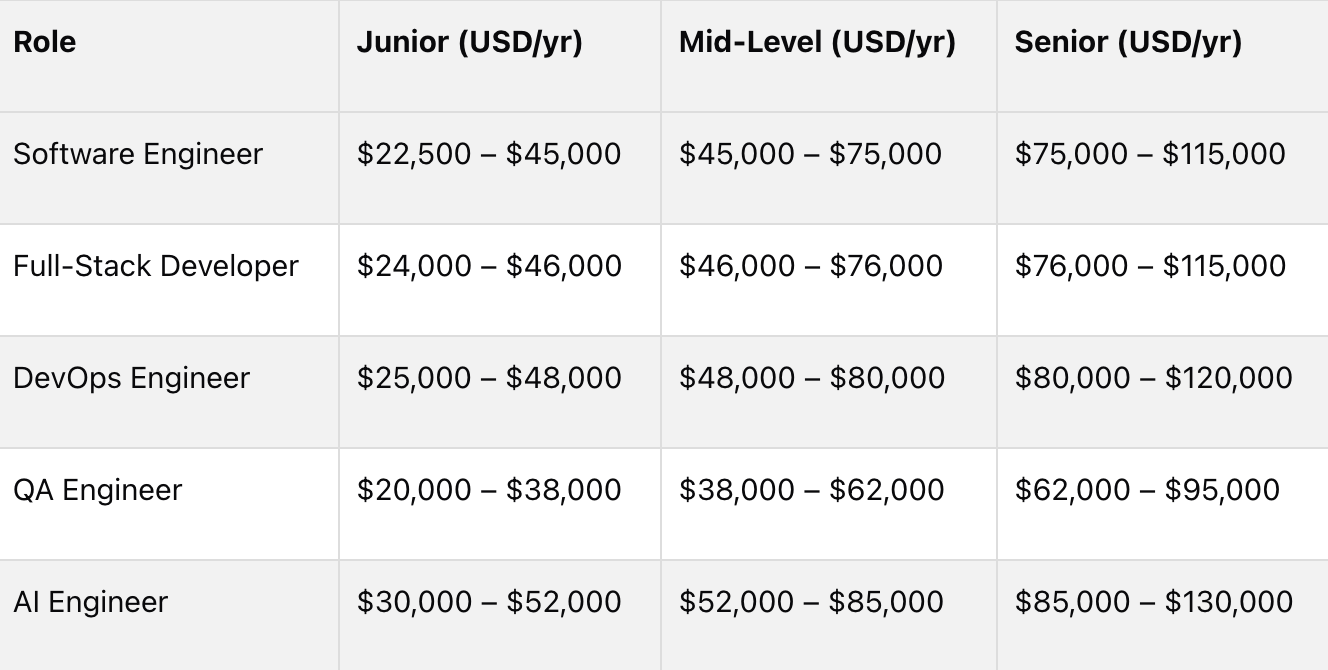
Role-Based Salary Benchmarks
The table below shows pay ranges for five core engineering roles across junior, mid-level, and senior levels. One thing stands out right now: AI tool fluency should be listed in job specs. It’s become a core signal of how much work someone can get done.
Use the role mix below to turn those hiring signals into clear offer ranges.
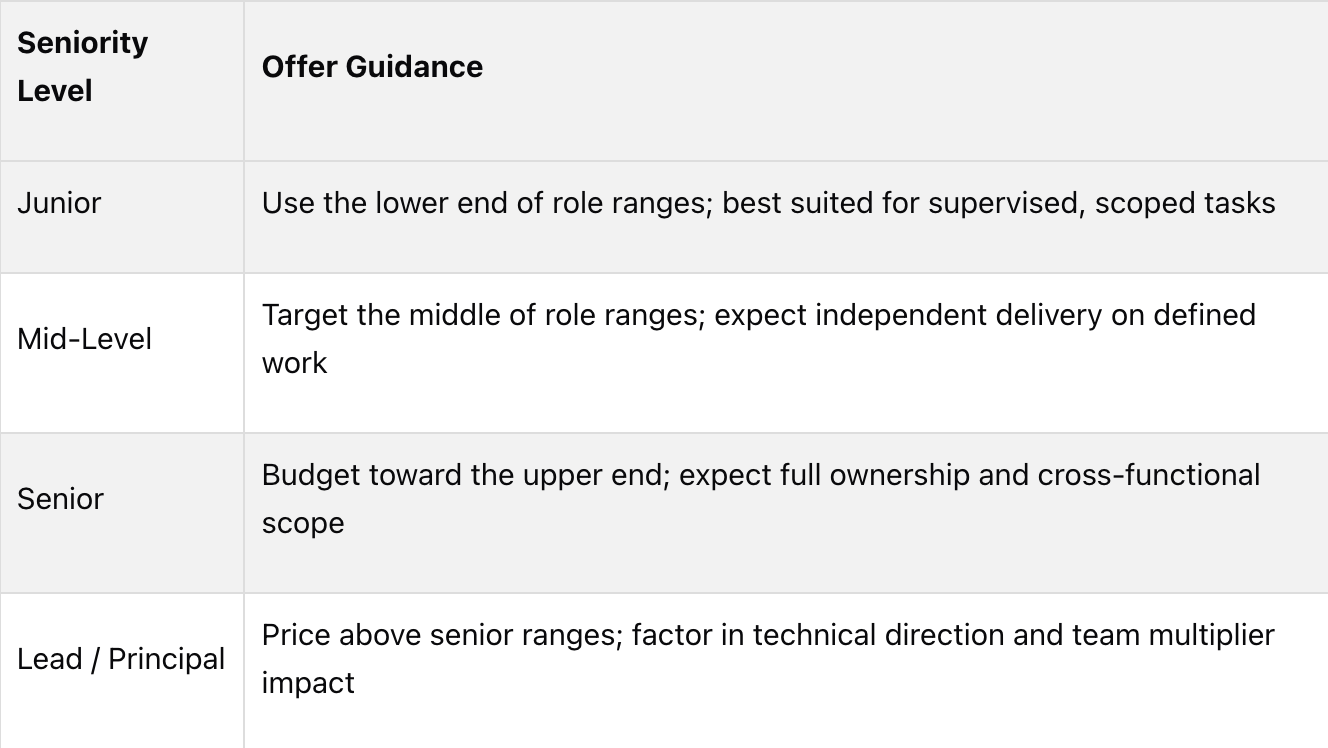
Seniority Planning: Junior to Lead/Principal
Seniority is about ownership, scope, and decision-making, not just time on the job. That matters a lot when you’re setting pay bands. Employers are putting more weight on senior talent, with senior LATAM engineer requests up 34% year over year as of April 2026 [1].
Using the Data for Offers, Budgets, and Team Mix
This data is most useful when you treat it as a headcount planning tool, not just a salary chart. In plain terms, the question isn’t only “What should we pay this person?” It’s also “What kind of team can we build with this budget?”
For example, hiring two strong senior LATAM engineers can often deliver better value than hiring one U.S.-based senior plus two juniors [1]. That difference gives you room to shape a deeper bench, add more ownership, and reduce the drag that comes with heavy supervision.
Use the country ranges above as your ceiling, then adjust from there based on role and seniority.
Methodology, Data Notes, and Key Takeaways
Methodology and Data Definitions
These ranges are directional. This section shows how they were put together.
All figures in this report are annual salary ranges in U.S. dollars. The data comes from iDelsoft recruiting records and a network of 40,000 professionals across Latin America, the U.S., Europe, and MENA [1].
Key Takeaways for 2026 Hiring Plans
The data shows one clear hiring pattern for 2026: demand is concentrated in mid-level and senior roles, which keeps salary pressure highest at the top of the band.
Use these ranges to set offer bands and plan budget by role and seniority.
FAQs
How should I adjust salary ranges for remote offers?
Use current regional benchmarks - about $30,000 to $100,000 per year, depending on the role, seniority, and country - and plan for a 10% to 15% increase by Q4 2026 as talent supply gets tighter.
For remote hiring, it often makes sense to offer pay in U.S. dollars when inflation or currency swings are a concern. You can also make the offer more attractive with perks like home-office stipends, professional development budgets, and paid time off.
Which Latin American country is best for senior engineering hires?
It comes down to what you need from the hire.
If you're after strong English skills and senior technical talent, Argentina often stands out, especially for work in AI and blockchain. If your main goal is scale, Brazil has the largest talent pool in the region.
For U.S. time zone overlap and smoother day-to-day alignment, teams often lean toward Mexico City, Medellín, and Buenos Aires. And if you're looking for more specialized senior talent, Argentina, Chile, and Peru are often on the shortlist.
What should I include beyond base salary in my budget?
Beyond base salary, set aside money for hiring costs too. Those often land between 15% and 25% of annual salary. If you're hiring people directly, add the day-one basics: equipment, home-office stipends, software licenses, and hardware.
It also helps to budget for the less obvious items that can sneak up on you later. That includes:
- Security
- Legal counsel for IP and contractor classification
- Possible currency hedging
- Retention support, such as career development, training, and cultural training
Miss these line items, and the total cost can look a lot different from what you first expected.
Looking to scale more efficiently? Connect with iDelsoft.com! We specialize in developing software and AI products, while helping startups and U.S. businesses hire top remote technical talent—at 70% less than the cost of a full-time U.S. hire. Schedule a call to learn more!
24.09.2026
See also
