


How to Evaluate Founding Engineers for Startups
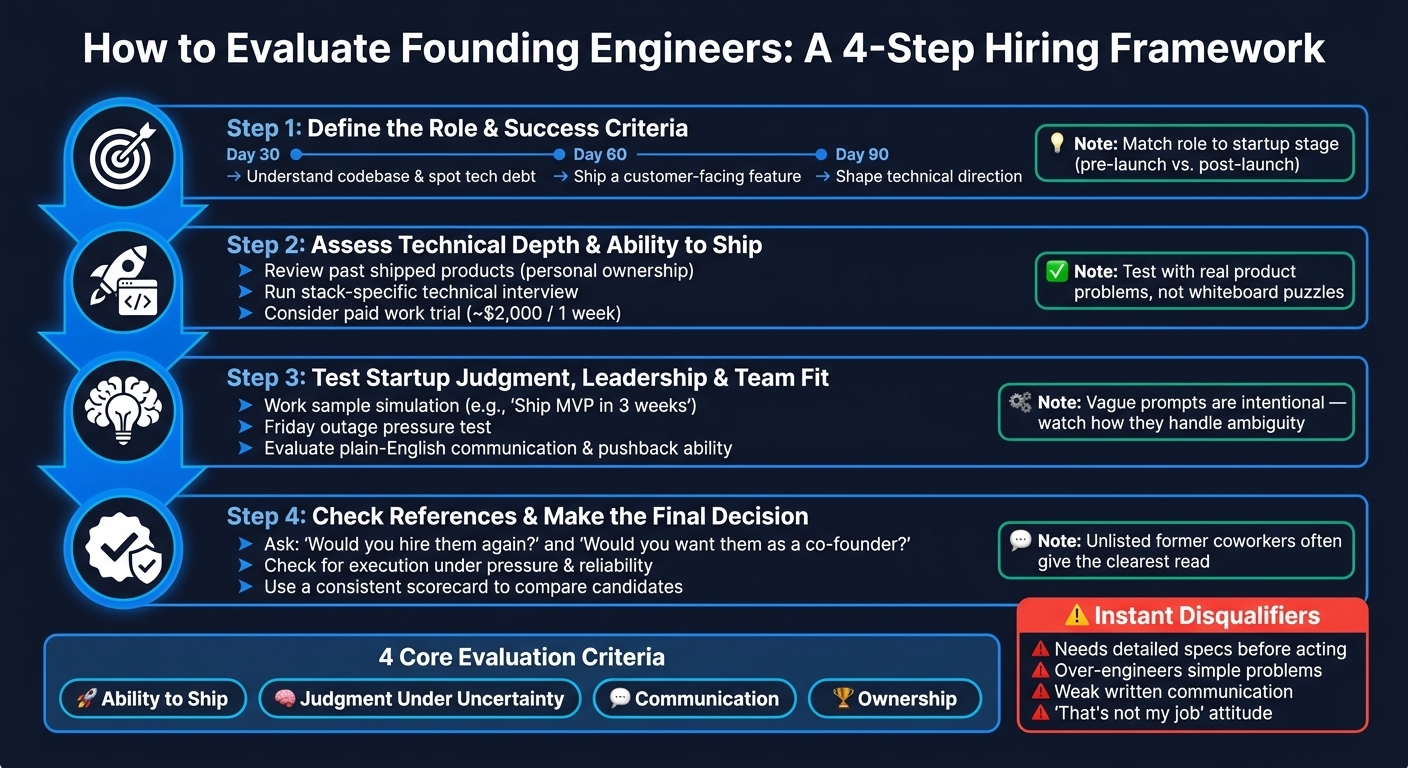
Hiring the wrong founding engineer can slow your startup for months. If we at iDelsoft were making this hire, we’d judge candidates on four things: ability to ship, judgment under uncertainty, communication, and ownership.
A founding engineer is not just another senior software engineer. They often help set the first engineering habits, ship early product work, and make trade-offs with little structure. In many startups, one early hire can shape months of product speed, code quality, and team norms, though some founders find benefits in IT staff augmentation to bridge early gaps.
A founding engineer is not just another senior software engineer. They often help set the first engineering habits, ship early product work, and make trade-offs with little structure. In many startups, one early hire can shape months of product speed, code quality, and team norms, though some founders find benefits in IT staff augmentation to bridge early gaps.
Being a founding engineer at an AI startup
Quick comparison
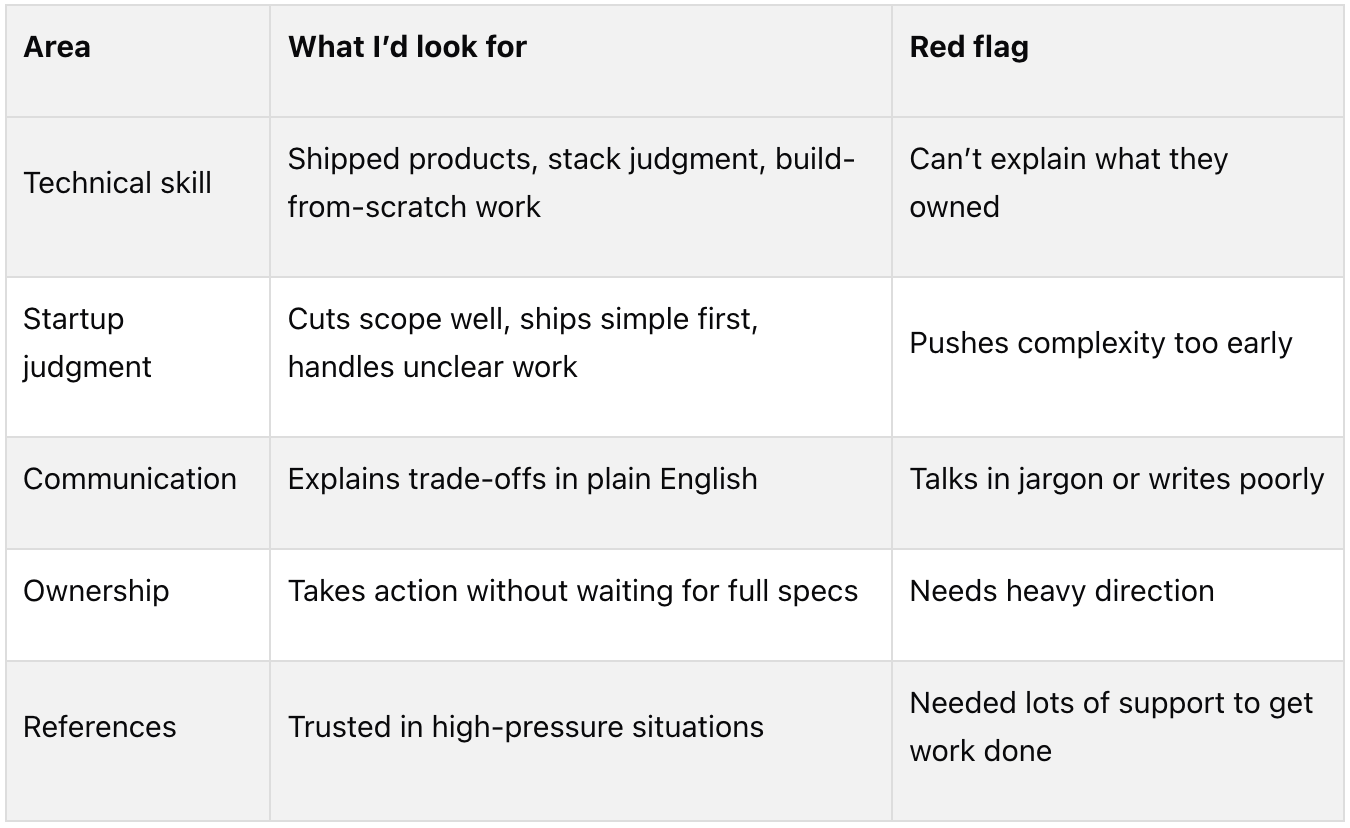
If we had to sum it up in one line, it would be this: hire the person who can turn vague ideas into working product without making your startup heavier than it needs to be.
Step 1: Define the Role and Success Criteria Before You Start Interviewing
Before you talk to candidates, get clear on what success looks like at 30, 60, and 90 days. That gives you a steady hiring bar and helps you screen for startup ownership, not just a polished senior title.
Be specific. By Day 30, the person should understand the codebase, spot technical debt, and set up core workflows. By Day 60, they should take a meaningful customer-facing feature from start to finish. By Day 90, they should help shape technical direction and make sound trade-offs.[2][1]
From there, tie the role to your startup’s stage.
Match the Role to Your Startup Stage
The role changes based on where the company is right now.
If you’re pre-launch, you need someone who can take a rough concept and turn it into a working v1. If you’re post-launch, you need someone who can steady the current product while also building what comes next.
Founder profile matters too. A technical founder often needs a first engineer who can extend their output by taking on feature work while the founder stays focused on architecture and strategy. A non-technical founder usually needs a dedicated software development team or a senior generalist who can own the stack end to end and turn half-formed ideas into shippable products.[6]
Once you know the scope, spell out the signals that matter most.
Set Your Must-Have Signals and Disqualifiers
After the role is defined, write down the must-have signals and the hard disqualifiers.
The strongest signals include hands-on product delivery, the ability to define missing requirements, broad technical range, and the skill to explain trade-offs in plain English to non-technical stakeholders.[1][7]
Disqualifiers matter just as much. Be careful with candidates who need detailed requirements before they can act, rely heavily on specialist support teams, or keep choosing technical elegance over business-focused judgment.[7][1]
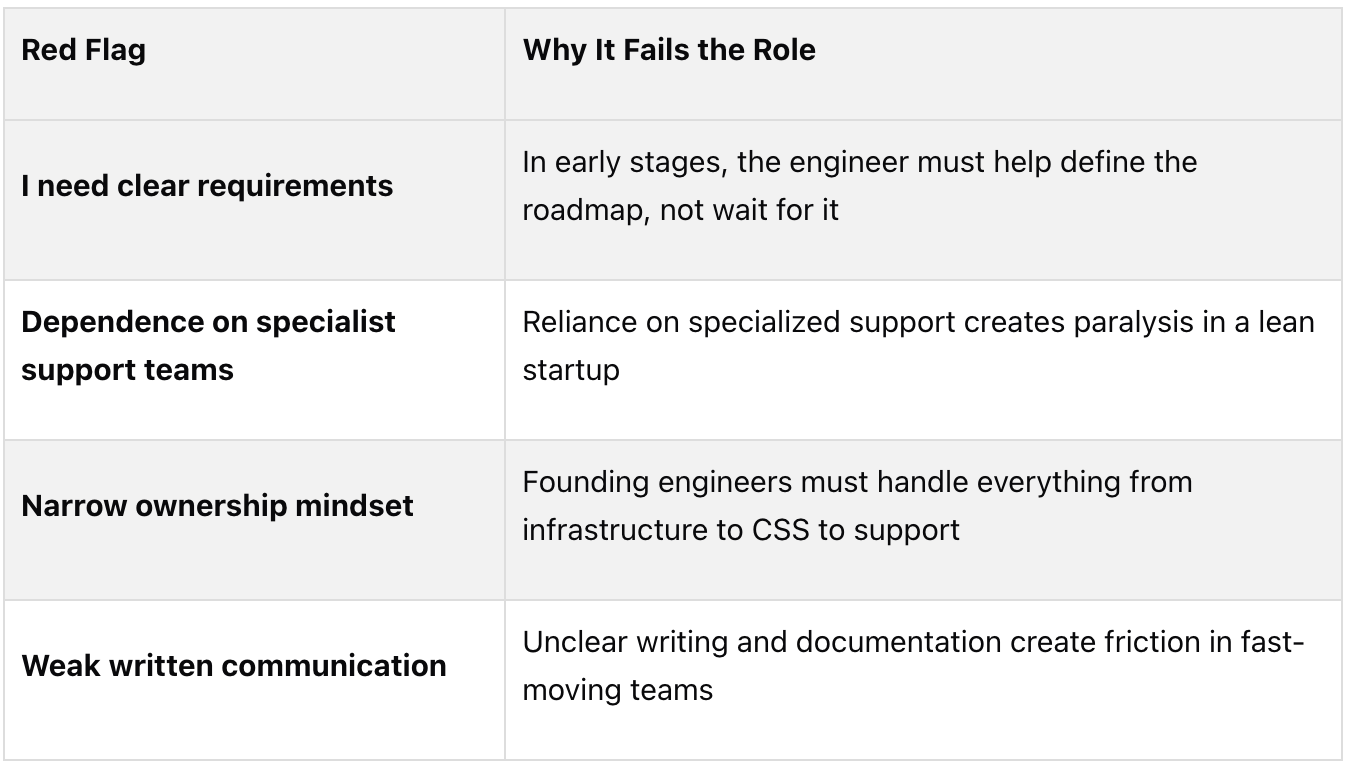
Next, test whether candidates can ship in your stack.
Step 2: Assess Technical Depth and Ability to Ship
Algorithm puzzles and polished interviews don't tell you if someone can actually ship. What you want is much simpler: proof of shipped work, then live problem-solving, then a real task. Start with what they've built. Then test how they make choices in your stack.
Review Past Products, Technical Depth, and Build-from-Scratch Experience
Ask the candidate to walk you through the most complex thing they have personally built. Not just something they touched - personally built. Listen for plain first-person ownership: "I designed", "I decided", "I shipped." If you hear a lot of "we" but can't pin down what they owned, that's a yellow flag.
If a candidate can't explain their own decisions, that's a weak signal.
Go deeper with a simple three-step drilldown [8]:
- What was the feature?
- What stack did they choose, and why?
- What broke in production, and how did they fix it?
Then ask, "Which technical decision would you change today, and why?"
This is where things get interesting. You can learn a lot from how someone talks about tradeoffs, mistakes, and pressure. Early-stage hires shouldn't default to heavy systems when a simple fix would do. In most cases, you want people who bias toward speed and simplicity, not extra layers and clever architecture.
Run a Structured Technical Interview Tied to Your Stack and Product
Use your actual product limits, not whiteboard theater. Ask how they would ship a core feature by next Friday, deal with a Friday outage, and make sense of an undocumented codebase [1][8]. Those questions show judgment when the clock is ticking.
Also check whether they use Cursor, Claude Code, or GitHub Copilot every day. Slower AI adoption often maps to slower shipping [8][2].
If you want the strongest signal, run a paid work trial: a scoped task from your actual codebase. A common range is about $2,000 for one week at a lead level [8]. If you're a non-technical founder, bring in dedicated engineering teams for a short review before making the final technical call [8].
Once you've got a read on technical depth, move on to startup judgment, communication, and fit.
Step 3: Test Startup Judgment, Leadership, and Team Fit
Once you know the candidate has the technical depth, shift the interview to something harder: how they think when the path isn't clear.
Technical skill gets them into the room. Judgment, ownership, and communication are what make them work in an early-stage startup.
At this stage, you're testing whether they can make calls, explain their thinking, and lead when there isn't a neat playbook to follow.
Run a Work Sample or Founder Simulation Exercise
Give the candidate a scenario pulled from startup life. For example:
"Ship an MVP for a B2B SaaS in three weeks. What do you build, skip, and document?"
Keep the prompt vague on purpose. The point isn't to get a polished answer. You want to see how they deal with uncertainty.
Do they ask sharp clarifying questions? Do they make sane assumptions? Can they put structure around a messy problem fast?
A strong candidate usually does a few things well:
- Makes practical trade-offs
- Says what they'll cut and why
- Focuses on getting something working fast
A weaker candidate tends to drift in the other direction. They may over-engineer, get lost in edge cases, or freeze because the prompt doesn't spell everything out.
Another good pressure test is a Friday outage: production is down. What happens first? You're looking for action, calm thinking, and clear communication when the heat is on.
A founding engineer doesn't just ask what to build. They help shape what should exist in the first place, then figure out how to ship it.
Evaluate Communication, Motivation, and Team Fit
Ask the candidate to explain a complex system design in plain English, like they're speaking to a non-technical co-founder. If they can't do that, things can fall apart fast once they join the team.
You should also ask directly about motivation. Are they pulled in by the problem? Do they want ownership? Are they up for zero-to-one work, where half the job is sorting through fog?
The people who do well in founding engineer roles can build through ambiguity. They also know when to push back.
A simple way to test this: give them a scenario where a founder wants a feature the engineer believes is the wrong call. Strong candidates won't just nod along. They push back in a useful way, explain their reasoning, and then commit once the call is made.
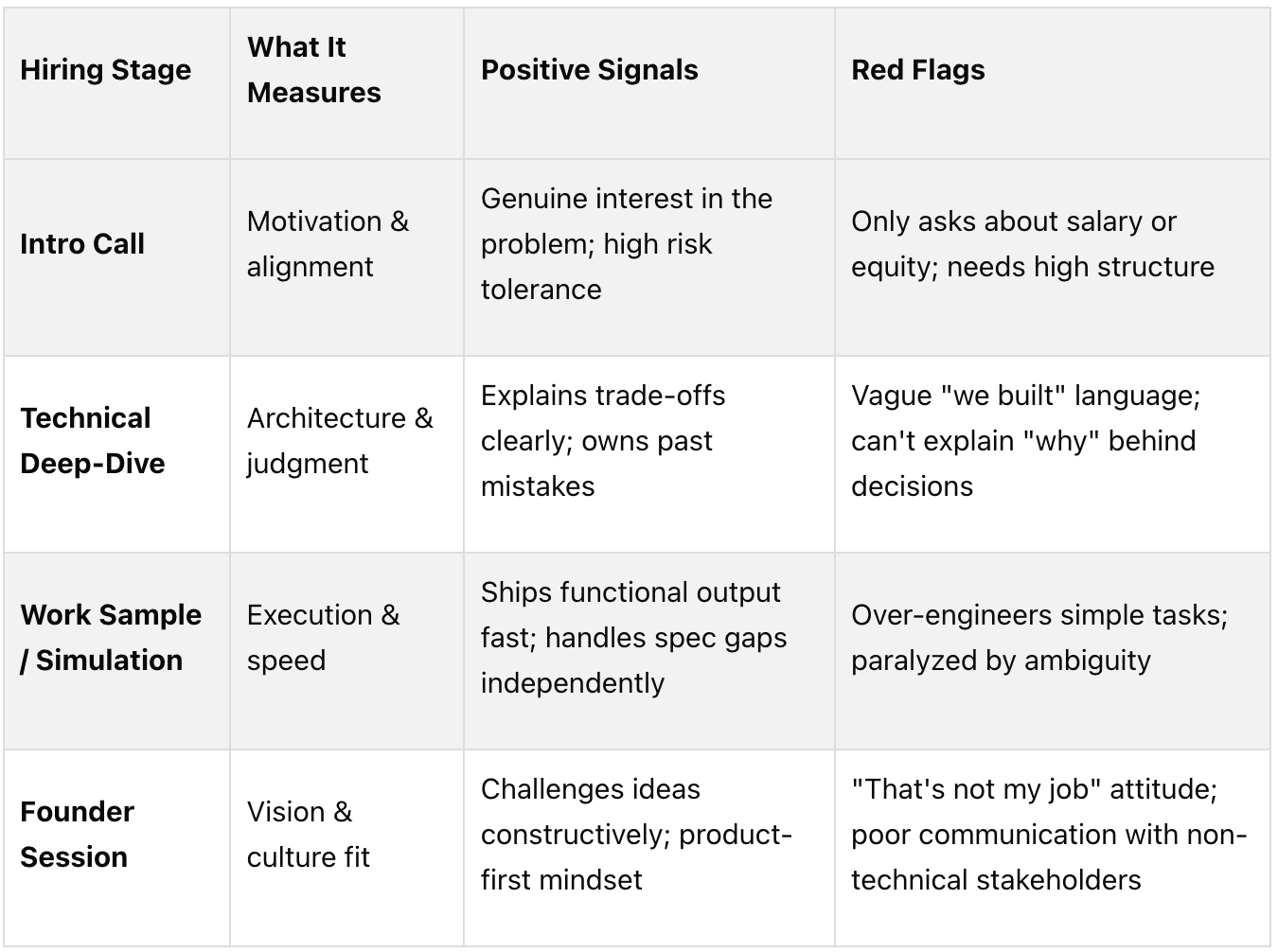
Comparison Table: What Each Hiring Stage Measures
Use the same signals across every stage so interviews stay consistent and easy to compare.
Step 4: Check References and Make the Final Decision
After the interviews and work sample, references help you check one thing: does the candidate's day-to-day behavior line up with what you saw?
Ask References About Execution Under Pressure and Reliability
Don't treat reference calls like a box to check. Use them to see how the person worked when things got messy, changed fast, or flat-out broke.
Keep your questions tight and aimed at three signals:
- How did they deal with unclear or fast-changing requirements?
- How did they respond to a production failure?
- Did they take ownership beyond their assigned technical work, such as talking to customers or suggesting product ideas?
Two questions tend to cut through vague praise fast: "Would you hire them again, and for what specific kind of role?" and "Would you want this person as a co-founder?" [4][9]
Unlisted former coworkers often give the clearest read. [9][3] If references say the candidate needed detailed specs or couldn't operate without support teams, that's a warning sign for a founding role. [5][7]
Use a Scorecard to Compare Candidates and Make Your Decision
Use the same scorecard from the interview process for the final comparison. That keeps the decision grounded and stops last-minute bias from creeping in.
Approve only if the candidate scores well on technical depth, startup judgment, communication, motivation, and references, with no major red flags.
FAQs
How do I score founding engineer candidates fairly?
Use a clear, repeatable hiring process built around judgment, ownership, and startup-style problem-solving, not abstract coding puzzles. Give every candidate the same core questions, then use a scorecard after each interview so comparisons stay fair and grounded in the same criteria.
A simple setup looks like this:
- A 30-minute intro call
- A 45- to 90-minute technical deep dive
- A 2- to 4-hour pairing session or paid work trial
Put more weight on candidates who show autonomy, sound judgment, and a strong sense of ownership.
When should I use a paid work trial?
Use a paid work trial as the last screening step before you make a full-time offer. It’s one of the best ways to see if a candidate can ship code, handle day-to-day startup work, and do well when things aren’t perfectly defined.
The best setup is simple: pay them for a one-week project tied to a real, clearly scoped task from your product workflow.
What matters most for non-technical founders?
For non-technical founders, the goal isn’t to test code. It’s to judge how the person thinks, communicates, and takes ownership.
Look for someone who can work well on their own when things are unclear, explain technical issues in plain English, and stay focused on user outcomes instead of chasing perfection. They should also understand business trade-offs, not just technical ones.
What you want is a true product partner. Someone who can connect technical direction with company growth and make sound calls as the business moves forward.
Looking to scale more efficiently? Connect with iDelsoft.com! We specialize in developing software and AI products, while helping startups and U.S. businesses hire top remote technical talent — at 70% less than the cost of a full-time U.S. hire. Schedule a call to learn more!
07.10.2026
See also
