


How Founders Build Teams Beyond Founding Engineers
Scaling engineering teams is about transitioning from a small, versatile group to a structured organization that supports growth. Here's what founders need to know:
Pro Tip: Tie hiring plans to your product roadmap, and start recruiting at least three months before a new hire is needed. Tools like GitHub Copilot can also help boost productivity, enabling startups to achieve more with smaller teams.
The shift from a hands-on founder to a team builder is crucial. Focus on enabling others, documenting principles, and revisiting team structures every 6–9 months to ensure they align with your company’s growth.
- Early-stage focus: Founding engineers handle multiple roles, but this flexibility becomes inefficient as the team grows.
- Growth stages and priorities:
- Pre-Seed: Rapid iteration for MVP.
- Seed: Reliability, CI/CD pipelines, and monitoring.
- Series A: Predictable delivery, formalized workflows.
- Series B+: Efficiency through internal tools.
- Delegation: Shift tasks like sprint coordination and feedback to an Engineering Manager (EM) once the team reaches 8–12 engineers.
- Team structure: Organize around product domains (e.g., payments, onboarding) instead of technical layers to reduce bottlenecks.
- Hiring strategy:
- Start with senior full-cycle engineers who can manage entire areas.
- Gradually add mid-level and junior engineers.
- Avoid hiring specialists too early unless there’s a clear need.
- Remote collaboration: Use tools like ADRs and RFCs to align distributed teams. Ensure at least 3–4 hours of time-zone overlap for better coordination.
- Metrics to track: Use DORA metrics (e.g., deployment frequency, MTTR) and team health indicators (e.g., eNPS, ramp-up time) to monitor performance.
Pro Tip: Tie hiring plans to your product roadmap, and start recruiting at least three months before a new hire is needed. Tools like GitHub Copilot can also help boost productivity, enabling startups to achieve more with smaller teams.
The shift from a hands-on founder to a team builder is crucial. Focus on enabling others, documenting principles, and revisiting team structures every 6–9 months to ensure they align with your company’s growth.
How to Scale High-Performing Engineering Teams in 2025 | Hiring, AI Workflows & Remote Culture
Align Team Growth with Company Needs
When scaling your team, focus on filling specific gaps. Every hire should address a clear and unmet need. It’s also essential to align hiring strategies with the evolving priorities of your engineering team as your company grows.
Understand Engineering Priorities by Stage
Engineering priorities shift as your company progresses through different growth stages. What works in the early days may not be effective later.
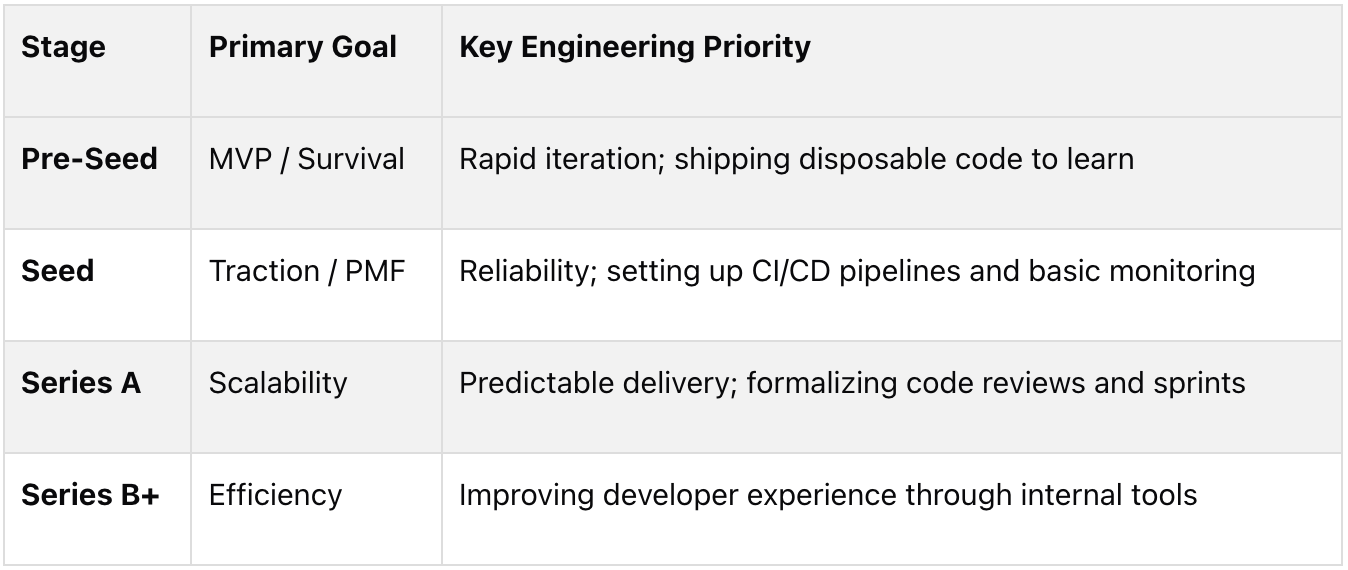
In the pre-seed phase, speed is everything. Hiring senior full-stack generalists who can handle features end-to-end is crucial. Avoid adding specialists like QA engineers or DevOps too early, or consider staff augmentation services, as this can drain resources before you’ve validated your product.
By the seed stage, with a team of 5 to 12 engineers, gaps in expertise become more apparent. This is the right time to bring on your first dedicated DevOps or platform engineer and someone focused on test automation to enhance reliability as your product gains users.
At Series A, with a team of 12 to 30 engineers, the focus shifts to consistent and predictable delivery. Tools like GitHub Copilot and Cursor are becoming game-changers. As of 2026, these tools can boost individual productivity by 30–50% on well-defined tasks, enabling companies to hit revenue milestones with 10–15% fewer engineers.
"At this stage [Seed], the focus is really on building the product - first getting your MVP out the door and then adapting, building, and modifying as you search for product market fit." - Jessica Popp, SVP of Engineering, Rula [1]
Define Which Responsibilities to Delegate First
In the early days, founding engineers take on a wide range of tasks - architecture decisions, code reviews, on-call rotations, hiring, and even customer support. This approach works for small teams but becomes a bottleneck as the team grows to around 15 engineers.
Start by delegating the less glamorous responsibilities, like sprint coordination, day-to-day 1:1s, performance feedback, and process ownership. These tasks should transition to an Engineering Manager (EM) once the team reaches 8 to 12 engineers. This allows founders to concentrate on strategy, technical vision, and executive communication.
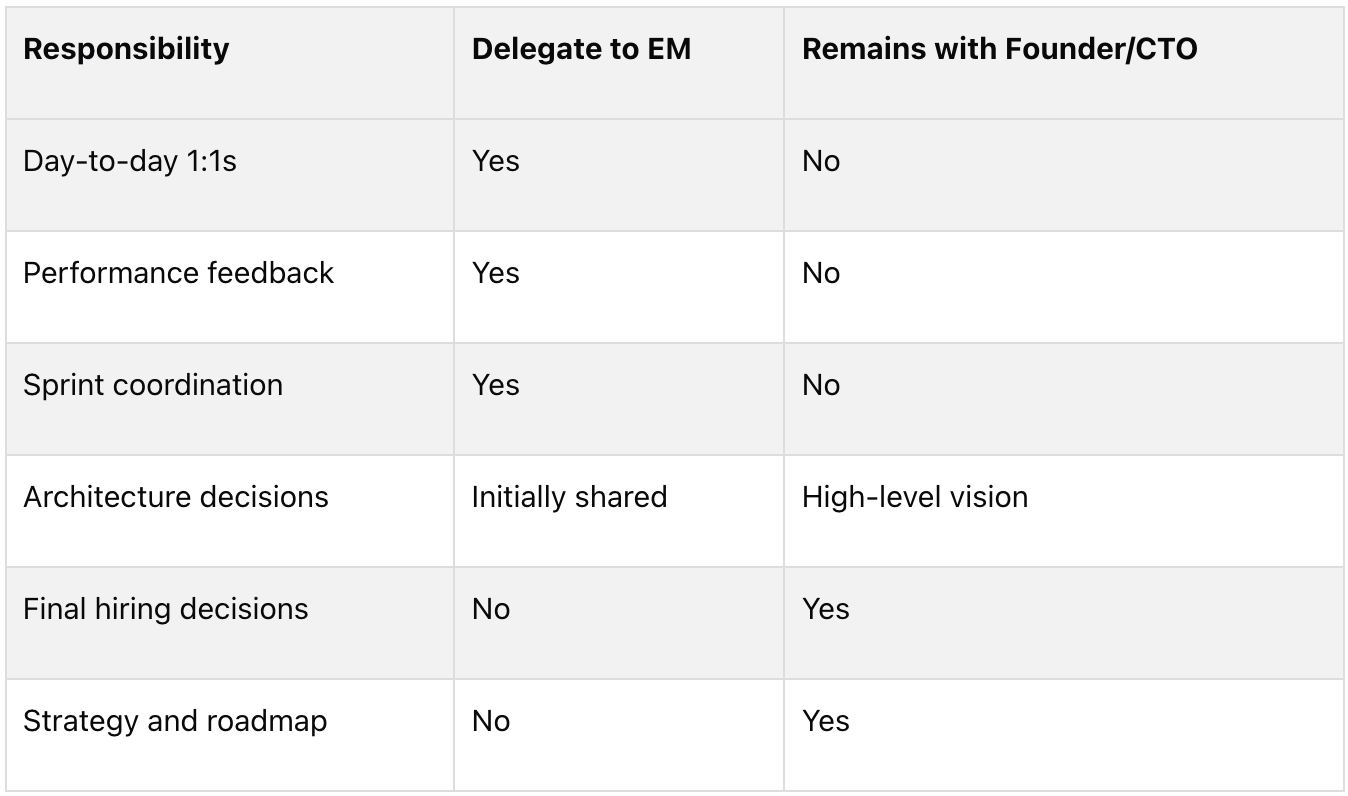
It’s important to distinguish between the roles of a Tech Lead and an Engineering Manager. While Tech Leads spend 50–70% of their time coding and contributing to architecture, EMs focus primarily on people management and ensuring reliable delivery, with less than 20% of their time spent coding.
"The best coder on your team is often the worst choice for EM - you lose a great IC and gain a reluctant manager." - Mikael Danielian, Engineering Leader [6]
Turn Your Product Roadmap into a Hiring Plan
To create a hiring plan, start with your product roadmap. Look 12 to 18 months ahead and ask: What technical skills are missing today that could cause a bottleneck in six months?
For instance, if your roadmap includes a major infrastructure migration in Q3 and a mobile launch in Q4, you’ll need a platform engineer ready to go by Q3. Since senior engineers typically take about three months to ramp up on a new codebase, you should start hiring in Q1.
Once you’ve identified the roles you need, tie each hire to a specific budget. In the U.S., senior engineers typically earn between $150,000 and $300,000 annually. For an eight-engineer team, monthly costs - including salaries, benefits, and tooling - can average around $160,000. By linking hires to specific milestones, you can justify expenses to your board.
"Hiring backend engineers before you have product-market fit... these mistakes are common, expensive, and avoidable." - Shev Dilay, Live Digital
Design a Team Structure That Scales
Building on the earlier hiring plan, this section focuses on creating a structure that supports growth without bottlenecks. A well-thought-out team structure speeds up delivery and reduces delays caused by miscommunication.
Team Patterns for Early Growth
In the early stages, teams often tackle tasks collectively. This approach works well for small groups - up to about 6–8 engineers. Beyond this size, informal coordination starts to falter, and inefficiencies from handoffs can slow progress.
"Engineering teams rarely break because they lack talent. They break because the structure stops matching the stage of the business." - Surton
To avoid these pitfalls, organize teams around product domains instead of technical layers. Cross-functional squads - small groups of engineers responsible for specific areas like payments, onboarding, or notifications - help reduce dependencies and allow teams to operate independently [6][15]. As the organization grows, introducing a dedicated platform team can make a big difference. This team focuses on internal tools, deployment pipelines, and improving developer experience, leaving product squads free to focus on customer-facing features.
Once the structure is in place, the next step is to determine which roles will best support this setup.
Which Roles to Hire First
Strategic hiring is key to maintaining momentum. After forming the founding team, the first hires should be senior full-cycle engineers. These generalists can manage entire product areas with minimal supervision, set quality standards, and excel in roles that require cross-functional collaboration.
Once you've built a core team of 3–5 senior engineers, bring in mid-level engineers. They handle the day-to-day execution while also creating a pipeline for internal talent development. Specialized roles like DevOps, security, or data engineering should only be added when specific challenges or bottlenecks make them necessary.
A good hiring ratio to aim for is:
- 20% senior engineers: They mentor and shape the architecture.
- 50% mid-level engineers: They handle execution and deliverables.
- 30% junior engineers: With the right mentorship, they grow into mid-level roles over time.
As the team grows with these key hires, fostering effective collaboration becomes the next priority.
Remote Collaboration Best Practices
For remote-first teams, the biggest challenges are not time zones but unclear communication. To succeed, distributed teams need to treat written communication as a core part of their infrastructure. Using tools like ADRs (Architectural Decision Records), RFCs (Request for Comments), and detailed design documents can help teams stay aligned, minimize repetitive discussions, and make onboarding smoother.
Time-zone alignment also plays a critical role in scaling remote teams. Even a 3–4 hour overlap in working hours can significantly improve coordination compared to a fully asynchronous setup. For founders looking to build distributed teams, iDelsoft offers pre-vetted, time-zone-aligned engineering talent across 150+ technologies. Their dedicated pods - ready to integrate in as little as 72 hours - are designed to function seamlessly alongside your in-house team.
Build a Repeatable Hiring Process
Once you've nailed down your scalable team structure, the next step is creating a hiring process you can rely on time and time again. A structured process ensures clear role definitions, efficient talent sourcing, and a streamlined interview approach. This not only saves time but also helps you avoid costly mistakes and make smarter hiring decisions under pressure.
Write Clear Role Scorecards and Job Descriptions
Start by drafting a concise, one-page role profile. This should include the problem the role will solve, success metrics for the first 30, 60, and 90 days, and five key skills the candidate must have. This combination of role clarity and measurable outcomes provides a solid foundation before you even begin speaking with candidates.
"If you can't describe what a successful hire looks like in concrete terms, you don't have a role - you have a wish." - HireFormly [16]
For early-stage engineering roles, behavioral traits often outweigh technical skills. Look for candidates who thrive in ambiguous situations (can they deliver when priorities shift every six weeks?), demonstrate an ownership mindset (do they take responsibility for solving problems?), and excel in practical problem-solving (can they find efficient, workable solutions without overcomplicating?). These qualities are much harder to teach than technical frameworks or programming languages.
To keep evaluations fair and consistent, use a structured scorecard with 4–6 defined competencies. Rate each competency on a 1–5 scale immediately after interviews, and require interviewers to provide specific evidence for each rating. This approach eliminates gut-feeling biases and ensures alignment across the hiring team [16]. Considering that a single bad hire can cost a startup an average of $240,000 in salary, training, and lost opportunities, investing in a clear and thorough evaluation process is well worth it [16].
Once you've defined the role, the next step is finding the right candidates.
Where and How to Source Top Engineering Talent
At the early stages, your personal network can be a great starting point, though it has its limits. Beyond referrals, consider these other sources:
- GitHub contributors: Check for engineers actively contributing to relevant open-source projects.
- Niche communities: Explore engineering-focused groups on platforms like Discord or Slack.
- Alumni networks: Target professionals from well-known but struggling companies - these engineers are often skilled, proven, and open to new opportunities.
If time is tight and you need to bridge the gap while searching for a permanent hire, staff augmentation can be a smart interim solution. Platforms like iDelsoft connect founders with pre-vetted engineers skilled in over 150 technologies. These engineers are time-zone aligned, allowing you to maintain momentum in product development without rushing into a permanent hire - an error that can be costly for early-stage startups.
Once you've identified potential candidates, it's time to focus on an efficient interview process.
Keep the Interview Process Lean
A streamlined interview process not only respects candidates' time but also helps you stay on track with your scaling goals. A lengthy process risks losing top talent, especially since engineers in 2026 often juggle multiple offers. Aim for two interview stages:
- 30-minute qualifying screen: This initial call assesses communication skills, motivation, and basic technical fit.
- 60–90 minute deep dive: This stage includes a short practical exercise that mirrors real-world tasks. Avoid trick questions, and keep the total process under two hours [16].
"The quality of your early hires defines your company's slope." - Zabie Elmgren, Partner, Andreessen Horowitz [12]
Build an Engineering Culture That Scales
Building dedicated software development teams is just the beginning. Keeping that talent comes down to creating and maintaining a strong engineering culture. What works naturally for a small team doesn’t always translate as your company grows. Informal norms can break down, and culture becomes something you need to actively shape. For founders, this means transitioning from doing the work yourself to building and supporting a team that can thrive on its own.
Move from Individual Contributor to Team Builder
For technical founders, the toughest adjustment isn’t hiring - it’s stepping back. If you’re still the one writing all the critical code or making every architecture call, you’re not leading a team; you’re just working alongside them. To truly scale, you have to shift from doing the work to enabling others to do it.
"If you find yourself constantly taking work back from your team, you have not actually hired anyone. You are just paying for an audience while you work." - Ben Schmidt, Founder
This shift often becomes necessary when your team grows to around 8–12 engineers. At that size, trying to directly manage everyone creates bottlenecks. But stepping back doesn’t mean abandoning technical work entirely. Staying involved through occasional code reviews or pairing sessions can help you maintain credibility and ensure quality. Your focus, however, should shift to coaching your team during one-on-ones, helping them grow their careers, and removing obstacles so they can succeed.
Write Down Your Engineering Principles
Once you’ve moved into a leadership role, it’s critical to codify your team’s principles. Relying on word-of-mouth or informal traditions doesn’t work as the team grows. What seems obvious to you might not even occur to someone new.
"Culture is a product. You can't set it once and forget it. As the team doubles, the proportion of people who were there for 'the early days' drops. Culture has to be transmitted deliberately." - Mikael Danielian, Engineering Leader[6]
Start by documenting how your team works - everything from how ideas turn into production code to what “done” really means. Include details about processes like code reviews and incident handling. For example, Stripe’s "Email at Stripe" guide outlines when to use email versus Slack, requires engineers to send "shipped@" emails after completing work, and discourages lurking in threads without contributing. Embedding these principles into onboarding helps new hires absorb them through real-world application rather than a one-time read-through.
Add Lightweight Processes Early
Processes aren’t about creating red tape - they’re about reducing mental load and keeping things running smoothly. A few simple tools can make a big difference.
For major technical decisions, RFCs (Request for Comments) are a great way to gather input, while ADRs (Architecture Decision Records) document why decisions were made, saving future teams from revisiting old debates. For daily planning, a Kanban board gives visibility without unnecessary complexity. When it comes to incidents, a straightforward protocol with a clear owner and a blameless postmortem process encourages transparency and trust.
"As a leader, you'll encounter many one-way doors: big decisions that may not feel big in the moment but will have ripple effects across your company and will be hard to reverse later." - Jessica Popp, SVP of Engineering, Rula[1]
Be aware that processes need regular updates to stay effective. What works for your team today might not work six months from now. Set a quarterly rhythm to review and adjust, ensuring your processes evolve alongside your team.
Track Team Growth and Adjust as Needed
Maintaining a strong engineering culture means keeping an eye on performance and addressing challenges early. As your team grows, hidden friction points can arise, and tracking key metrics ensures you can tackle these issues before they escalate.
Track Key Engineering Metrics
Pay attention to critical metrics that give insight into your team's performance:
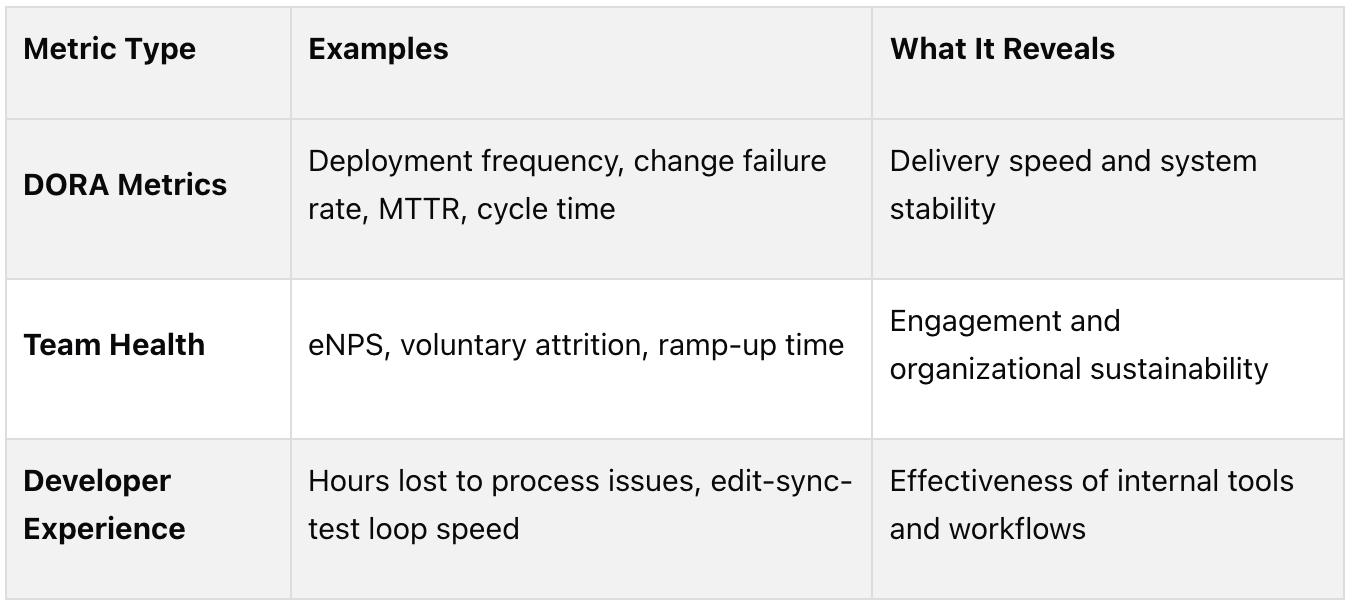
Among these, DORA metrics stand out for their ability to provide actionable insights. They objectively measure whether your team is delivering efficiently or accumulating risks beneath the surface. As Mikael Danielian, an engineering leader, explains:
"A team can inflate velocity easily. Shipping frequently without breaking things is genuinely hard." - Mikael Danielian [6]
To complement DORA data, consider qualitative signals like eNPS (employee Net Promoter Score) and ramp-up time - the time it takes for a new hire to make their first production contribution. If ramp-up times start to stretch, it could indicate onboarding issues or a lack of adequate codebase documentation.
By regularly monitoring these metrics, you can fine-tune your team structure and processes to keep things running smoothly.
Review Team Structure on a Regular Basis
Make it a habit to review team structures every quarter. As Mikael Danielian points out, "The fundamental problem with scaling is that the things making you effective at 10 people become liabilities at 30, and outright blockers at 100."
Typically, processes and organizational designs are effective for about 6–9 months before they need adjustment. During your quarterly reviews, focus on a few key areas:
- Check if any manager has more than eight direct reports, as this often signals a bottleneck.
- Ensure team boundaries align with product domains rather than technical layers.
- Evaluate how well remote collaboration is working.
If you find skill gaps - like the absence of a critical data engineer - consider bringing in pre-vetted remote talent through services like iDelsoft to quickly fill those roles and maintain momentum.
Compare Growth Strategies Side by Side
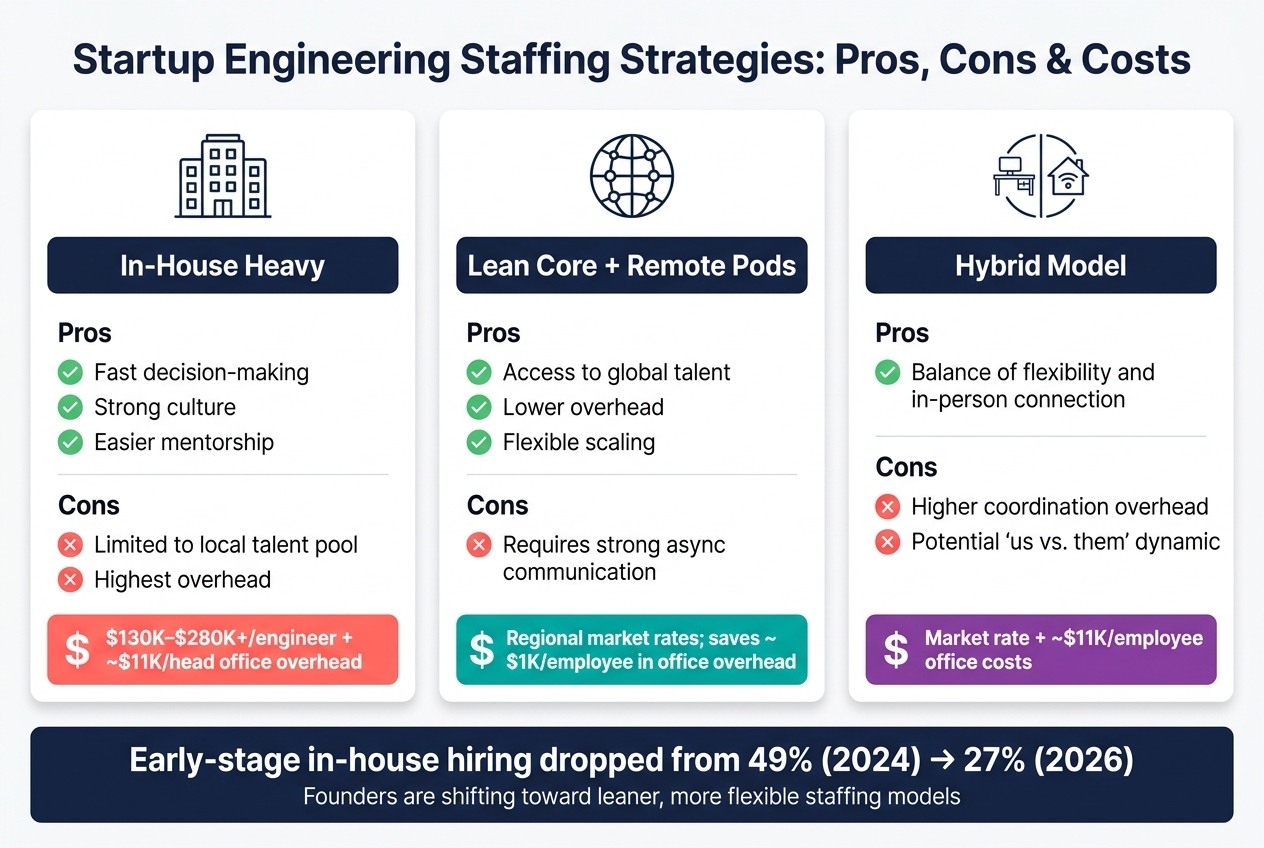
Once you've assessed your internal teams and metrics, it’s time to evaluate different staffing strategies. Your approach to staffing will influence your team’s cost, speed, and flexibility:
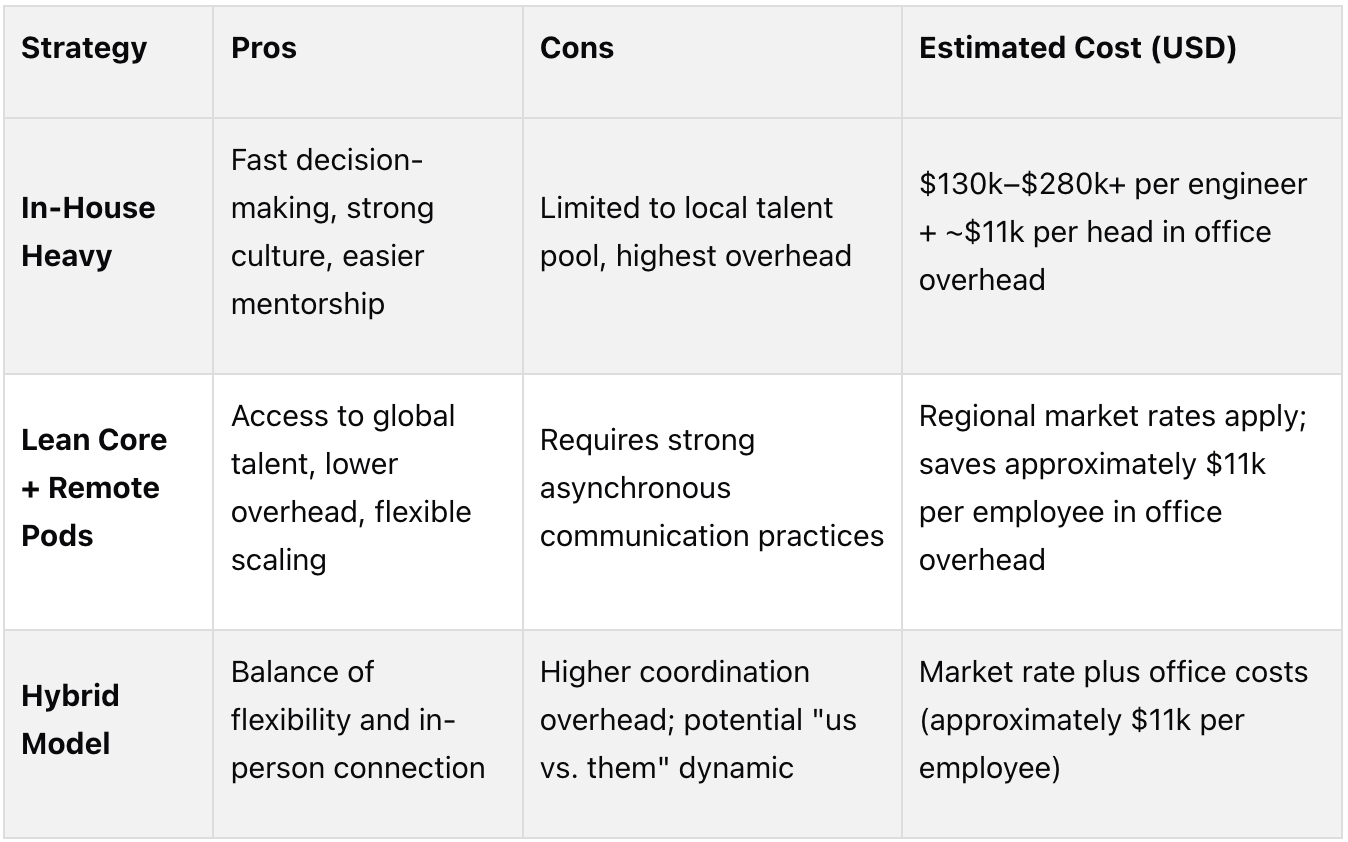
Choosing the right staffing strategy is all about balancing cost, speed, and flexibility. This trend is reflected in declining early-stage hiring rates, dropping from 49% in 2024 to 27% in 2026. Adapting your approach as your team grows will help you stay ahead of the curve.
Conclusion: Building a Team for Long-Term Success
Scaling an engineering team isn’t about sticking to a perfect organizational chart - it’s about making thoughtful choices at every stage of growth. The strategies that work when you have 5 engineers won’t cut it when you hit 30 or 50, and that’s completely normal. As Mikael Danielian says, "A 10-person engineering team is a prototype of an engineering organization, not the real thing."
The key to navigating these transitions is intentionality. Organize teams around product domains instead of technical layers. Document your engineering principles early - before word of mouth becomes unmanageable. Promote engineers into management roles based on their ability to support and elevate others, not just their technical contributions. These aren’t one-off decisions; they’re commitments that grow in impact over time.
When skill gaps inevitably arise, acting quickly is critical. Whether you need a data engineer to unlock a critical project or a senior backend developer to stabilize your systems, waiting months for a hire can derail progress. iDelsoft accelerates this process by offering pre-vetted remote engineers across 150+ technologies, with teams ready in as little as 72 hours - at savings of up to 60% compared to U.S. salaries.
The most successful founders understand that building a strong engineering team is an ongoing effort, not a one-time task. Regularly evaluate your structure, measure what matters, and remain honest about what’s working. The decisions you make today will shape the products and innovations your team delivers tomorrow.
FAQs
How do I know it’s time to hire my first Engineering Manager?
When your engineering team grows to more than 5 to 10 members, hiring your first Engineering Manager becomes a critical step. At this stage, founders or team leads often find themselves spending more time managing people than focusing on technical tasks. Other signs that it's time to bring in an Engineering Manager include communication breakdowns, noticeable drops in productivity, or when the team size hits 12 or more engineers - making it harder to manage with a flat structure.
An Engineering Manager brings structure to the chaos. They establish scalable processes, ensure clear accountability, and provide focused leadership. This allows technical team members to stay productive and concentrate on innovation without being bogged down by organizational inefficiencies.
What’s the best team structure once we’re past 10 engineers?
When your engineering team surpasses 10 people, it’s time to move away from a flat structure and adopt a more scalable framework. This means defining clear roles and adding management layers. For example, you might introduce engineering managers, team leads, and specialized teams (like platform or infrastructure) to better manage increasing complexity and interdependencies.
To keep productivity and alignment intact, incorporate structured practices such as sprint planning and a solid onboarding process for new hires. This layered structure doesn’t just help with day-to-day operations - it also sets the foundation for sustainable growth as your company continues to scale.
When should we start hiring specialists like DevOps, QA, or security?
When your engineering team expands beyond the early stages - usually hitting the 5 to 10 engineer mark - and your projects become more technically complex, it's a good time to think about bringing in specialists like DevOps, QA, or security experts. These roles are crucial for managing operational reliability, maintaining quality, and ensuring security as your team scales. Without them, generalist engineers can become overwhelmed, which might jeopardize both stability and growth.
Looking to scale more efficiently? Connect with iDelsoft.com! We specialize in developing software and AI products, while helping startups and U.S. businesses hire top remote technical talent — at 70% less than the cost of a full-time U.S. hire. Schedule a call to learn more!
20.11.2026
Keep reading
