


A Practical Guide to Hiring in Latin America
We at iDelsoft would start hiring in Latin America with a clear role brief - not the lowest salary. Define the work, required skills, and shared hours with your U.S. team before choosing Brazil, Mexico, Argentina, or Colombia.
Our rule: approve the full budget and legal setup before sending an offer. A lower salary is only one part of the decision - not proof of a lower total cost.
Our rule: approve the full budget and legal setup before sending an offer. A lower salary is only one part of the decision - not proof of a lower total cost.
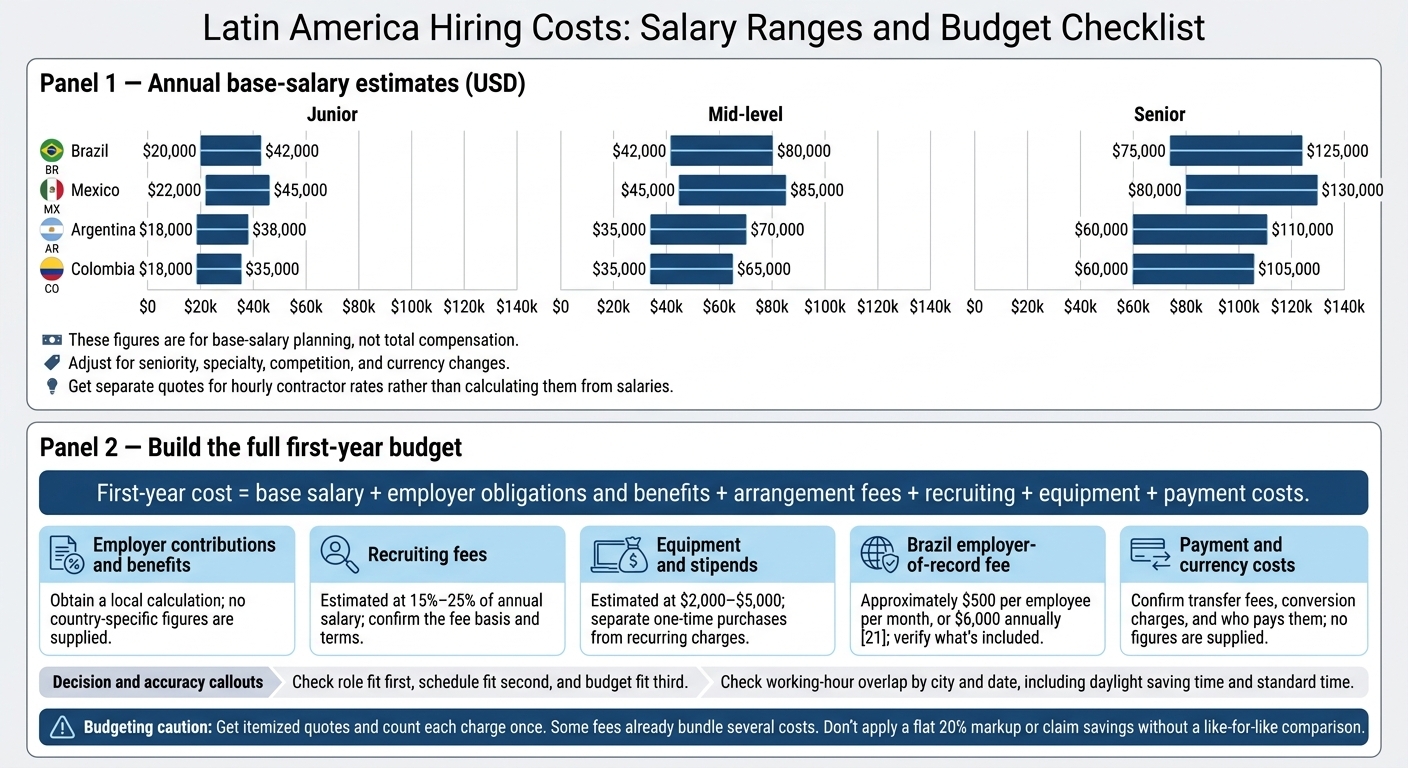
Latin America Hiring Costs: Salary Ranges and Budget Checklist
1. Choose a Country and Set Your Budget
Turn your hiring brief into four market filters: salary, working-hour overlap, English proficiency, and labor requirements. Check role fit first, schedule fit second, and budget fit third. These tradeoffs help narrow your search before sourcing begins.
Compare Brazil, Mexico, Argentina, and Colombia
Choose a market based on the role - not salary alone. Use this table to compare the talent pool, hiring conditions, and budget fit.
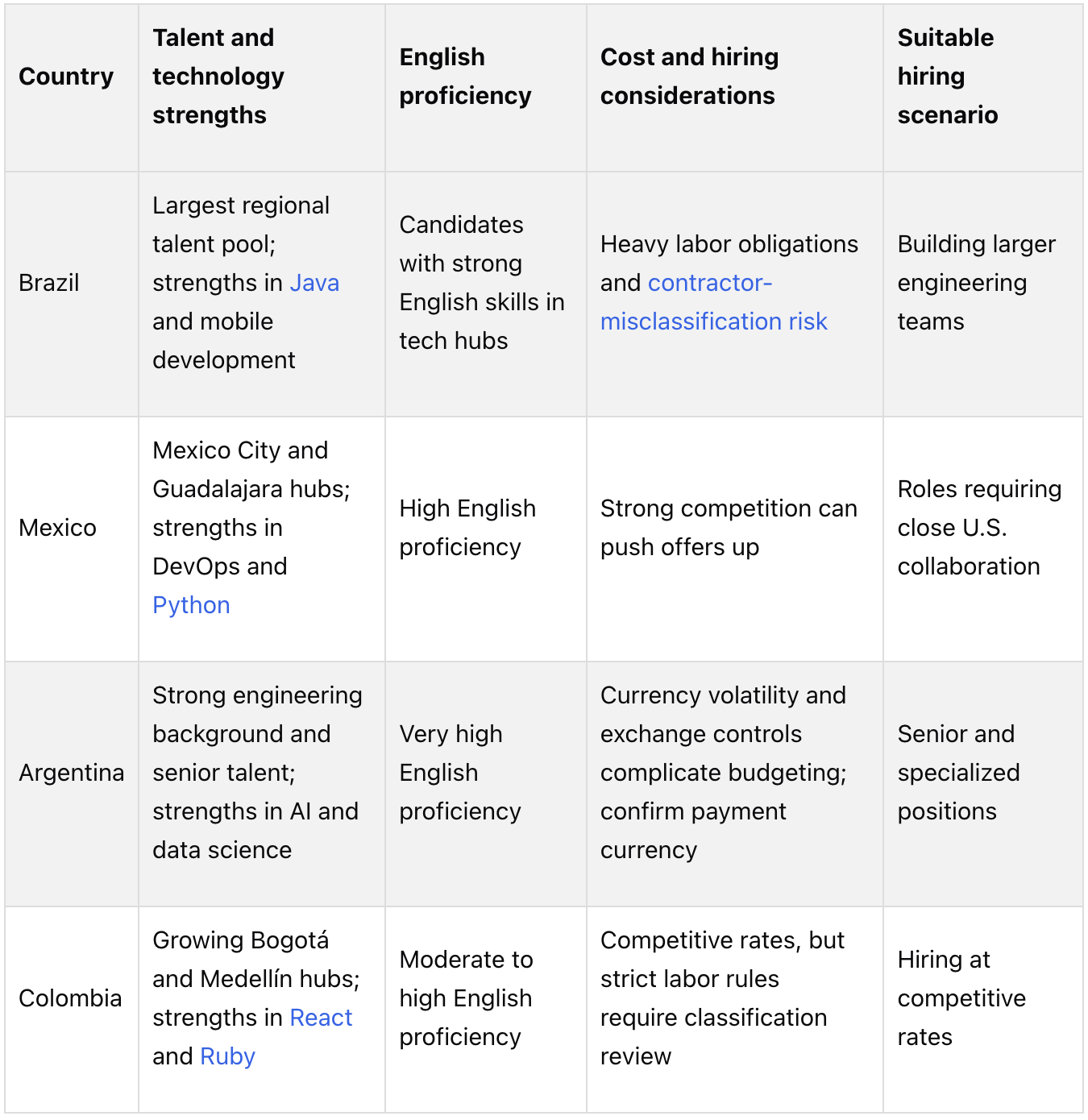
Assess English skills candidate by candidate. Proficiency varies within every market.
Compare Working-Hour Overlap
Check overlap by city and date, not by country average. Compare the agreed local working hours with your U.S. schedule during both daylight saving time and standard time.
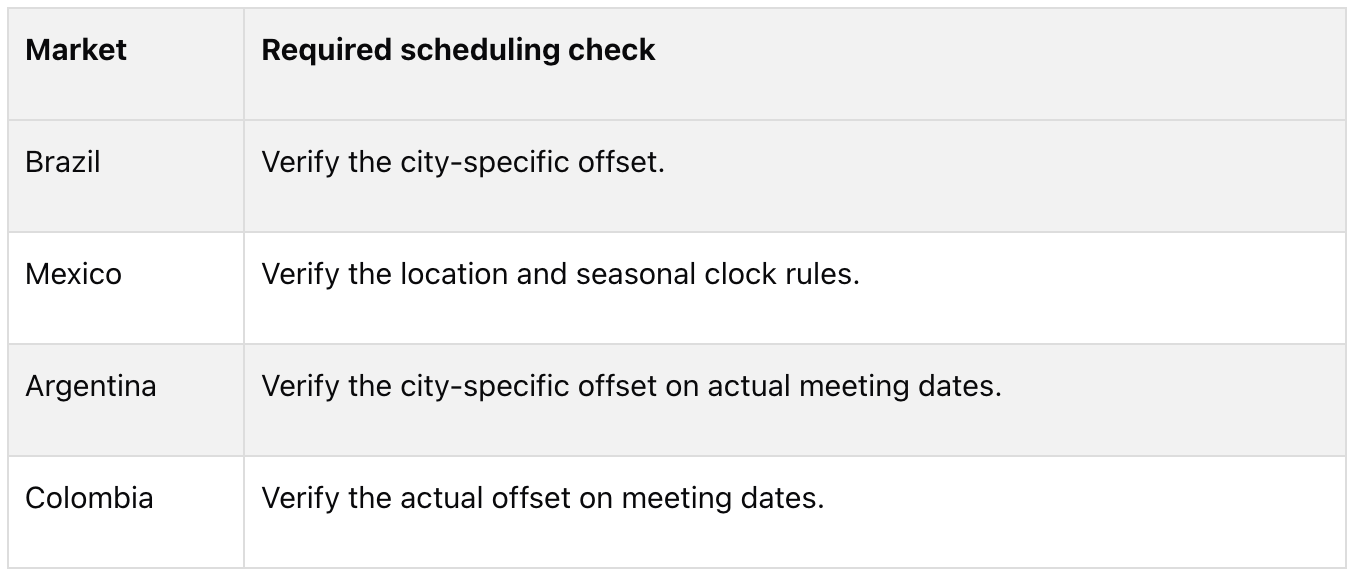
Document the results in the working agreement. Include required shared hours, recurring meetings, response-time expectations, handoff deadlines, emergency coverage, and where asynchronous updates should go. Rule out markets that can't support the role's meeting load.
Calculate Pay and Total Hiring Costs
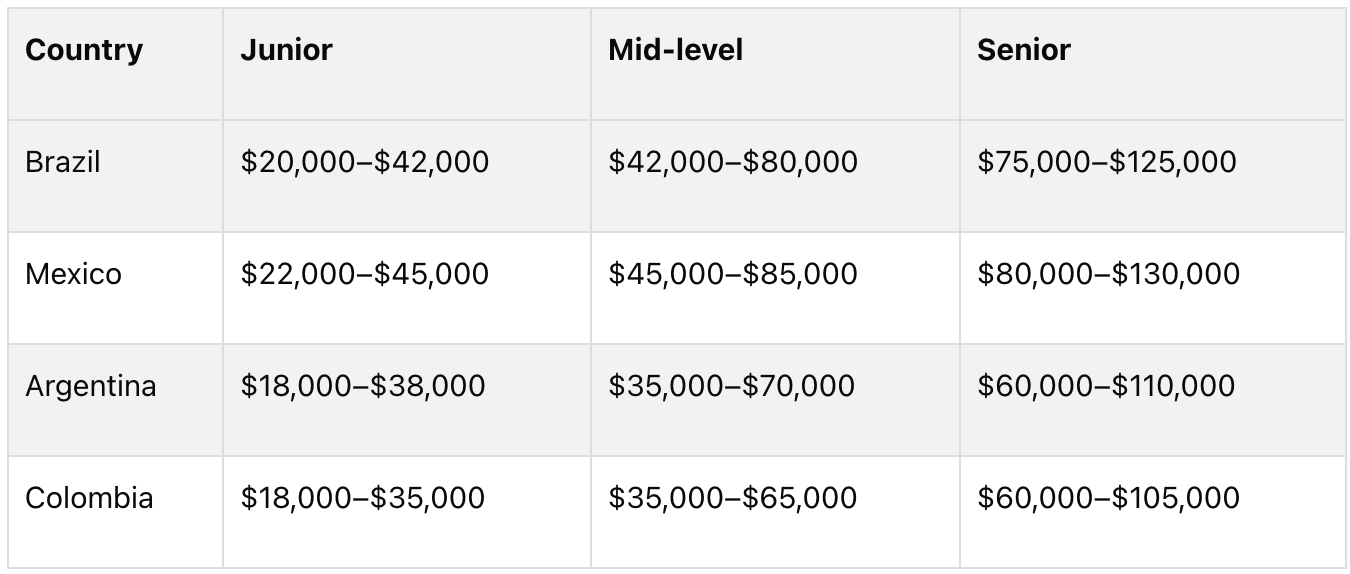
For markets that pass the schedule check, use the annual base-salary ranges below in USD. Adjust for seniority, specialty, competition, and currency changes.
These figures are for base-salary planning, not total compensation. Get separate quotes for hourly contractor rates rather than calculating them from salaries.
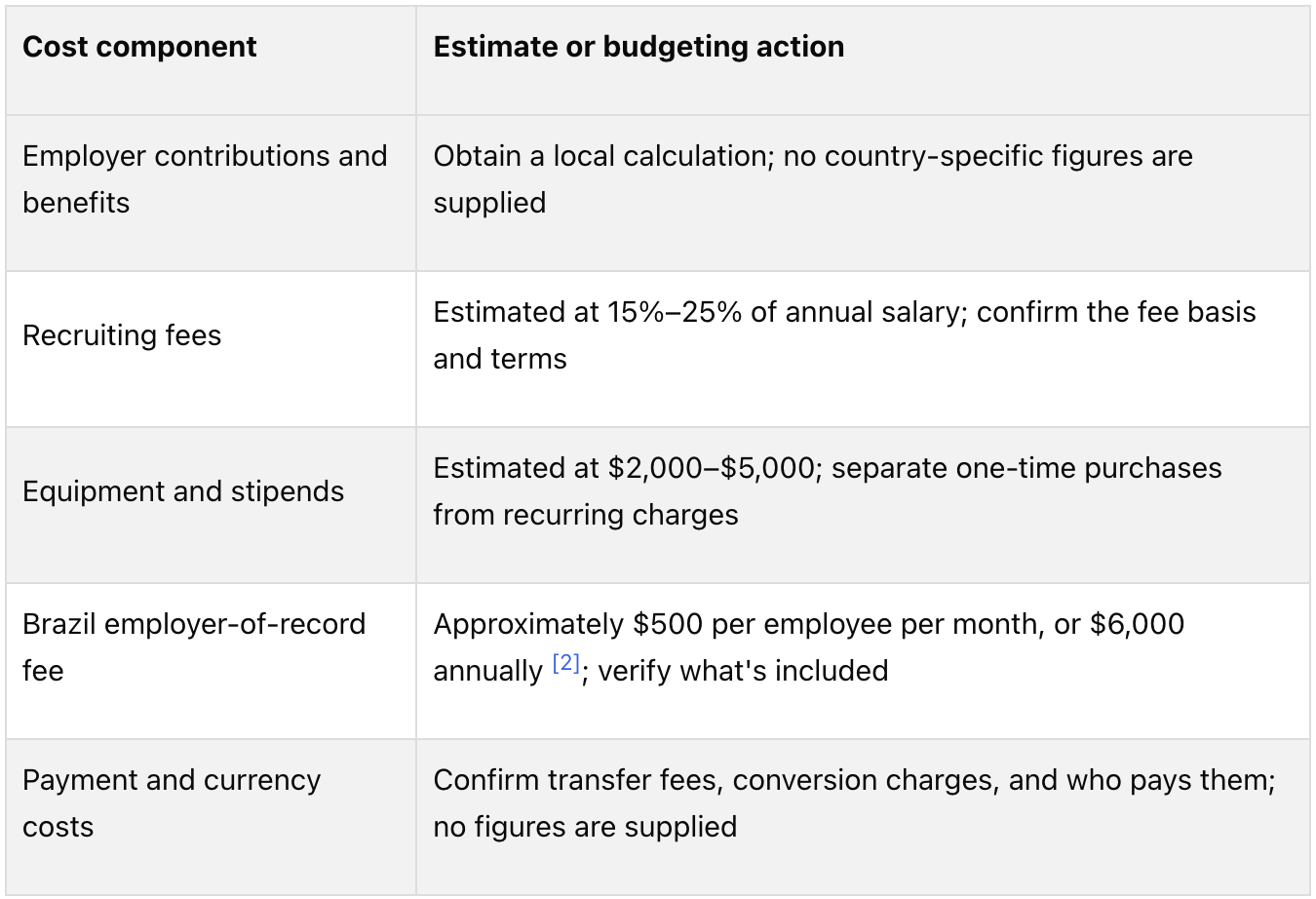
First-year cost = base salary + employer obligations and benefits + arrangement fees + recruiting + equipment + payment costs.
Get itemized quotes and count each charge once. Some fees already bundle several costs. Don't apply a flat 20% markup or claim savings without a like-for-like comparison.
Get itemized quotes and count each charge once. Some fees already bundle several costs. Don't apply a flat 20% markup or claim savings without a like-for-like comparison.
2. Choose a Hiring Model and Assess Candidates
Compare Employment and Service Arrangements
Employment status and engagement model are separate choices. Decide on the legal relationship separately from how the work will run. The legal setup determines who handles pay, compliance, and risk.
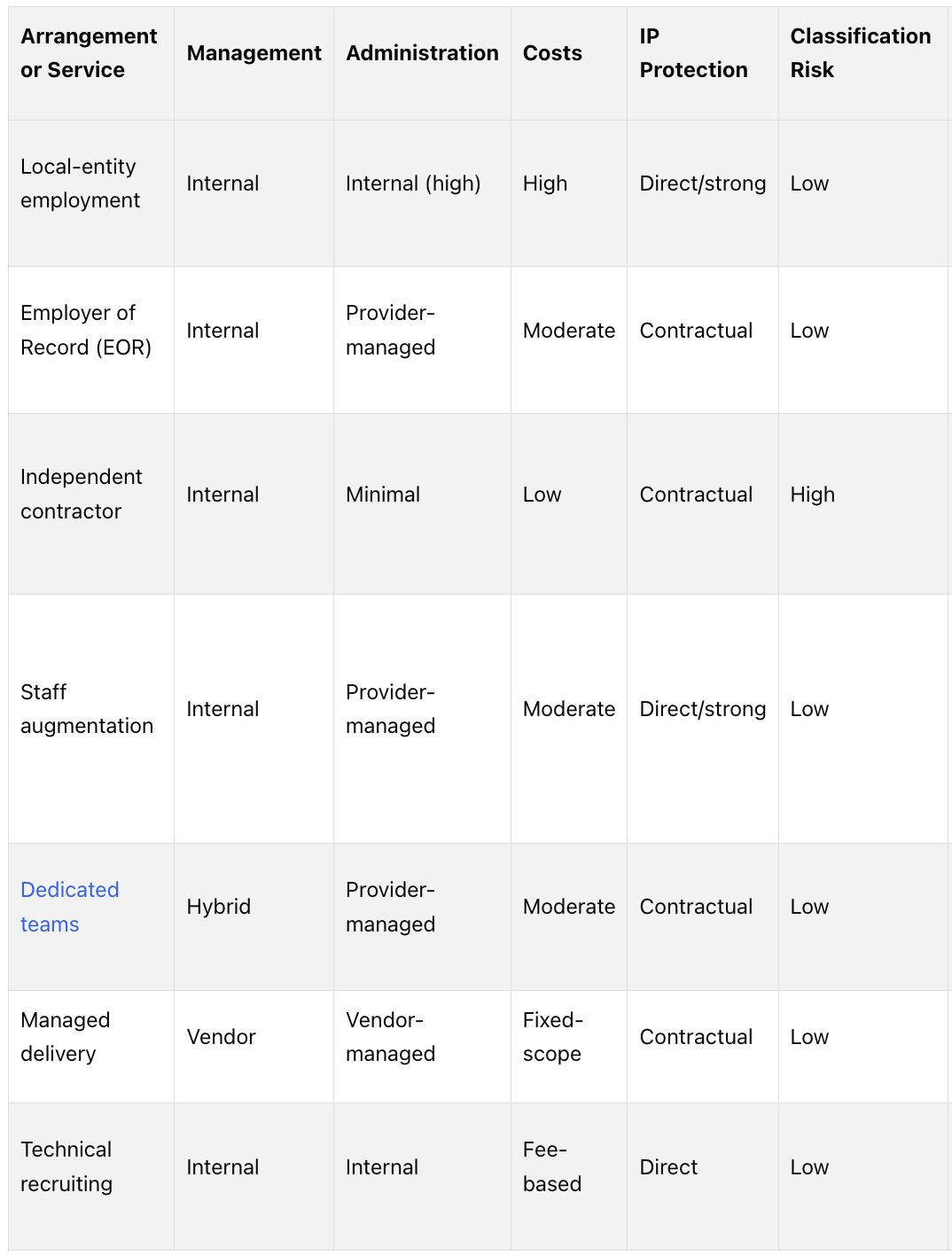
Review worker classification before choosing a contractor model in Brazil, Mexico, Argentina, or Colombia. Then define exactly what the candidate will own and who they'll report to. Use those responsibilities and reporting expectations to guide screening.
Plan Candidate Sourcing and Screening
Once you've set the country and budget, define the search around the required stack, ownership level, relevant project experience, English proficiency for work, availability, and shared working hours.
Screen in stages. Start with recent, relevant work, confirm constraints, and test technical ability. Then check references and employment history with the candidate's consent. Use the same questions and criteria for every candidate, and carry those criteria into the scorecard.
Assess Candidates with a Technical Scorecard
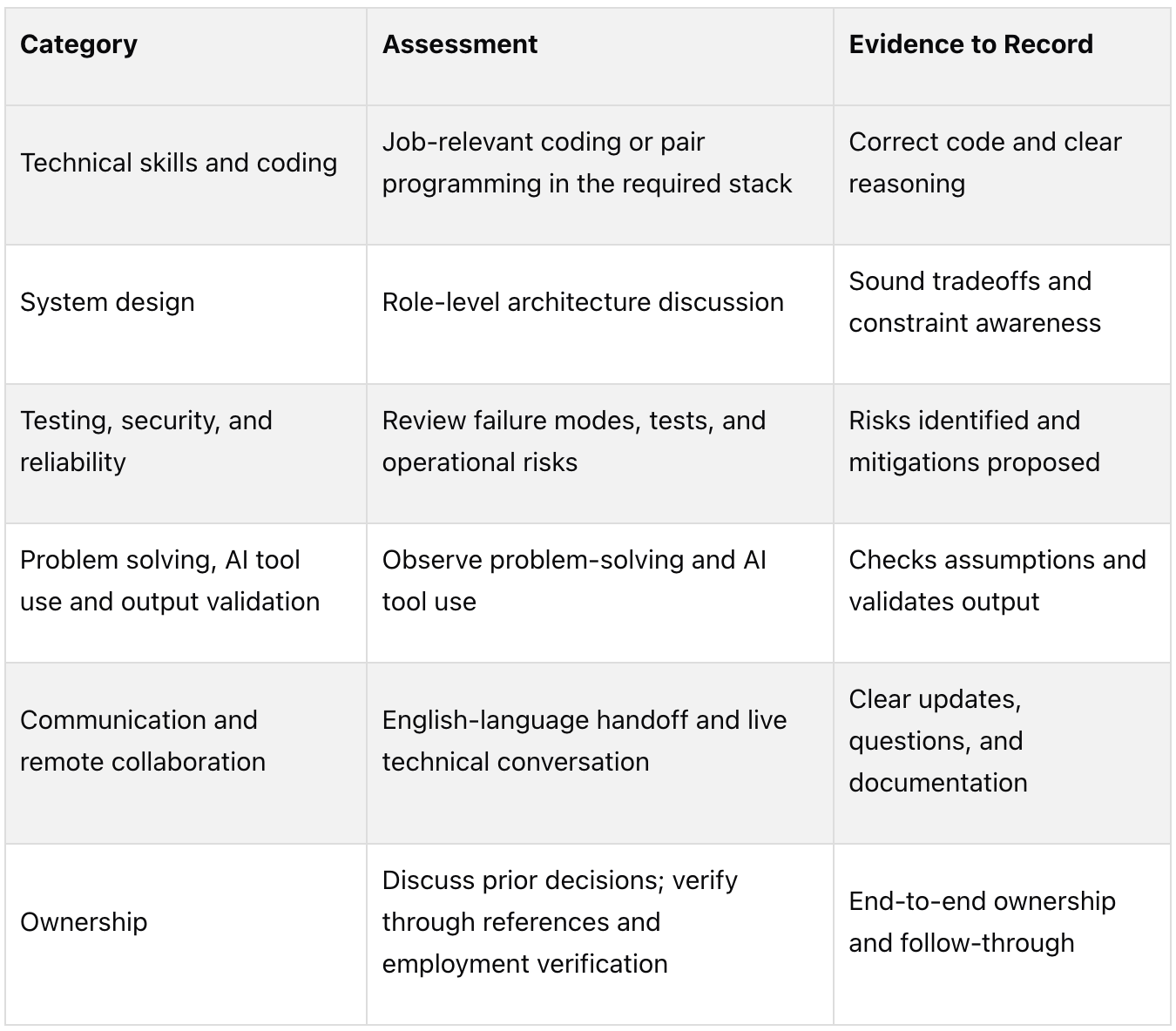
Build a repeatable scoring rubric from your sourcing criteria before interviews begin. Define seniority by ownership, decision-making scope, and architectural responsibility - not years alone.
Measure the skills the role will use every week. Use realistic English-language tasks and short paid exercises to gather evidence. Check reliability through references, portfolio review, and employment verification.
3. Set Up Contracts, Payments, and Onboarding
Review Local Rules and Contract Terms
Once you choose a hiring model, confirm compliance before the offer is accepted. Have local counsel review the employment or contractor arrangement, including employment, tax, IP, privacy, and data-processing rules for that worker type.
Put work-product ownership, confidentiality, security duties, access controls, and data-processing terms in writing. The review should cover Brazil’s labor and LGPD rules, Mexico’s IMSS registration and payroll obligations, Argentina’s currency controls and cross-border payment limits, and Colombia’s labor and withholding rules.
Worker classification depends on the working relationship - not the contract label.
Agree on Currency and Payment Terms
Write down the payment currency, exchange-rate source and date used, payment frequency, transfer fees, and withholding. Keep employee payroll separate from contractor payments.
Plan the First 30 Days
After signing the contract, turn the role brief into an onboarding plan. Confirm that agreements are signed, required paperwork is complete, and equipment is ready. Set clear expectations for first-week access and orientation.
Define first-week deliverables before granting access, then limit access to the systems needed for that work. For the first 30 days, agree on shared hours, task ownership, and recurring meetings. Include delivery goals for the 30-day milestone in the role brief.
4. Conclusion: Your Latin America Hiring Checklist
Before sending offers, check the role brief, budget, hiring model, and onboarding plan to decide whether you're ready to proceed.
Confirm the role brief, market fit, working-hour overlap, and start date. Approve the full first-year cost in USD, including pay, employer charges, recruiting, equipment, payment fees, and exit costs.
Once the budget is approved, document the worker-classification decision with local counsel. Assign the sourcing owner and complete reference and employment checks with consent.
Verify readiness before day 1: approved contracts, enforceable intellectual-property terms, payment setup, equipment responsibility, and access controls. Confirm who owns onboarding and who will serve as the new hire’s buddy.
Schedule the first review for 30, 60, or 90 days. Reassess sooner if scope, supervision, hours, location, pay, or local rules change. Reclassify contractors who become long-term, closely supervised team members.
Use the brief to align recruiting, compliance, and onboarding before outreach.
FAQs
How do I validate salary ranges before making an offer?
Set a clear budget ceiling using regional benchmarks, currently $30,000 to $100,000 per year, depending on the role, seniority, and country. Start with country-specific salary ranges, then narrow your offer bands by role and experience level.
Request quotes from several developers to check your budget against market rates. When finalizing your offer, factor in perks like professional development budgets or home-office stipends to stay competitive.
Where can I find qualified engineering candidates in Latin America?
Focus your search on major tech hubs: Mexico City, Guadalajara, and Monterrey in Mexico; Bogotá, Medellín, and Cali in Colombia; Buenos Aires in Argentina; and São Paulo, Rio de Janeiro, and Porto Alegre in Brazil. These cities have active startup ecosystems, universities, and coding bootcamps.
Find candidates through professional networks or iDelsoft, which provides access to pre-vetted talent pools and handles compliance and recruitment logistics.
When should I convert a contractor to an employee?
Consider converting a contractor to an employee when the working relationship looks like employment. Local labor authorities in Latin America often look at how the work is done - not what the contract calls it [1].
Signs include close managerial oversight, a fixed 9-to-5 schedule, or treating the worker as staff within internal HR processes and systems. If you expect the contractor to work exclusively for your company, you may need to convert them to an employee to avoid misclassification risks [1].
Looking to scale more efficiently? Connect with iDelsoft.com! We specialize in developing software and AI products, while helping startups and U.S. businesses hire top remote technical talent — at 70% less than the cost of a full-time U.S. hire. Schedule a call to learn more!
21.10.2026
Keep reading
