


Building an AI Startup: A Beginner's Guide
We at iDelsoft would start an AI startup with one customer problem, not a model. Before writing code, we’d confirm that a buyer will pay, check permission to use the data, and define one result to measure.
Here’s the path we’d follow:
For a pilot, we might test targets such as more than 90% correct outputs, over 40% less manual work, and under $0.05 per task. These are example targets, not promised results.
Our rule: prove that customers will pay and the system works before spending more.
Here’s the path we’d follow:
- Validate the demand: Interview users and buyers, map the task, and seek a paid pilot.
- Choose the simplest build: Test rules, an existing model, or retrieval-augmented generation (RAG) before paying for custom AI development.
- Keep the MVP focused: Build one workflow, assign clear owners on a small team, and separate build costs from running costs.
- Test with safeguards: Limit data use, add human review, and measure quality, response time, time saved, and cost per task.
- Scale only after the pilot passes: Fix failures and check quality, privacy, reliability, and cost before expanding.
For a pilot, we might test targets such as more than 90% correct outputs, over 40% less manual work, and under $0.05 per task. These are example targets, not promised results.
Our rule: prove that customers will pay and the system works before spending more.
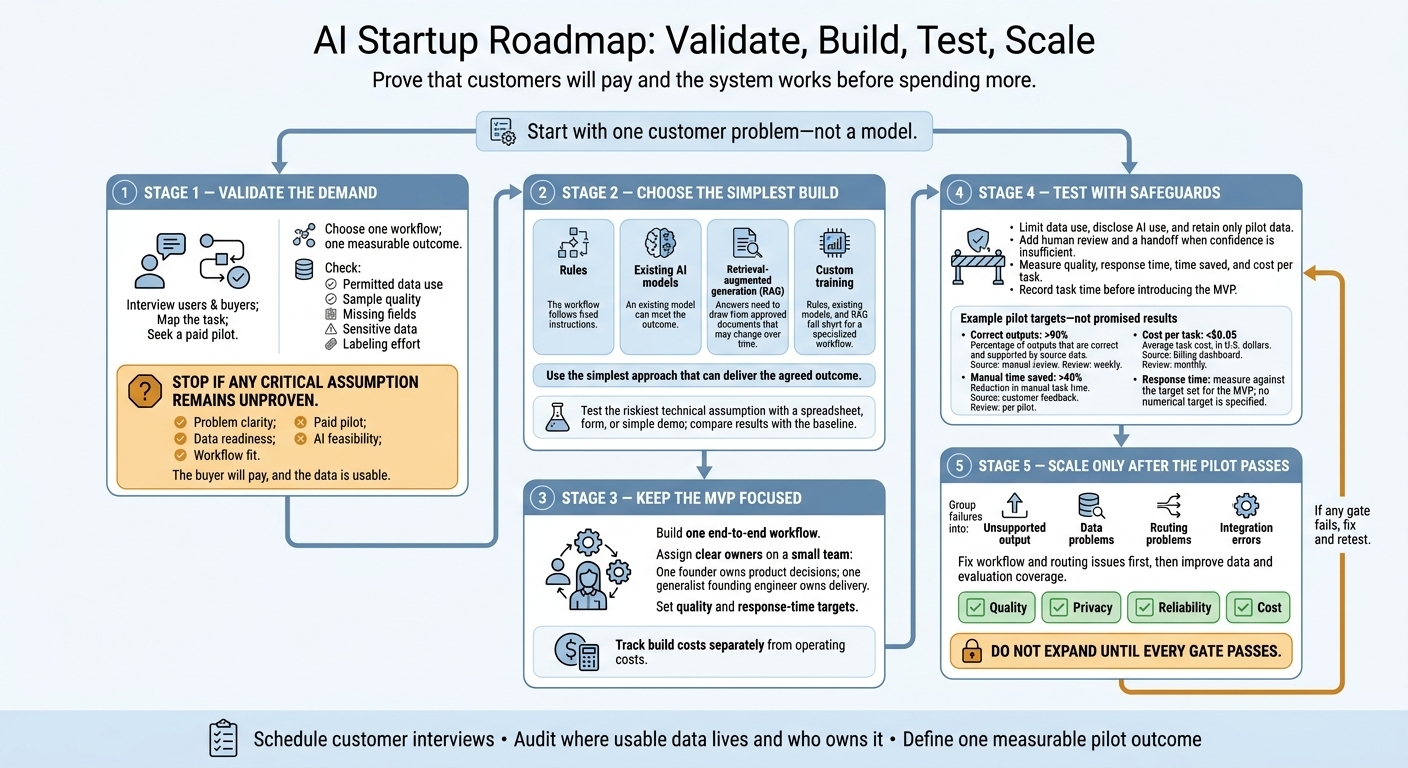
How to Start an AI Startup - 2026 (Step-by-Step Guide) AI Startup Roadmap
Validate Demand and Data Access
Before building, prove two things: the buyer will pay, and the data is usable.
Choose One Workflow and Define the Outcome
The user’s problem and the buyer’s decision are different. Ask users about repetitive tasks, delays, errors, and workarounds. Ask buyers who controls the budget, what approval takes, and which results would justify paying.
Use those answers to choose one measurable outcome. Compare it with the current process, agree on an improvement target before testing, and seek a paid pilot.
Check Whether AI Fits and Data Is Ready
With the workflow defined, test the data before choosing a model.
First, check whether AI adds value beyond a simpler, rule-based process. Give one technical owner responsibility for confirming data access early. Unclear ownership or hard-to-use APIs can stop the project.
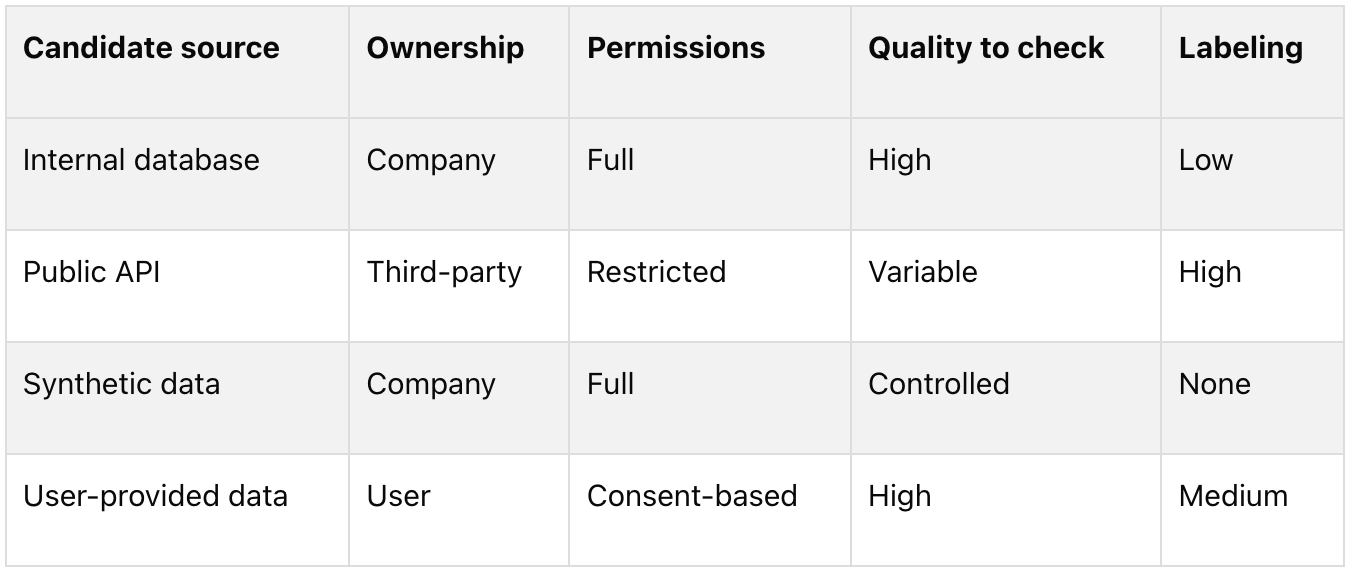
Check permitted use, sample quality, missing fields, sensitive data, and the effort needed to label the data.
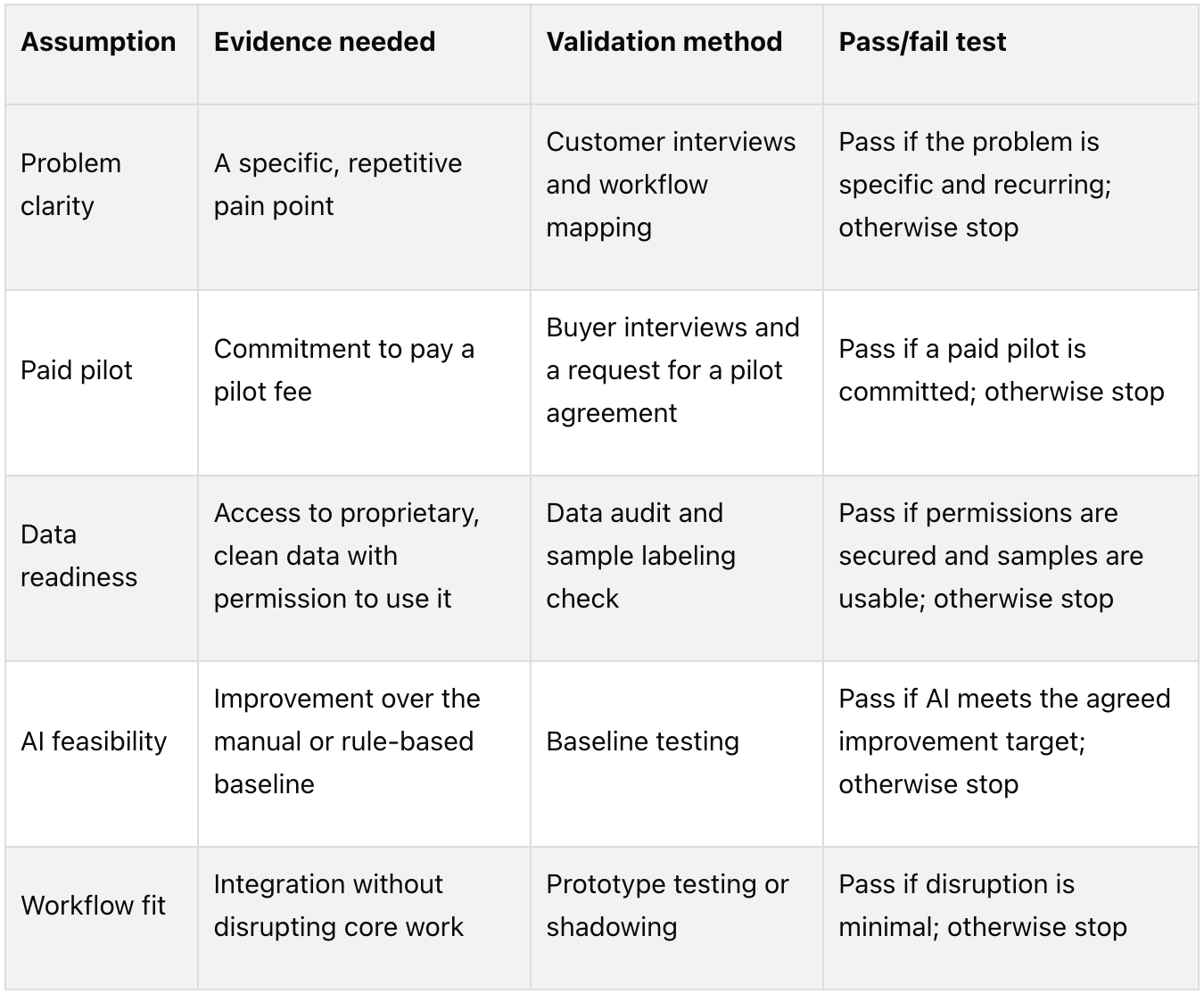
Score Your Assumptions Before Building
Score the key assumptions in a spreadsheet before writing code. Stop if any critical assumption remains unproven.
Choose an AI Approach and Build the MVP
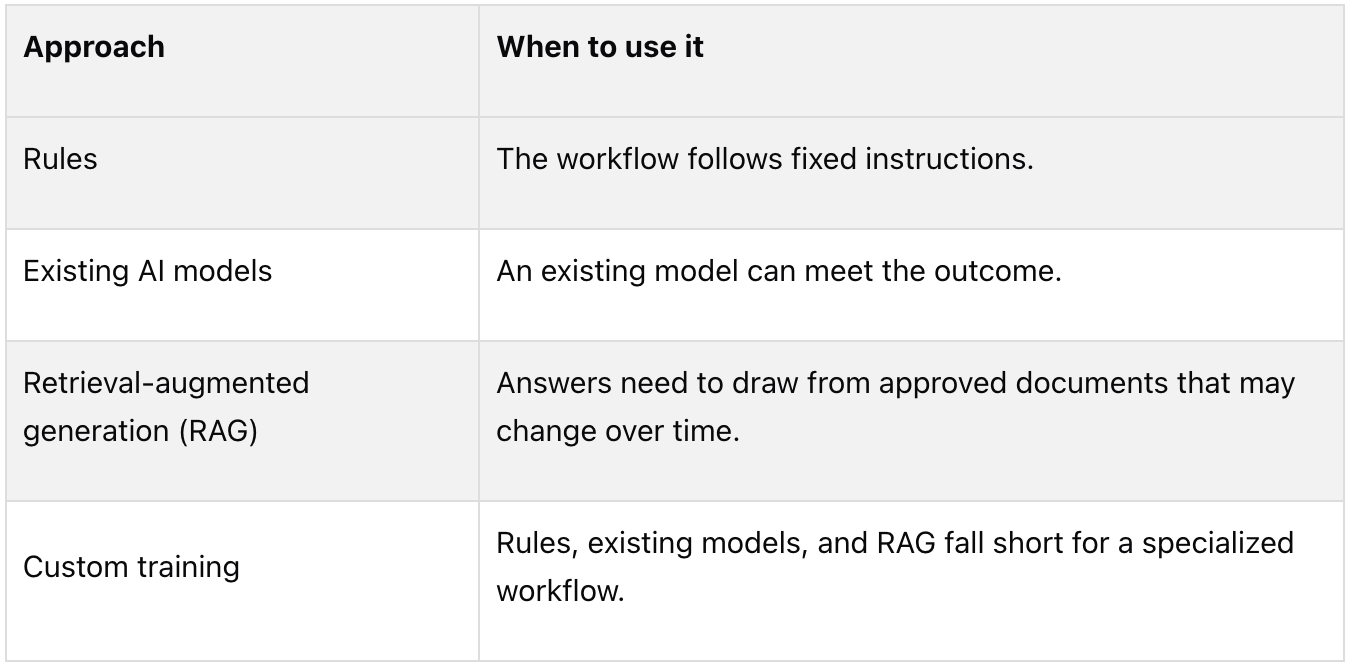
Compare Rules, Existing Models, RAG, and Custom Training
Once the problem, data, and pilot terms are clear, choose the lightest build path that can meet your target. Use the simplest approach that can deliver the agreed outcome.
Before building the full MVP, test your riskiest technical assumption with a spreadsheet, form, or simple demo. Use representative inputs, log failures, and compare results with the baseline.[2]
Set MVP Scope, Targets, and Budget
Build one end-to-end version of the single workflow you validated. Set targets for quality and response time, then budget in U.S. dollars for the build, data, model usage, and operations. Track build costs separately from operating costs.
Set Data, Privacy, and Reliability Controls
Keep the pilot’s data scope narrow and make it clear what happens when the system fails. Carry forward approved data permissions, disclose AI use to users, and retain only pilot data.
Add human review and a handoff to a person when the system cannot answer with enough confidence. Use guardrails, evaluation, and monitoring to catch failures early.
Build a Small Team and Run a Pilot
Once the MVP is built, the next step is to prove it works for real users.
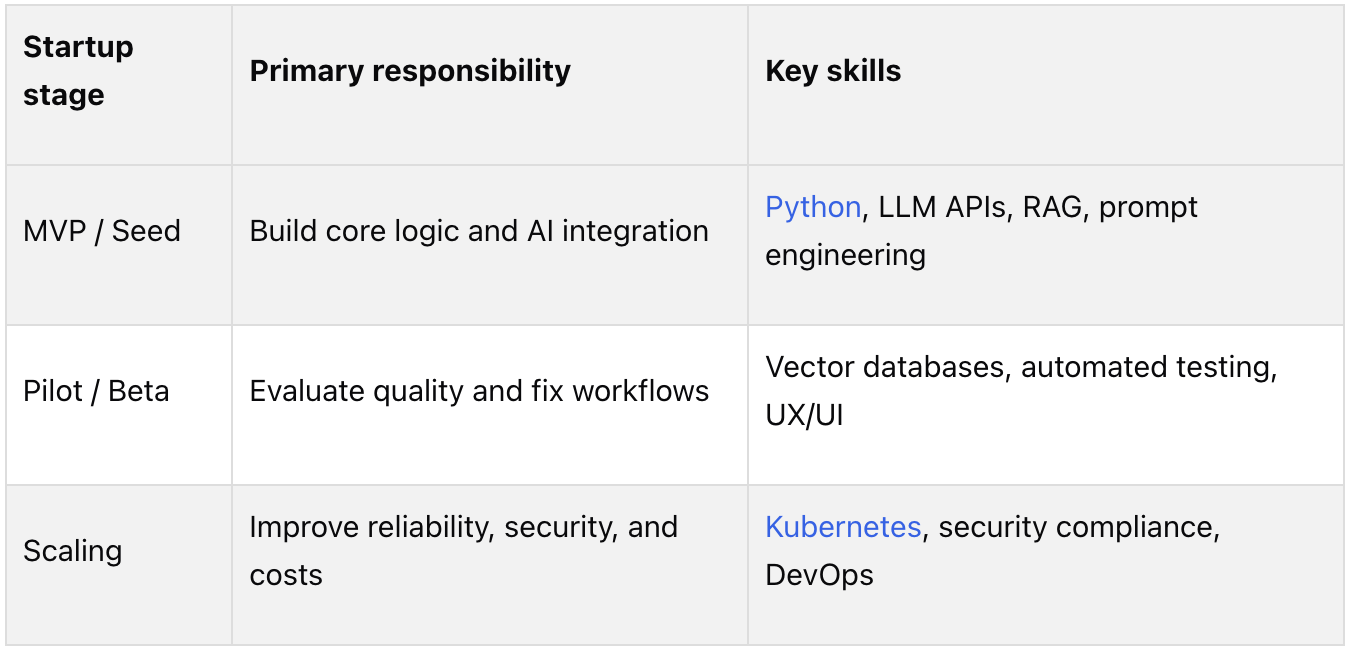
Assign Owners and Hire for Skill Gaps
Put one founder in charge of product decisions and one generalist founding engineer in charge of delivery. Keep the team small and close to customers, with a clear focus: ship, test, and fix.
Measure Quality and Customer Results
Record how long the task takes before introducing the MVP. Then measure both model quality and the effect on customers during the pilot.
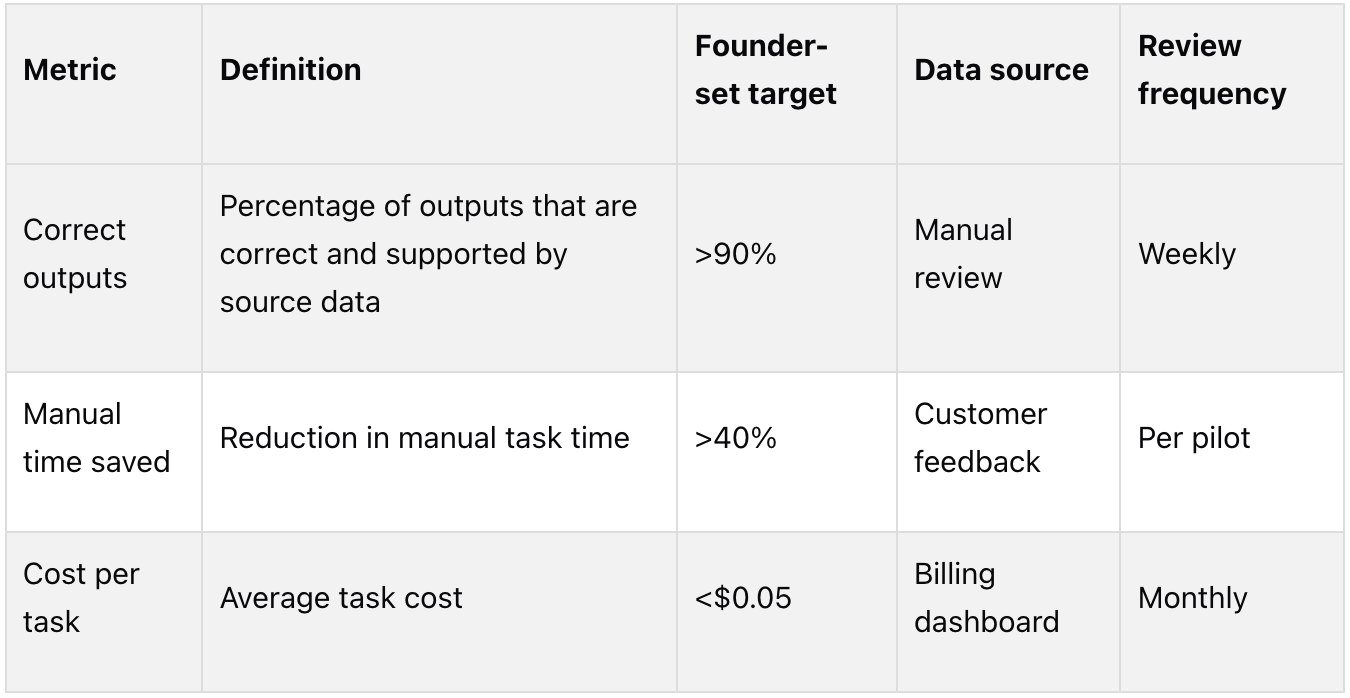
Also check whether response time meets the target set for the MVP.
Fix Failures Before Expanding
Standardize the workflow, automate stable steps, and send exceptions to human reviewers. Use pilot failures to pinpoint whether the model, data, or workflow caused the problem. Human review helps separate unsupported output from data or routing problems.
Group failures into four categories: unsupported output, data problems, routing problems, and integration errors. Fix workflow and routing issues first, then improve the data and evaluation coverage.
Before moving beyond the pilot to broader hiring or custom training, require release gates for quality, privacy, reliability, and cost. Do not expand until every gate passes.
Conclusion: Validate, Build, Test, Then Scale
Validate the problem, build one focused workflow, and test it with real users. Scale only after you’ve proven demand and reliability.
Keep a decision log that records what you learned, what failed, and what still stands in the way of a larger commitment. For each decision, track the result and the proof you need next.
Follow that sequence to plan your next three steps: schedule customer interviews, audit where usable data lives and who owns it, and define one measurable pilot outcome.
FAQs
Can I start an AI startup without coding skills?
Yes, you can start an AI startup without coding skills. No-code platforms let you build prototypes fast, while AI-powered coding assistants can help with technical development. For specialized tasks, such as AI model integration and infrastructure, you can hire a small remote engineering team or bring in extra technical staff.
As software development gets faster and cheaper, focus on solving a clear customer problem. Test whether people want your solution, find ways to reach those customers, and deliver enough value that they recommend it to others.
How should I price my first paid pilot?
Price your first paid pilot to encourage collaboration and feedback - not immediate profit. Focus on building a partnership. At this stage, distribution and trust are your biggest assets.
Treat early users like co-founders and involve them directly in development. Rather than relying only on cash discounts, offer clear value that makes their time and input worthwhile. These relationships help build your reputation and the word-of-mouth momentum your business needs to keep going.
How much test data do I need to trust my MVP?
Validate one narrow workflow instead of chasing a data-volume target. Set measurable outcomes for a repeatable task, such as invoice processing or lead qualification. Then use scoring rubrics, evaluations, and human reviews to check whether outputs stay consistent.
Use each completed job to improve routing and exception handling. Testing against actual task outcomes helps you show value and refine your model before scaling.
Looking to scale more efficiently? Connect with iDelsoft.com! We specialize in developing software and AI products, while helping startups and U.S. businesses hire top remote technical talent — at 70% less than the cost of a full-time U.S. hire. Schedule a call to learn more!
05.11.2026
Keep reading
