


GPT-6 Astra vs. Claude Opus 5: How They Compare
GPT-6 Astra vs. Claude Opus 5: How They Compare
If we at iDelsoft had to sum it up in one line: we’d pick GPT-6 Astra for range and fast turnarounds, and we’d pick Claude Opus 5 for long, hard engineering work.
Here’s the short answer:
- GPT-6 Astra fits teams that want one model for many jobs
- Claude Opus 5 fits teams that spend more time on deep code and long reviews
- Astra has a 1.05 million-token context window
- Opus 5 has a 1 million-token context window and 128,000-token max output
- The article compares:
- coding help
- debugging
- documentation
- hiring support
- speed
- consistency across multi-step work
In plain terms: if you need help with boilerplate, CRUD work, unit tests, PR summaries, frontend QA, and high-volume candidate review, Astra looks like the better match. If you need help with hard debugging, repo-level refactors, architecture calls, long coding sessions, and rubric-based candidate review, Opus 5 looks like the better match.
A key number stands out right away: the context gap is small - 1.05M vs. 1M tokens, or about 5% more room for Astra. So the bigger split is not context size. It’s how each model tends to work under pressure: Astra moves faster across short tasks, while Opus 5 holds up better across long chains of work.
Quick takeaway: if your team values throughput, choose Astra first. If your team values precision over many steps, choose Opus 5 first.
GPT-6 Astra vs Claude: Do You Actually Need to Switch?
Quick Comparison
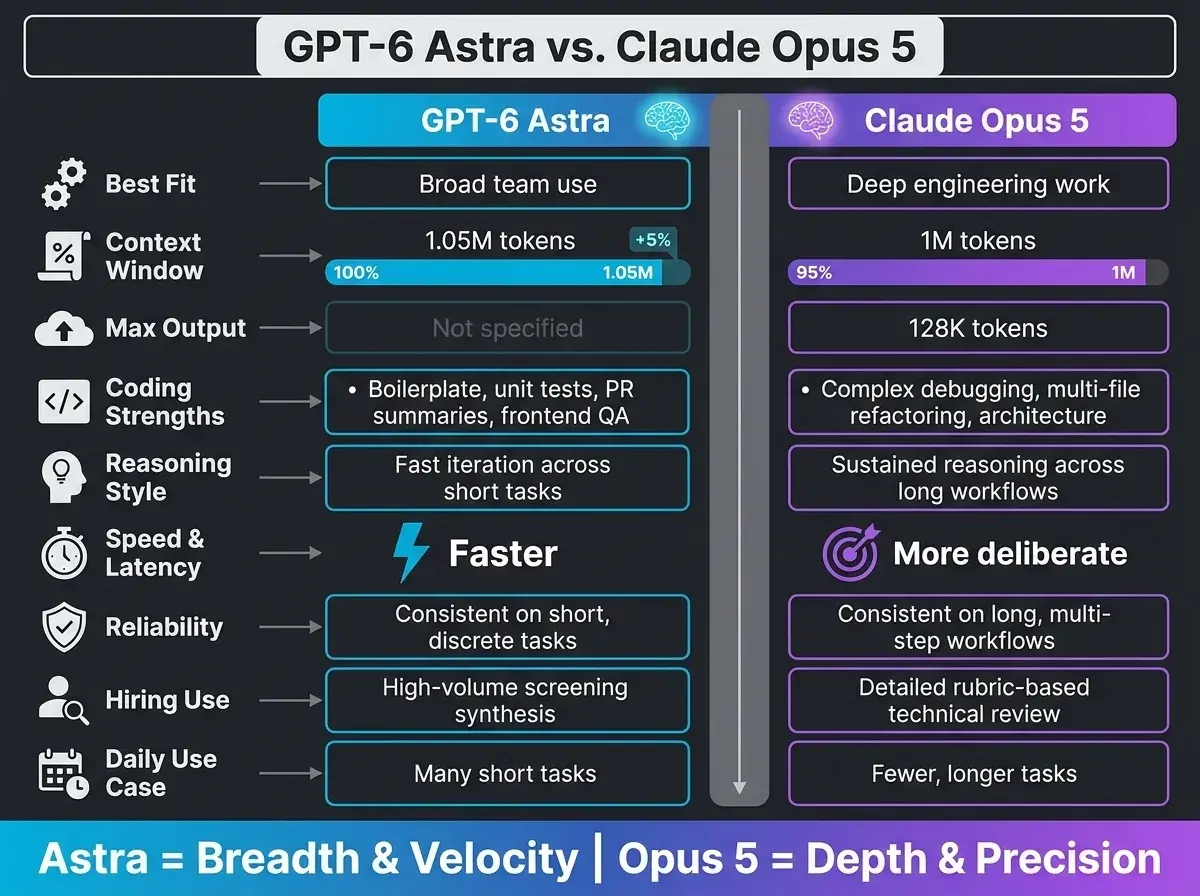
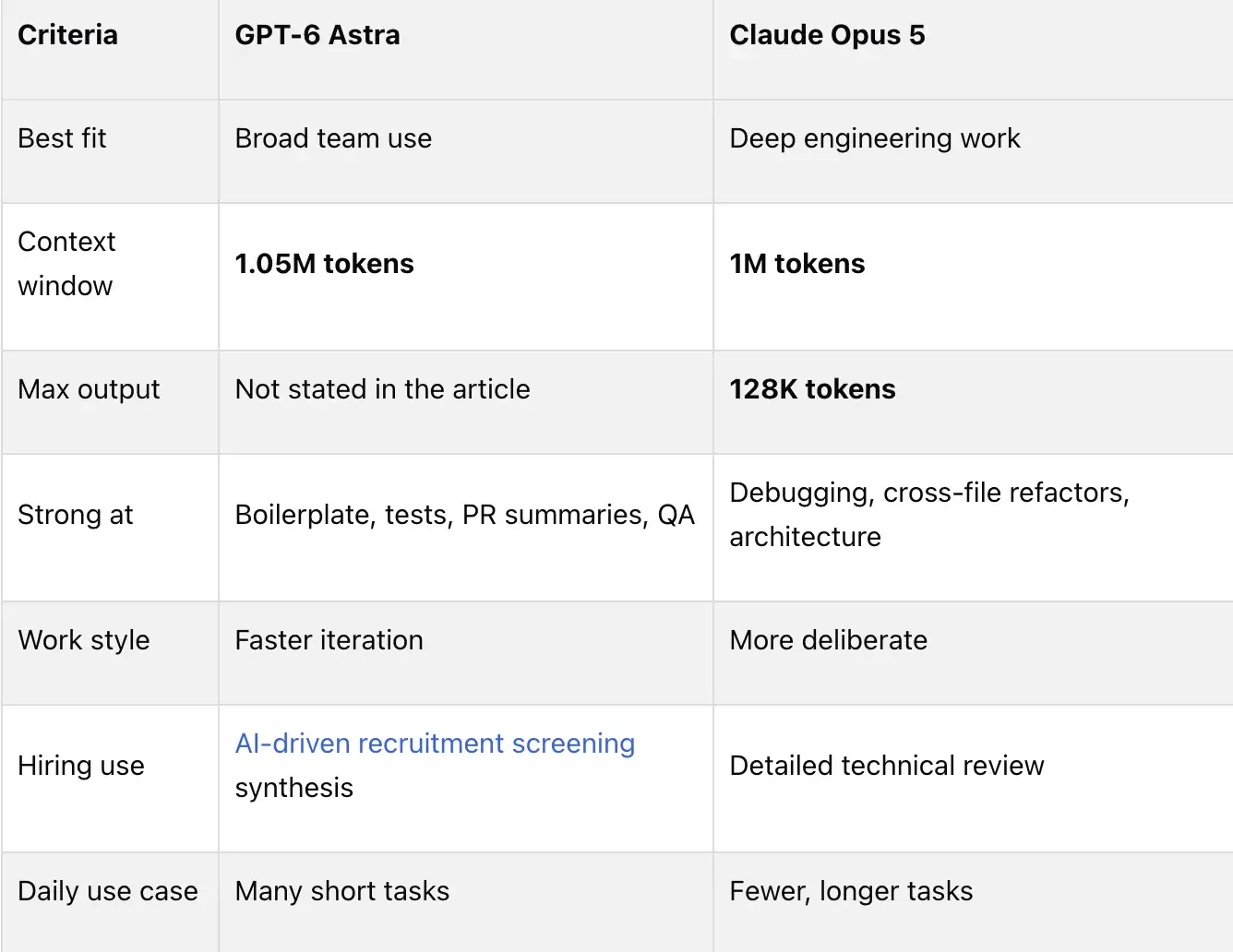
So if we at iDelsoft were choosing by workflow, we’d keep it simple: Astra for breadth, Opus 5 for depth.
GPT-6 Astra
GPT-6 Astra works well for teams that want one model across a wide range of engineering and hiring work. It handles multi-step workflows, autonomous tasks, and browser or desktop environments without much fuss.
Core strengths and specs
The headline spec here is the 1.05 million-token context window. That’s enough room for an entire repo, long docs, or a full hiring packet in a single prompt. Put simply, Astra can keep a lot in view at once.
Astra also handles autonomous workflows, including frontend QA and multi-file code reviews. In day-to-day use, that makes it a strong match for tools that automate code review, testing, and QA.
Best use cases for engineering and hiring
For engineering work, Astra fits tasks like:
- Boilerplate
- CRUD code
- Multi-file refactors
- Unit tests with mocks
- Frontend QA
For hiring teams, the large context window is the big draw. It can pull together a candidate summary from profiles, transcripts, and screening notes, which helps with faster screening synthesis and cleaner side-by-side comparisons. It can also help with technical screening and draft role summaries from long inputs.
That makes Astra the better fit for broad, fast-moving workflows; the next section covers the model that goes deeper on sustained analysis.
Claude Opus 5
Where Astra is broader and faster, Opus 5 goes deeper and stays locked in longer. Claude Opus 5 is built for depth: sustained reasoning, long-document analysis, and multi-file coding.
Core strengths and specs
Claude Opus 5 has a 1M-token context window and a 128K-token max output. Prior Opus models scored 87.6% on SWE-bench Verified and 64.3% on SWE-bench Pro [1], which is a strong sign for coding reliability.
You tend to notice that depth most during long coding sessions and document-heavy reviews. Give it a messy codebase, a stack of files, or a long technical brief, and this is where it starts to shine.
Best use cases for engineering and hiring
For engineering teams, Opus 5 is a strong fit for:
- Complex debugging
- Multi-file refactors
- Long coding sessions
Claude Code can also coordinate multi-file changes on its own. That makes it useful when a task spills across several parts of a codebase instead of living in one neat file.
It also helps with architectural decisions and turning complex product requirements into technical implementation plans. In plain English: it can take a fuzzy product ask and map it into code steps that make sense.
For hiring teams, Opus 5 works well for resume and portfolio review, interview-note synthesis, and steady policy handling across large document sets. Those are the same strengths that matter most in a side-by-side comparison of coding, reasoning, speed, and reliability.
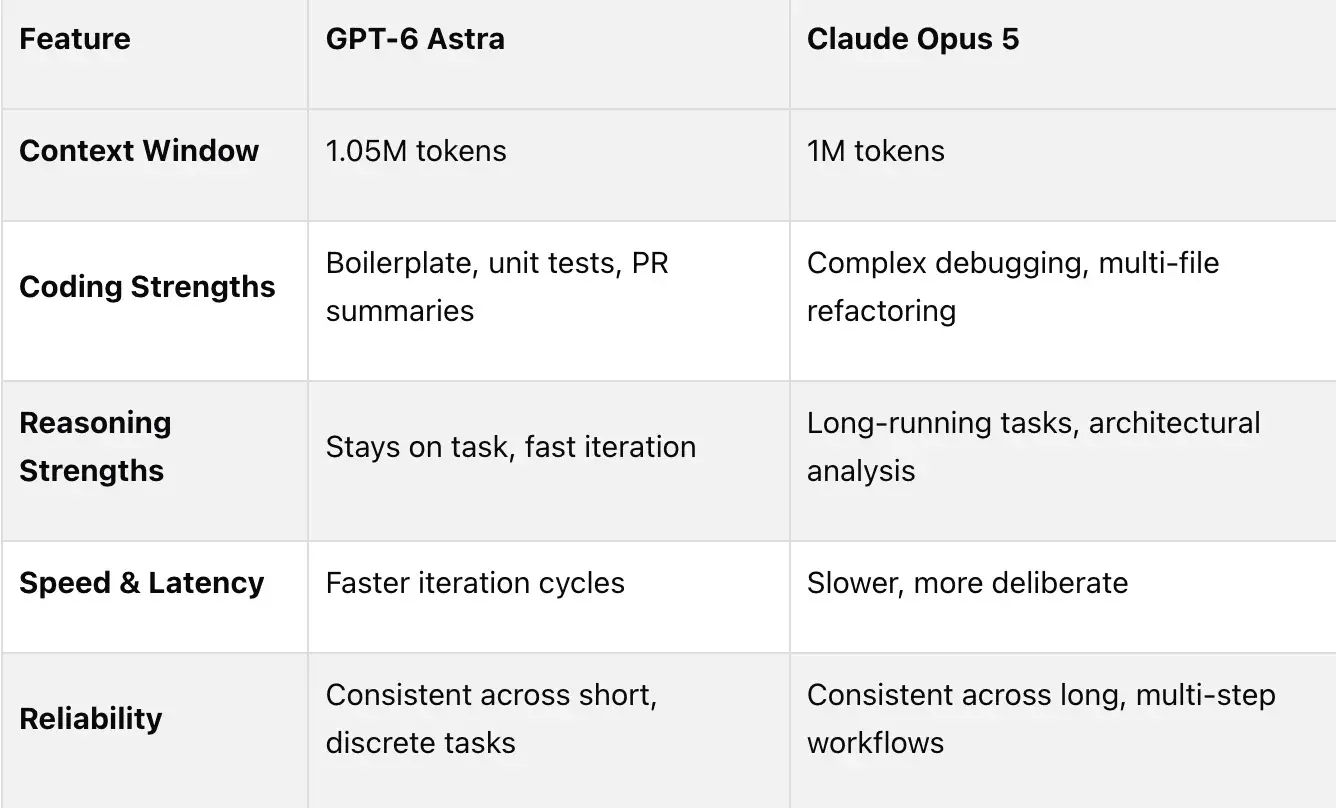
Direct Comparison: Coding, Reasoning, Context, Speed, and Reliability
The table below turns those strengths into clear tradeoffs.
Where GPT-6 Astra has the edge
Astra’s 1.05M-token context window gives it a slight lead when you need to process a huge amount of input in one pass. That shows up most with PR summaries and candidate packet synthesis, where pulling together a lot of material fast can save time.
It also stands out in workflows that need browser or desktop control. If your process touches web apps or other on-screen tools, Astra is the stronger pick. For busy engineering teams, that mix of speed and focus makes it well suited to fast iteration across many kinds of software work.
Where Claude Opus 5 has the edge
Opus 5 stands out when the work takes time and the task has many steps. If you’re tracing a bug through a large codebase or reviewing a candidate’s technical portfolio against a detailed rubric, it tends to keep the main goal in view instead of drifting.
Its autonomous coding feature, especially through Claude Code, also matters here. It can move through full repositories and handle multi-step tasks with less back-and-forth. When accuracy matters more than speed, Opus 5 is usually the better fit.
How the differences show up in daily work
In day-to-day use, the split shows up pretty fast. Candidate-packet synthesis is a natural fit for Astra: give it a lot of input, and it returns a clean result fast.
Complex debugging across a large codebase is where Opus 5 tends to pull ahead. That contrast usually makes the workflow choice easier in the next section.
Which Model Fits Your Engineering or Hiring Workflow
Use this split to line up each model with how your team works day to day.
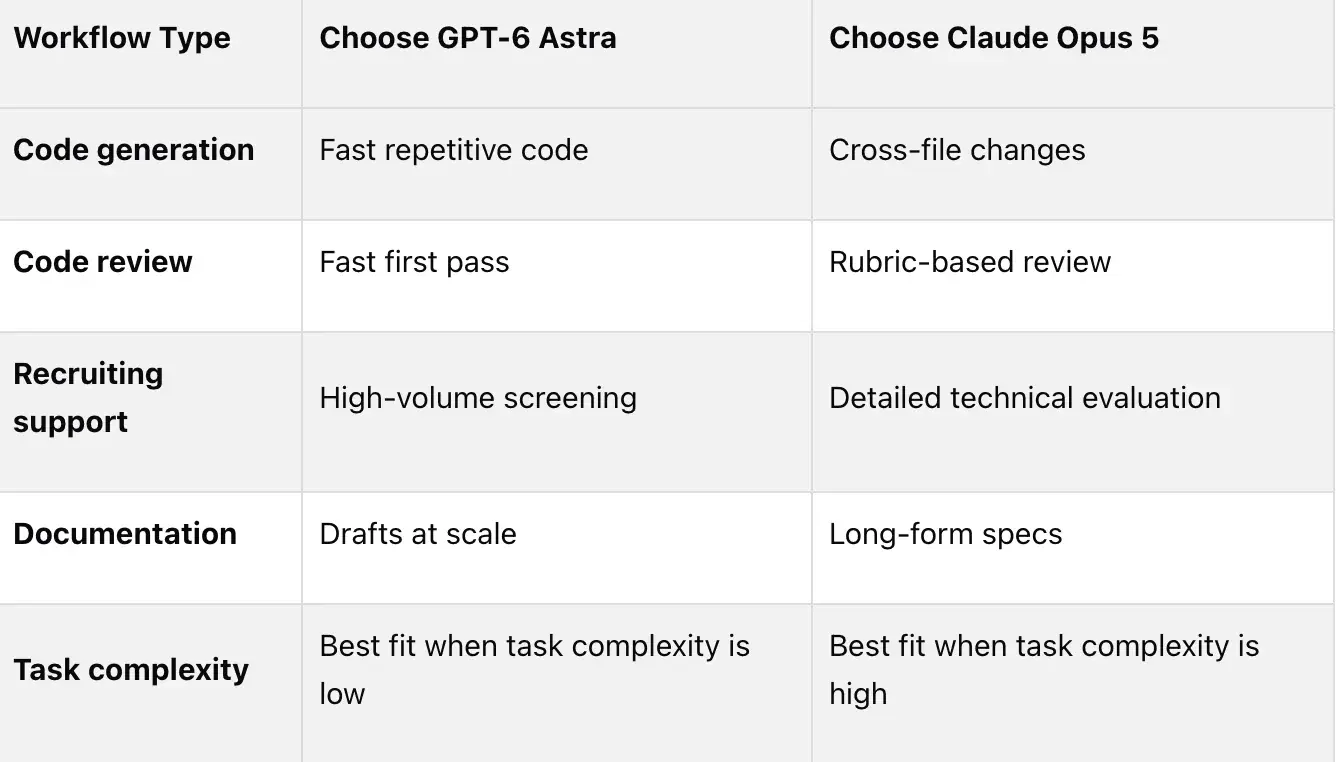
The table gives you the quick answer. The next two sections make that choice easier in day-to-day work.
Choose GPT-6 Astra when speed and task variety matter most
If your work is repetitive, fast-moving, and varied, Astra is usually the better fit. It handles high-volume tasks well across code generation, PR summaries, and candidate packet synthesis. It also works well inside common developer tools and editors.
On the recruiting side, Astra is a good match for synthesizing candidate reviews at scale. If your team needs to move through a large queue without getting stuck in the weeds, this is where it tends to shine.
Choose Claude Opus 5 when depth and deep, multi-step analysis matter most
If your work is complex, long-running, and detail-heavy, Opus 5 is the better fit. For tricky bugs and cross-file refactoring, it tends to be the more reliable choice. It also does better when a task calls for deep reasoning across many steps.
On the recruiting side, Opus 5 stays more consistent when evaluating a candidate's technical portfolio against a detailed rubric. That makes it a strong option when the goal isn't just speed, but careful judgment.
Conclusion: Key Takeaways for Recruiting and Delivery Teams
The short version: Astra for breadth and velocity, Opus 5 for depth and precision. Neither model wins outright. The better choice depends on what your team spends most of its time doing.
For delivery teams, that difference shapes which tool becomes the daily driver. For recruiting teams, it affects candidate review, screening, and onboarding workflows.
FAQs
Which model is better for mixed team workflows?
For mixed team workflows, the better pick comes down to one thing: does your team need architectural reasoning or speed?
Claude Opus 5 is better at deep reasoning, complex multi-file refactoring, and high-level architectural decisions. But for fast-moving, day-to-day coding, the best setup is often a quick inline assistant paired with a more strategic tool like Claude.
Does the small context-window gap really matter?
Yes. Context window size can have a big effect on development work.
A larger window gives the model room to understand more of the codebase at once. That means it can follow the overall architecture, spot patterns across files, and keep more of the project in mind while it works.
Smaller windows can still work well for simple autocomplete or short edits. But once the job shifts into complex refactoring or large repo updates, they often miss the bigger picture. And when that happens, the odds of bugs, mismatched logic, or maintenance headaches go up.
How should I choose for recruiting tasks?
Choose based on your workflow. For higher-level recruiting work, like reviewing technical docs or judging complex product-thinking prompts, Claude may be a better fit because it tends to handle reasoning and system design well.
For code review or candidate technical assignments, treat these models like workflow partners, not stand-ins for your team. They can help move things along, but candidate input still needs human judgment and direct interaction with the people they’d work with.
Looking to scale more efficiently? Connect with iDelsoft.com! We specialize in developing software and AI products, while helping startups and U.S. businesses hire top remote technical talent—at 70% less than the cost of a full-time U.S. hire. Schedule a call to learn more!
17.09.2026
See also
