Best Latin American Countries to Hire Software Developers
Top Latin American Countries to Hire Software Developers in 2026
Latin America is now a leading destination for hiring software developers, offering a mix of skilled talent, cost savings, and convenient time-zone alignment with U.S. businesses. Here's a quick breakdown of the top countries to consider in 2026:
- Brazil: Largest tech talent pool (500,000–750,000 developers), strong in fintech and enterprise solutions. Senior salaries: $70,000–$100,000/year.
- Mexico: Second-largest talent pool (800,000 developers), excelling in AI, cloud, and mobile development. Senior salaries: $54,000–$99,600/year.
- Colombia: Rapidly growing market with 165,000 developers, focused on full-stack, fintech, and SaaS. Senior salaries: $55,000–$90,000/year.
- Argentina: Known for senior-level expertise and top English proficiency in the region. Senior salaries: $64,000–$104,700/year.
- Uruguay: Smaller, highly skilled workforce (24,000–33,000 developers), ideal for niche projects. Senior salaries: $61,732/year.
Key Comparison
| Country | Developer Pool | Avg. Senior Salary (Annual) | Key Strengths | Time Zone (U.S. ET) | English Proficiency |
|---|---|---|---|---|---|
| Brazil | 500,000–750,000 | $70,000–$100,000 | Fintech, enterprise, cloud, DevOps | +1 to +3 hours | Moderate |
| Mexico | 800,000 | $54,000–$99,600 | AI, cloud, mobile development | Same or -1 to -3 | Moderate to High |
| Colombia | 165,000 | $55,000–$90,000 | Full-stack, fintech, SaaS | Same | Moderate |
| Argentina | 115,000–150,000 | $64,000–$104,700 | AI, blockchain, senior-level expertise | +1 to +2 hours | High (#1 in LATAM) |
| Uruguay | 24,000–33,000 | $61,732 | AI, data science, IoT | +1 to +2 hours | Very High |
Each country offers unique advantages depending on your needs. Brazil and Mexico are ideal for scaling large teams, while Argentina and Uruguay excel in specialized roles. Colombia strikes a balance with cost efficiency and skilled developers. Choose based on your project size, budget, and time-zone requirements.
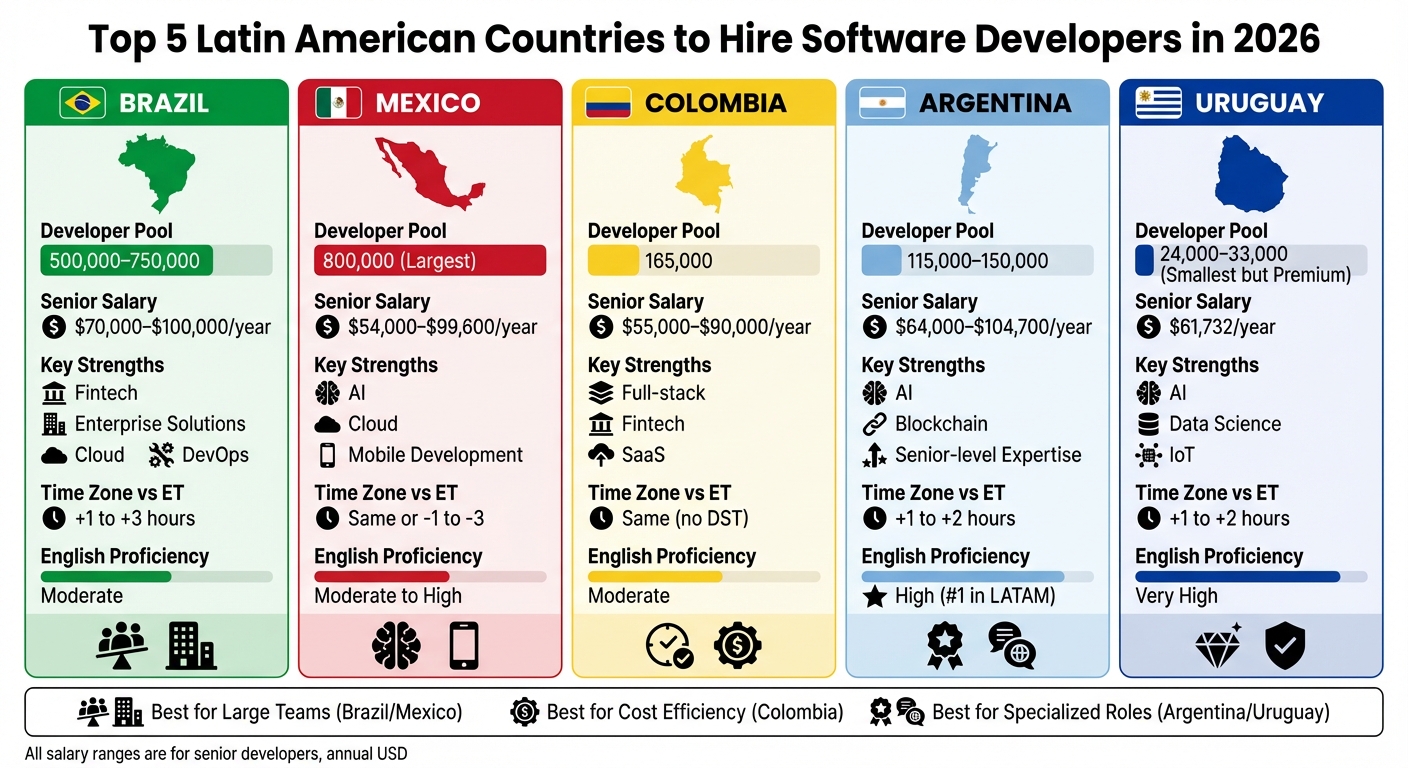
Latin America Software Developer Hiring Comparison 2026: Top 5 Countries
What Makes LATAM Developers So In-Demand Among US Companies? | Alcor Insider Talks | Episode #1
sbb-itb-82c15c5
1. Brazil
Brazil is Latin America's tech powerhouse, boasting a developer community estimated at 500,000 to 763,000 professionals - the largest in South America. São Paulo, in particular, leads the region’s startup scene, generating more venture activity and tech output than Chile, Colombia, Argentina, and Mexico combined. This dynamic environment is supported by a rich network of IT companies and startups.
Developer Pool Size
Brazil's tech landscape includes over 15,000 IT companies and 12,000 startups, along with 16 unicorns like Nubank and QuintoAndar. Tech giants such as Google, Amazon, IBM, and Microsoft have established a strong presence in cities like São Paulo and Rio de Janeiro, offering developers opportunities to tackle large-scale, enterprise-level challenges. The country also boasts four universities ranked among Latin America’s top 15, and it leads the region in innovation, as highlighted by the Global Innovation Index. This extensive ecosystem supports expertise across a wide range of cutting-edge technologies. For a deeper dive into the region's potential, watch our guide on unlocking Latin America's tech talent pool.
Technical Expertise
Developers in Brazil are well-versed in modern technologies, including JavaScript, Java, Python, React, Node.js, and mobile languages like Kotlin and Swift. Brazil’s booming fintech sector has also nurtured engineers skilled in high-scale distributed systems, artificial intelligence, and cloud computing. The country ranks second in Latin America for AI readiness, further showcasing its technical capabilities.
"Brazil produces engineers who excel at complexity, specialization, and scale - a strong fit for companies with enterprise-grade engineering needs." - BEON.tech
Cost-Effectiveness
Senior developers in Brazil earn between $70,000 and $100,000 annually, offering companies a cost savings of 40% to 60% compared to U.S. salaries. Hourly rates for developers generally fall between $30 and $50, while highly specialized senior talent may charge $45 to $75 per hour. Although Brazilian labor laws add 30–40% to overall personnel costs, the market remains an attractive option for accessing senior-level expertise.
Cultural Compatibility
Brazil operates on UTC-3, which aligns closely with the U.S. East Coast, ensuring a workday overlap of 1 to 3 hours. This time zone compatibility simplifies real-time collaboration for agile workflows, including standups, code reviews, and other team activities. While English proficiency is rated as moderate overall, developers in major tech hubs are increasingly honing their communication skills to better serve international clients.
2. Mexico
Mexico stands out as a major player in Latin America's tech landscape, solidifying the region's reputation as a hub for tech talent. With over 800,000 IT specialists and an impressive 124,000–130,000 new engineering graduates annually, Mexico boasts the second-largest tech talent pool in Latin America. Key tech hubs include Mexico City, which houses over 320,000 tech professionals and 9 of the country’s 11 unicorns. Guadalajara, often referred to as the "Silicon Valley of Mexico", focuses on electronics and software, while Monterrey is gaining recognition for industrial tech and enterprise software advancements.
Developer Pool Size
Mexican developers are ranked 4th globally for technical proficiency and hold the second spot in Latin America for programming skills. They excel in languages like JavaScript, Python, Java, SQL, C++, React.js, and Flutter. Mexico also ranks 5th in the world for AI research output and, alongside Brazil, accounts for 95% of AI patents in Latin America. This talent pool is particularly skilled in areas like cloud-native architectures, enterprise software, and scalable mobile development, making it a cornerstone of the country’s growing tech sector.
Technical Expertise
Mexico’s AI industry is on track to hit $1.91 billion by 2025, driven by significant investments. Google has established its first AI lab in Puebla, CloudHQ is investing $4.8 billion in a data center in Querétaro, and Salesforce has committed $1 billion over five years to promote AI adoption across the country. Additionally, institutions like Banco Santander México have fully migrated to the cloud, showcasing the country's advanced technical capabilities. These developments not only elevate Mexico's tech ecosystem but also support competitive wages without compromising quality.
Cost-Effectiveness
Senior developers in Mexico earn between $54,000 and $99,600 annually, depending on their specialization, offering U.S. companies savings of about 47% compared to domestic salaries. Factoring in mandatory benefits like the Aguinaldo (a 15-day year-end bonus) and approximately 24.1% in social security contributions, total cost savings range from 45% to 52%. For instance, in late 2025, the California-based startup Franki hired seven tech professionals in Mexico, including iOS and Android developers as well as QA engineers, achieving a 40% cost reduction while adhering to local labor laws.
Cultural Compatibility
Mexico's time zones (UTC-6 to UTC-8) align closely with U.S. Central and Pacific time zones, allowing for smooth real-time collaboration during agile ceremonies and code reviews. The USMCA agreement simplifies the relocation process for Mexican developers through TN visas, making cross-border work arrangements more accessible. While English proficiency varies, tech professionals in key hubs like Mexico City, Guadalajara, and Monterrey typically demonstrate strong communication skills, further facilitating collaboration with U.S.-based teams.
3. Colombia
Colombia has solidified its position as the #3 software market in Latin America, boasting a tech talent pool of approximately 165,000 professionals. Among these, an estimated 63,000 to 120,000 are active software engineers. The country's developers are primarily based in three key cities: Bogotá, Medellín (often called the "Silicon Valley of Latin America"), and Cali. This growth is fueled by government initiatives like Ruta N in Medellín and INNpulsa Colombia, which promote tech entrepreneurship and attract foreign investors. Today, Colombia is home to over 1,582 startups, including the unicorn Rappi, and has a thriving fintech sector with 394 startups.
Developer Pool Size
Colombia's tech scene has seen explosive growth, with software engineer placements increasing by 250% year-over-year in 2025. By 2026, the country surpassed Argentina as the top hiring destination for U.S. companies, accounting for 23% of all placements. Esteemed institutions such as Universidad de los Andes, Universidad Nacional, and EAFIT play a major role in producing tens of thousands of STEM graduates annually, ensuring a steady flow of skilled professionals. Colombia's startup ecosystem now ranks as the second strongest in Latin America, and in 2024, the tech sector attracted $1.2 billion in venture capital, marking a 70% jump from the previous year. This growing talent pool is well-equipped to handle diverse technical challenges.
Technical Expertise
According to the 2023 Coursera Skills Report, Colombian developers are ranked #2 in Latin America and #6 globally, showcasing impressive mastery in operating systems (99%), networking (98%), and computer programming (94%). The workforce is increasingly specialized in areas like mobile development, cloud architecture, DevOps, fintech, SaaS, AI, and blockchain. Notably, 84% of nearshore placements in Colombia are for mid-to-senior roles. For example, in 2024, BigCommerce collaborated with Alcor to establish a team of 30 highly skilled developers in Colombia within six months. This team, covering roles such as QA for PHP, helped the company save 50% in costs while setting up a new R&D office in just one month.
Cost-Effectiveness
Senior developers in Colombia earn between $55,000 and $90,000 annually, offering U.S. companies cost savings of 40% to 70% compared to hiring domestically. Even with mandatory employer contributions (30% to 50% for social security, bonuses, and severance), total employment costs remain about 54% lower than U.S. standards. For instance, a senior cloud developer in Colombia costs around $75,800 annually (including benefits and taxes), compared to $241,600 in the U.S. - a savings of nearly 69%. On top of this, government incentives such as a 25% tax discount, full income tax deductions for R&D investments, and reduced corporate tax rates of 20% in Free Trade Zones make Colombia an even more attractive option.
Cultural Compatibility
Colombia operates year-round on UTC-5, aligning with U.S. Eastern Time and offering 5–8 overlapping business hours. This time zone advantage has led 30% of companies hiring in Colombia to move away from offshore locations in South and Southeast Asia. Eric Tabone, CEO of Nearshore Business Solutions, highlights this benefit:
"Colombia works well for teams needing Eastern Time overlap and strong data protection under Law 1581".
4. Argentina
Argentina stands out in Latin America for its impressive concentration of senior-level tech talent. While the country's developer pool, estimated at 115,000 to 150,000 professionals, is smaller than Brazil's or Mexico's, it boasts the highest density of experienced developers in the region. Each year, Argentina produces between 15,000 and 27,000 STEM graduates from its 130 universities, 10 of which are ranked among the Best Global Universities. This strong academic foundation has helped Argentina foster 11 of Latin America's 34 unicorns, including notable companies like Mercado Libre and Globant.
"Argentina has become a reliable destination for software development in Latin America" - RolesPilot Team.
Developer Pool Size
Argentina's tech talent is primarily concentrated in Buenos Aires, home to 85% of its developers, with additional hubs in Córdoba, Mendoza, and Rosario. In 2025, Dotmatics collaborated with Alcor to expand their R&D team in the region, successfully hiring over 30 developers - including a Director of Engineering and specialists in React, Node.js, and QA Automation - within just 12 months. This was achieved by leveraging a database of over 253,000 candidates. To further strengthen its tech workforce, the government launched the "Argentina Programa 4.0" initiative, aiming to train 70,000 new developers in coding and digital skills.
Technical Expertise
Argentina shines in advanced fields like AI, machine learning, blockchain, and data science [37,4]. The country ranks 4th in Latin America for data science skills and is increasingly focusing on cloud APIs and modern architectures, such as microservices and API-first design. Additionally, Argentina has experienced the fastest growth in GitHub developer accounts across the region. Approximately 85% of its international tech placements are for mid-to-senior roles, underscoring its reputation for experienced talent.
Cost-Effectiveness
Hiring senior developers in Argentina can result in significant savings, with costs 40%–60% lower than in the U.S. Companies can hire developers from LatAm to optimize their engineering budgets without sacrificing quality. The average annual salary for senior developers is around $63,163, compared to over $160,000 in the U.S.. Senior salaries range from $64,000 to $104,700, while tech leads often earn over $100,000. High inflation rates (exceeding 200% in 2023) and currency volatility make U.S. dollar-denominated salaries particularly attractive for local professionals. Additionally, the Knowledge Economy Law offers tech startups the ability to convert up to 70% of payroll costs into tax credits and reduces corporate income tax to 15% for qualifying activities.
Cultural Compatibility
Argentina's GMT-3 time zone aligns closely with U.S. Eastern Time, making real-time collaboration seamless. The country also leads Latin America in English proficiency, ranking 1st regionally and 26th globally. This high level of English fluency ensures clear and effective communication, outpacing other regional hubs like Brazil, Mexico, and Colombia.
"The country ranked number one in Latin America for English proficiency on the EF English Proficiency Index. This means clear, nuanced conversations without language barriers" - Mismo Team.
5. Uruguay
Uruguay stands out as a premium hub for tech talent, with a developer pool of 24,000–33,000 professionals. Known for its high-skill workforce, it’s an ideal market for boutique hiring, offering reliability and consistency that rivals larger markets in the region.
"Uruguay might not have the size of Brazil or Mexico, but it more than makes up for it with consistency. It's small, stable, and incredibly reliable." – RolesPilot Team
Developer Pool Size
Uruguay’s tech talent is mainly concentrated in Montevideo and Punta del Este. Thanks to the Plan Ceibal initiative, which introduced early mandatory computer education, the country has cultivated a well-educated workforce. Around 76% of IT professionals hold a university degree, a stark contrast to the 26% of the general workforce. The industry also boasts an impressive 98% retention rate, reflecting its stability and appeal.
Technical Expertise
Uruguayan developers specialize in areas like AI, data science, IoT, and fintech. The country hosts Latin America’s first Microsoft AI/IoT lab, and Montevideo ranks as the #2 rising city globally for fintech. Developers here perform exceptionally well in global assessments, scoring 90% in Data Analysis, 82% in Statistical Programming and Mobile Development, and 80% in Computer Networking. With 99% internet penetration - the highest in Latin America - the country’s infrastructure supports advanced tech work. Furthermore, about 74% of its IT services are exported to the U.S., highlighting its strong international ties. These technical capabilities are paired with competitive labor costs, making Uruguay a compelling option for high-quality development work.
Cost-Effectiveness
While Uruguay’s rates are higher than some regional markets, they remain cost-efficient compared to U.S. salaries. Senior developers earn an average of $61,732 annually, offering 60–65% savings compared to U.S. counterparts earning over $160,000. Hourly rates range from $40–$70, with senior-level rates reaching $70–$100. The country’s stable currency and low inflation ensure predictable labor costs. Additionally, a 100% tax exemption for software development outsourcing, along with robust intellectual property protections and minimal employment complexities, makes Uruguay one of the safest and most attractive markets for North American companies.
Cultural Compatibility
Uruguay’s cultural alignment with North America further enhances its appeal. Ranked #34 globally in English proficiency, 98% of the country’s IT professionals are fluent in English. Its GMT-3 time zone allows for a one- to two-hour overlap with U.S. Eastern Time, enabling seamless collaboration. Combined with a stable political and economic environment, Uruguay minimizes operational risks, making it a reliable partner for outsourcing.
Country Comparison: Strengths and Weaknesses
Each Latin American country offers unique benefits, making the best choice highly dependent on your specific needs - whether it's team size, cost considerations, time-zone compatibility, or specialized skills. The table below summarizes the key strengths and challenges of hiring developers in the region.
| Country | Developer Pool | Avg. Senior Salary (Annual) | Technical Strengths | Time-Zone Alignment | English Proficiency |
|---|---|---|---|---|---|
| Brazil | 500,000 - 750,000 | $50,000 - $53,000 | FinTech, Enterprise, Cloud, DevOps | 1-3 hrs ahead of ET | Moderate |
| Mexico | 326,000 - 800,000 | $50,000 - $52,000 | Web, Mobile, AI, SaaS | US Central/Pacific | Moderate to High |
| Argentina | 115,000 - 150,000 | $47,000 - $54,000 | AI, UX/UI, Software Architecture | 1-2 hrs ahead of ET | High (#1 in LATAM) |
| Colombia | 62,000 - 165,000 | $46,000 - $50,000 | Full-stack, E-commerce, Mobile | US Eastern (no DST) | Moderate |
| Uruguay | 15,000 - 33,000 | $53,000 | AI, Data Science, FinTech | 1-2 hrs ahead of ET | Very High |
Here’s a closer look at what each country brings to the table.
Brazil stands out for its scale, making it a go-to option for building large teams. With over 100,000 IT graduates entering the workforce annually, Brazil is a strong choice for enterprise-level projects requiring extensive resources. However, navigating its complex labor laws and tax systems can slow down the hiring process.
Mexico offers excellent time-zone compatibility for U.S.-based companies, particularly those on the West Coast. Its proximity to the U.S. is further supported by USMCA trade protections and IMMEX tax incentives. While its large talent pool is a major advantage, the high demand for developers can drive up costs in certain areas.
Argentina is unmatched in English proficiency, ranking #1 in Latin America and #26 globally. This, combined with tax incentives provided by the Knowledge Economy Law (a reduced 15% income tax rate through 2029), makes it a strong contender. However, currency instability could pose challenges for budget planning.
Colombia is known for its cost efficiency and alignment with Eastern Time, making it a great option for product-focused development. The country’s thriving startup scene adds to its appeal. However, fluctuating currency values may affect budget predictability. Even so, the balance between cost and skill remains a major draw.
"CTOs ask us which country is the right fit, and the answer depends on their priorities. Colombia works well for teams needing Eastern Time overlap... Mexico offers the largest talent pool and USMCA trade protections. Argentina provides top English proficiency." – Eric Tabone, CEO, Nearshore Business Solutions
Uruguay is a standout choice for companies looking for political and economic stability. With 76% of IT professionals holding university degrees, the country delivers a level of consistency that larger markets may struggle to match. However, its smaller talent pool could be a limitation for companies needing to scale quickly.
Conclusion
When weighing options across talent availability, technical expertise, cost, and alignment with U.S. business culture, each country in Latin America offers distinct strengths. Brazil, with its massive talent pool of approximately 750,000 developers, is ideal for large-scale hiring initiatives. Mexico and Colombia, on the other hand, shine in time-zone compatibility, enabling seamless real-time collaboration with U.S.-based teams, all while offering a solid mix of cost savings and skilled engineers. For specialized roles like AI or data science, Argentina and Uruguay are standout choices, thanks to their high English proficiency and deep technical expertise.
If your goal is to scale quickly with a team of 50 or more engineers, Brazil's extensive pipeline of developers can meet that demand. For core product development requiring seasoned professionals, Mexico and Colombia strike the perfect balance with their senior talent and overlapping work hours. Meanwhile, Argentina and Uruguay are excellent for niche projects, where premium skills like AI development or advanced data systems are essential, even if they come with a slightly higher price tag.
Beyond hiring costs, there are additional factors to consider. Brazil's labor laws, for example, can present compliance challenges. Argentina's currency volatility may require FX hedging to manage financial risks. And while Uruguay offers exceptional talent, its smaller developer pool - around 33,000 professionals - could pose scaling limitations for larger projects.
To simplify the hiring process, iDelsoft offers a solution tailored to these challenges. They provide access to pre-vetted developers across all five countries, handling everything from technical assessments to compliance. Whether you need a few developers or an entire team, iDelsoft can deploy dedicated talent pods in as little as 72 hours, ensuring your project demands are met efficiently and effectively.
FAQs
Which country is best for my tech stack?
The best country to outsource depends on what matters most to you - whether it's cost, the quality of talent, or how easily you can collaborate. If you're managing large-scale projects, Brazil stands out with its skilled workforce and competitive salaries averaging around $53,000 per year. For those prioritizing proximity and shared work culture, Mexico and Colombia offer great options, with salaries ranging from $55,000 to $56,000 per year. Need senior-level expertise? Look to Argentina, Chile, or Peru, where salaries average between $61,000 and $63,000 per year. Your decision should align with your technical needs and budget.
What’s the fastest way to hire in LATAM?
The quickest way to bring software developers on board from Latin America in 2026 is by using nearshore hiring strategies. This approach taps into local talent, benefits from overlapping time zones, and simplifies recruitment. By collaborating with platforms or agencies that specialize in pre-vetted professionals from the LATAM region, hiring timelines can shrink to just 15 days. Countries such as Colombia, Mexico, and Argentina stand out with their thriving tech communities and robust developer networks, making it easier to connect with skilled candidates swiftly.
How do I manage compliance and taxes there?
Managing compliance and taxes in Latin America can be complex, which is why many businesses turn to an Employer of Record (EOR). An EOR takes care of essential tasks like local employment contracts, payroll, benefits administration, and tax obligations. By doing so, they help minimize legal risks for companies.
With an EOR, you can ensure compliance with local labor laws, handle payroll processing, and manage required benefits and filings. This makes it much simpler to onboard new talent quickly, all without the need to establish a legal entity in the country.